
By Amanda Clark
Unraveling the Impact of Kenyan Seed Legislation on Climate-Resilient Agriculture
Abstract
Existing literature establishes a direct link between climate change and weather unpredictability in Kenya, resulting in more frequent and extreme weather events like droughts and floods.[i] The agricultural sector bears the brunt of these changes, with decreased rainfall, rising temperatures, and unpredictable weather patterns adversely affecting crop yields, pest and disease patterns, and overall food security.[ii]
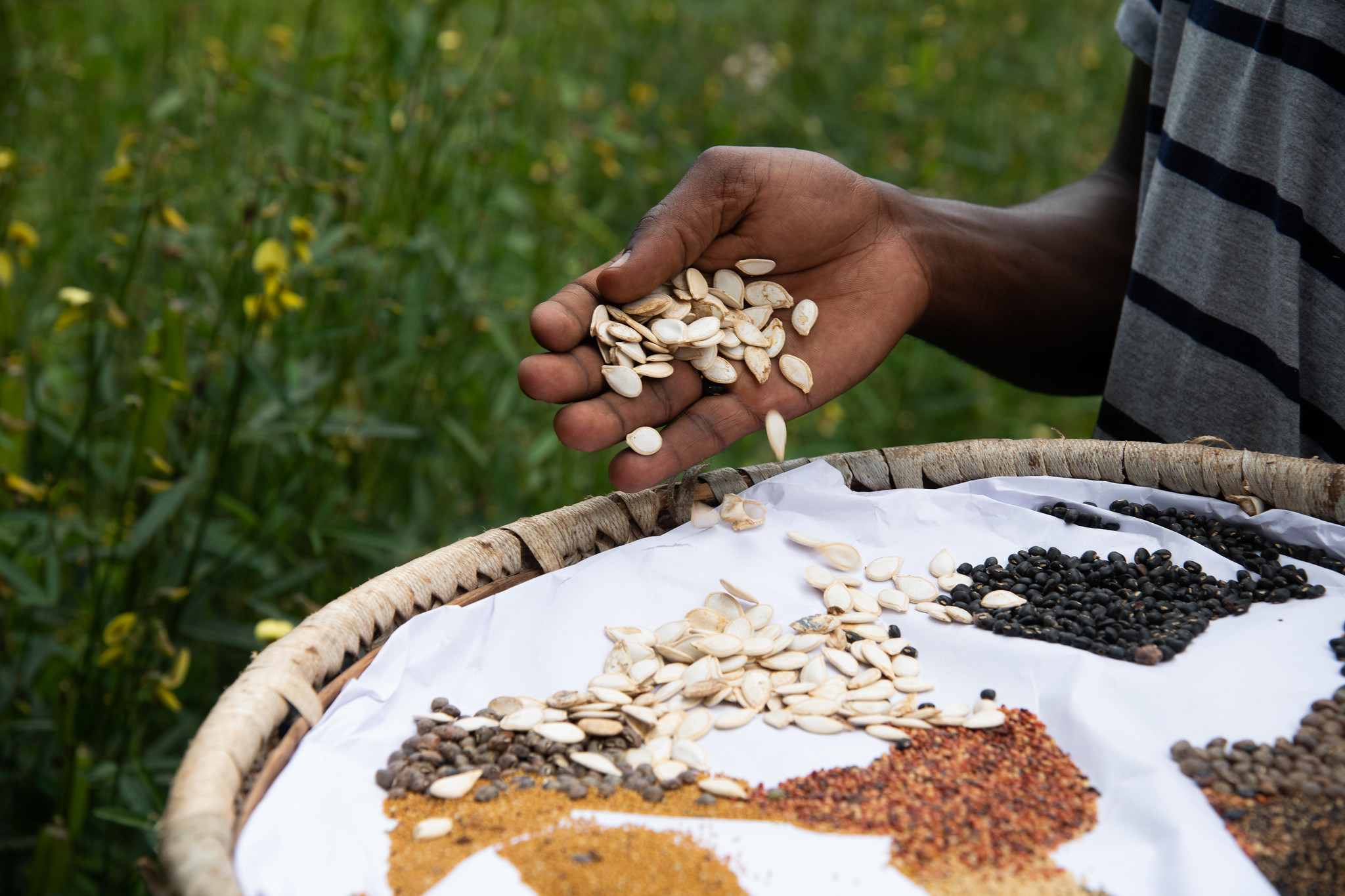
Indigenous, agrobiodiverse farming methods such as the planting of millet, sorghum, cowpeas, and other naturally drought-resistant crops support farmers’ capacity to adapt to the coming climate crisis.[iii] By planting a diverse range of seeds, farmers can ensure food production under varying weather conditions; however, in response to heightened climate uncertainty, corporate seed companies and philanthrocapitalists have targeted vulnerable farmers as the new frontier for privately owned seeds, which are protected both nationally and internationally by intellectual property regimes.[iv] These “climate-smart” seeds are associated with a rise in monoculture and a decline in agrobiodiversity.[v]
This study further explores the influence of international agreements on farmers’ rights to seeds, specifically the World Trade Organization’s Agreement on Trade-Related Aspects of Intellectual Property Rights (TRIPS) and the role of the Union for the Protection of New Varieties of Plants (UPOV). It reveals how powerful multinational corporations and industrialized nations exert pressure on developing economies, pushing for the adoption of stringent Plant Variety Protection (PVP) legislation.
Then, I will dissect the historical evolution of Kenyan seed laws by emphasizing the tension between constitutional protections for indigenous seeds and the gradual erosion of these safeguards through the harmonization of national legislation with UPOV 91 standards. My analysis uncovers corporate-driven changes introduced by the Seed and Plant Varieties (Amendment) Act of 2012 (SPVAA 2012), which criminalizes the use of unindexed seeds. The thesis argues that multinational corporations have gained control over Kenya’s food system with the intention of extracting profit, which resembles a form of modern colonialism. Through dataset analysis, I show that the imposition of SPVAA 2012 has contributed to an increase in agriculture for export rather than local consumption, leading to domestic food insecurity.
Influenced by international dictates, Kenyan seed legislation not only impacts farmers’ climate resilience and food security but also further threatens long-term ecosystem sustainability. The study ends by advocating for alternative futures, marked by a shift toward agroecology systems dominated by indigenous seed-saving practices.
Introduction
In recent years, global discourse on climate change has intensified, with particular scrutiny focused on the impacts of rising temperatures and changing weather patterns on agricultural production and food security. This paper explores the intricate web of issues faced by small-scale farmers in Kenya, whose livelihoods, food security, and food sovereignty are simultaneously under threat by the rise in global temperatures, the pressure to adopt “climate-smart” seeds, and legislation that criminalizes the saving and sharing of unindexed Indigenous seeds.
The Kenyan economy is largely dependent on agriculture, whose products account for 65% of the country’s export earnings.[vi] The sector directly makes up 33% of the nation’s Gross Domestic Product (GDP) and indirectly contributes to another 27% of the GDP.[vii] Over 40% of the Kenyan population is employed in the agricultural sector, with rates especially high in rural areas, where over 70% of the population is employed in agriculture.[viii] Despite these high rates of involvement in and export earnings from the agricultural sector, the Food and Agricultural Organization reports that as of 2021, 72.3% of the population experienced moderate to severe food insecurity.[ix]
East Africa’s colonial history has played a significant part in Kenya’s high economic dependence on the export of raw goods, such as agricultural products, to other countries. The Imperial British East Africa Company, a “commercial association founded to develop African trade in the areas controlled by the British Empire,” was granted a charter by the British Queen in 1888.[x] When the company went bankrupt, the crown took over the administration of the colony. As the Kenyan landscape did not have a wealth of mineral resources to exploit, colonial tactics focused on forcibly taking land and forced labor as a means of production and control.[xi] This colonial history thus has deep roots in the exploitation of local lands and people for the trade and growth of wealth elsewhere. Furthermore, it engendered patterns of dependence on extractive power structures and vulnerable economic sectors.[xii]
High economic dependence on the agricultural sector, coupled with high rates of food insecurity, make Kenya especially vulnerable to the effects of climate change. According to the University of Notre Dame Global Adaptation Initiative Matrix, which analyzes’ countries’ preparedness for and vulnerability to the climate crisis, Kenya is the 41st most vulnerable country and the 152nd most ready country.[xiii] In the face of these daunting outlooks, agricultural adaptation and climate resilience have become increasingly important both to individual farmers and the national government.
Agrobiodiversity is a key factor in the resilience of farmers in the face of a changing climate.[xiv] Planting a diverse range of seeds enables farmers to navigate varying weather conditions and ensures a variety of nutrient inputs on small acreage plots. However, the emergence of “climate-smart” seeds, propelled by corporate powers and philanthrocapitalists (philanthropists that rely on market-based interventions), signals a concerning shift. Privately owned seeds, protected by both national and international intellectual property regimes, contribute to a rise in monoculture and a decline in agrobiodiversity.[xv] I aim to shed light on the detrimental impact of these seeds and the laws that protect them on small-scale farmers, exposing how they deepen vulnerability and compromise food sovereignty and security in an era of ever-increasing climate risks.
Methods
This study begins with a comprehensive literature review, comprising academic, grey literature, and activist sources. The academic sources include journal articles and book chapters written by climatologists, biologists, anthropologists, sociologists, and political scientists. The grey literature includes sources from government agencies and NGOs, such as the United States Agency for International Development (USAID), the Food and Agriculture Organization (FAO), La Via Campesina, and the Alliance for Food Sovereignty Africa (AFSA), among others. Activist sources include blog articles by reputable NGOs, short films featuring farmer voices, and movement texts like public speeches or calls to action.
The next part of this study includes the analysis of several data sets, which will be interwoven with the literature review below to provide greater context and explanation for the significance of the data. The three datasets used in this study are the GRAIN Trade Agreements Privatising Biodiversity Data Set (2021), the FAO Food Insecurity Data (2015-2021), and the Kenya Ministry of Agriculture, Livestock, Fisheries and Cooperatives Kenya Crops Seed Data (2012-2017). The GRAIN dataset provides crucial information on international trade agreements that mandate Global South partners adopt strict plant variety protections. The FAO data set shows rates of food insecurity within Kenya year-by-year from 2015 to 2021. Lastly, the Kenya Ministry of Agriculture, Livestock, Fisheries, and Cooperatives dataset displays information on the number of crops grown for domestic consumption or export each year from 2012 to 2017.
These three data sets have notable limitations. First, there is limited data available on some years, with no data beyond 2017 for the types of crops grown in the country and no data before 2015 on the rates of food insecurity in the country. Secondly, the data sets do not disaggregate to show other factors of food insecurity and crop production patterns (i.e., climate conditions, economic changes, geopolitical factors, etc). Thus, it is only possible to draw a correlation between the institution of Kenyan seed policies, changing crop production patterns, and food insecurity rates. That said, the correlation is significant, and the trends are worrying enough to warrant further investigation into how seed policy impacts crop planting patterns, food insecurity, and climate resilience.
Food Security and Agrobiodiversity in an Era of Climate Change
Existing literature shows an impact of climate change on weather irregularity and unpredictability in Kenya, with more frequent and extreme climate events such as droughts and floods already affecting some regions[xvi] This has drastic implications for the country’s agricultural sector, which employs over 40% of the population.[xvii] Climate scientists project that a decrease in rainfall and a rise in evaporation will decrease yields on rain-fed farms, rising temperatures will shift the patterns of pests and disease (leading to pre-harvest losses), and unreliable earnings from crop production will decrease the purchasing power of families who rely on agriculture.[xviii] All of these factors combine to affect both family and community food security.
In an era of increased weather uncertainty, seed biodiversity is an essential buffer to risk.[xix] . By embracing a diverse range of seeds, farmers can bolster their resilience against a changing climate. Planting a variety of seeds offers a hedge against the threats posed by erratic weather patterns, pests, and diseases. In the event of adverse conditions, such as droughts, floods, or unexpected frosts, having a diverse array of crops increases the likelihood that at least some will thrive, ensuring a measure of food security even in challenging circumstances. Furthermore, diverse seed stocks serve as a form of insurance for farmers, enabling them to rebound more effectively after a poor growing season.[xx] In the words of Ethiopian farmers Muhammed and Ayalnesh, “It is good to have different varieties of the same seed. Because if we have only one variety and we lose it that means we are lost.”[xxi]
However, there is increasing pressure at numerous scales for farmers to adopt “climate-smart” seeds, which are associated with monoculture.[xxii] Climate-smart seeds are bioengineered seeds that according to industrial seed companies can supposedly ‘withstand’ pests and diseases, though the claim that they do so better than other seeds is questionable.[xxiii] Like other genetically modified seeds, these seeds are expensive, must be rebought year-by-year, and require costly, hazardous chemical inputs.[xxiv] They also lead to monocropping, a form of agriculture that increases the presence of pests and diseases–the very same things that “climate-smart” seeds are supposed to prevent.[xxv]
Farmers particularly vulnerable to climate impacts are more susceptible to these “novel” seed interventions as a result of philanthrocapitalism and aid projects that target vulnerable farmers in their aim to promote the spread of these private seed products.[xxvi] Philanthrocapitalism is a type of philanthropy that employs “a capitalist, market-based, for-profit approach” to solving the world’s problems.[xxvii] In the context of African agriculture, the Rich Appetites Film Project claims that philanthrocapitalism “is furthering the interests of corporations and harming African farmers and communities while claiming to advance the humanitarian goal of feeding the world.”[xxviii] The Bill and Melinda Gates Foundation, for example, is a leading philanthrocapitalist organization pushing small-scale African farmers to use privatized seeds. A GRAIN report finds that of the US$6 billion spent by the foundation over seventeen years in the attempt to “improve agriculture,” the majority of grant money earmarked for African agricultural development actually went to institutions in the US and Europe, not African farmers.[xxix]
Many African-based civil society organizations are diametrically opposed to the spread of these “climate-smart” varieties because they increase the vulnerability of already vulnerable small-scale farmers.[xxx] Monocultures, such as those promoted by “climate-smart agriculture,” are particularly susceptible to climate impacts. This is due to “their narrow genetic variability,” which makes crops less able to adapt to changing climatic conditions.[xxxi]
According to the Alliance for Food Sovereignty in Africa (AFSA), these are “false solutions which act largely to the detriment of food sovereignty, environmental conservation, and livelihoods, and are ultimately likely to worsen the impact of climate change by further degrading the soil, destroying biodiversity and using chemical fertilizers, generating even more greenhouse gas emissions”.[xxxii] In their opening declaration at a counter-mobilization opposing the United Nations Food Systems (UNFSS) Pre-Summit, the People’s Counter-Mobilization to Transform Corporate Food Systems stated that large multinational corporations are “increasingly infiltrating the multilateral spaces of the United Nations to co-opt the narrative of sustainability and divert it back into the channels of further industrialization with digital and biotechnologies, extraction of wealth and labor from rural communities, and concentration of corporate power.”[xxxiii] For example, at the UN Food Systems Summit, the group charged with discussing solutions to ”boost nature positive production” included 26 private sector corporations such as Nestlé, Tyson, Bayer, and the International Fertilizer Association, and a single Indigenous group.[xxxiv] Civil society organizations like AFSA encourage Kenyan farmers to reject bioengineered, “climate-smart” varieties and instead rely on naturally drought-resistant seeds that are native to the region.
Climate-resistant crops can provide both food and economic security for farmers and their communities. Drought-resistant staple grains indigenous to Kenya include indigenous maize, sorghum, and millet.[xxxv] Other indigenous vegetable crops, such as cowpeas, amaranth, black nightshade, and Jute mallow, provide essential nutrients, are important to the cultural heritage of communities, are pest resistant, and require low inputs, making them an essential component of climate resilient agriculture and diets.[xxxvi] However, the ability of communities to access these seeds has been threatened, particularly by the institutionalization of plant variety protection regimes at the international level.
International Property (IP) Rights and Plant Variety Protection (PVP) at the International Level
In 1995, the World Trade Organization (WTO) Agreement on Trade-Related Aspects of Intellectual Property Rights (TRIPS) made it compulsory for all WTO members to adopt some form of Plant Variety Protection (PVP) legislation.[xxxvii] The least-developed countries were mandated to do so by 2021.[xxxviii] PVP is a form of Intellectual Property (IP) right that provides legal protection to breeders of new plant varieties.[xxxix] Though TRIPS provides some flexibility, such as allowing countries to determine for themselves (also known as determine sui generis) how to institute these IP rights, industrialized countries and seed companies have exerted pressure on developing economies to institute strict requirements through the Union for the Protection of New Varieties of Plants (UPOV). UPOV is an intergovernmental organization responsible for implementing plant breeders’ rights. By joining UPOV, countries give up their right to develop sui generis legislation and instead must “harmonize” their national policy with UPOV dictates.[xl] UPOV 91, the newest and currently in-force iteration of the UPOV convention, eliminates the right of farmers to save privatized seeds and limits what other plant breeders can do with privatized seeds.[xli]
Developing countries have faced heavy economic pressure to join UPOV[xlii] The United States African Growth & Opportunity Act (AGOA) is a prime example: “US trade benefits to 38 AGOA-eligible countries are unilaterally gauged on (the) extent to which they go beyond TRIPS standards of IPR protection.”[xliii] Other examples of pressure asserted on Kenya and the broader East African Community through trade agreements include The G8 New Alliance for Food Security and Nutrition in Africa (NAFSN), the EU-East African Community Economic Partnership Agreement (EPA), the UK-Kenya EPA, EU-Eastern and Southern Africa EPA, the EU-East African Community EPA, and the EU-ACP Cotonou Agreement, among others[xliv]. According to Van der Borght & Ghimire, “the manner in which [multinational corporations and industrial economies] push their interests hollows out the inherent flexibility of TRIPS and uses undue influence on countries in weaker negotiating positions” (2022, p. 193).”[xlv] In the Kenyan context, this has translated into seed laws strictly following UPOV mandates.
The History and Evolution of Kenyan Seed Laws
Adopted in 2010, the Kenyan Constitution provides certain protections for Indigenous seed systems and smallholder farmers.[xlvi] In Article 11(3)(b), the Constitution states that “Parliament shall enact legislation to recognize and protect the ownership of indigenous seeds and plant varieties, their genetic and diverse characteristics, and their use by the communities of Kenya.”[xlvii] However, more recent seed legislation has undermined this constitutional mandate in an attempt to harmonize with international standards like UPOV 91.[xlviii]
Leading up to the passing of Kenya’s Seed and Plant Varieties (Amendment) Act (SPVAA 2012), the acting piece of seed legislation in Kenya, the executive branch pushed through two fast-track pieces of legislation. These fast-track laws were pushed through by the executive branch and did not have to pass through Parliament. By expediting the groundwork of PVP legislation in this way, the state was able to build judicial legitimacy for the further liberalizing agenda that would be pushed by SPVAA 2012. The Seeds Regulation set new guidelines on the registration, certification, quality, and labeling of seeds, developed a penalty system for offenders, and protection from liability for corporations. In doing so, this legislation enhanced the “proprietorial environment that shifts seed sovereignty away from farmers, especially the majority smallholder farmers, towards the corporate/ commercial paradigm.”[xlix] The National Performance Trials Regulation lays out guidelines for the commercialization of the seed sector by intending to shift the informal seed sector towards a formal, profit-generating model (O’Grady Walshe, 2019c).[l]
Another key piece of legislation published before the passing of SPVAA 2012 was the National Seed Policy 2010, which provided a roadmap for seed certification, plant variety protection, and plant-breeders rights. This policy established UPOV 91 as the international frame of reference for Kenyan seed policy moving forward. It also aimed to “transform the informal seed sector into a formal one.”[li]
SPVAA 2012 is an amendment of the 1972 Seed and Plant Varieties Act and the 2002 amended version of that same law, Chapter 326 – Seed and Plant Varieties Act (Cap 326). While developing SPVAA 2012, no farmers or civil society organizations were consulted. Instead, two “shadow task forces” made up of representatives from government agricultural agencies and the Seed Trade Association of Kenya (STAK – an advocate for seed transnational corporations, Monsanto, Syngenta, and the Kenya Seed Company) dominated the decision-making space. In the first draft of this bill, the seed law included the informal seed system[lii] However, the actors dominating the shadow task forces “feared loss of market share due to the anticipated competition from a ‘better organized’ informal sector in the market,” which drove the second draft of the legislation to exclude the informal seed system.[liii]
The changes from CAP 326 to SPVAA 2012 fulfilled the STAK member’s goals, such as harmonization with UPOV 91, stricter Plant Breeder Rights, strict PVP rules, diminished rights of smallholder farmers to use farm-saved seed of protected varieties, deletion of any mention of agroecology, increased openness “novel” technologies, and mandated cooperation with international research institutions. The act sketches certified seeds as better–disease-free, viable, and high-yielding–in its attempts to criminalize indigenous seeds.[liv]
Most importantly of all to small-scale farmers, SPVAA 2012 punishes the sale and sharing of all unindexed seeds. The maximum penalty for those who disobey SPVAA 2012 is a jail term of two years or a fine of one million Kenyan Shillings, which amounts to nearly four years of savings for the average farmer.[lv] In attempting to formalize the seed sector, SPVAA 2012 has limited farmers’ access to affordable seed varieties, criminalized farmers’ traditional seed practices like seed saving, and opened up indigenous seeds to bio-piracy.[lvi] Additionally, SPVAA 2012 gives the Kenya Plant Health Inspectorate Service (KEPHIS), the government agency responsible for the implementation of the Act, the directive to “authorize competent private or public persons to perform specified functions under this Act on its behalf,” including enforcement.[lvii] This endangers farmers by giving private corporations the capacity to enforce a law that exclusively benefits them.
There are currently no data points or new stories available on whether a farmer has been prosecuted for saving, sharing, or selling uncertified seed. This may be due to limited information available in English or limited data collection on the subject. However, limited data on prosecutions has not eliminated the environment of fear for Kenyan farmers and the resulting pressure to purchase certified seeds. As farmer Veronic Kiboino explains, “I cannot afford to purchase seeds for every planting season. With indigenous seeds I am sure I can get the seeds I need, when I need them. Why does the government want to oppress smallholder farmers by abolishing the use of indigenous seeds?”[lviii]
Power Analysis of International Seed Policy and Kenyan Seed Legislation
Mirroring Kenya’s colonial history of global powers extracting from the country as a means of growing their wealth, powerful multinational corporations and large industrial countries are co-opting the seed space to place profits in their own hands. As seen above, powerful multinational corporations and large industrial countries have co-opted the drafting of seed legislation at both the international and national levels.[lix] In doing so, these powerful players have gained control over Kenya’s food system. In the words of Kloppenburg, “who controls the seed gains a substantial measure of control over the shape of the entire food system.”[lx] By shifting the political landscape to give corporations control, these actions have limited the ability of small-scale farmers to participate in the continued diversification of seeds meaningfully and have severely restricted their capacity to use the seeds their ancestors cultivated for millennia, driving increased food insecurity.[lxi]
Miriam Mayet, director of the African Center for Biodiversity, likens the actions of these powerful players to colonialism. “it is, on the face of it, a friendlier approach than colonialism: it is negotiated on a business basis rather than imposed by force, but the outcome is a second wave of extraction from Africa,” she explains. “It is similar to the first wave of colonialism in that it is based on the extraction of natural resources and building markets.”[lxii] Similar to colonialism, the profits are stockpiled elsewhere, while little to no economic benefits accrue within the Kenyan economy.[lxiii]
The Kenyan government has done nothing to remediate this shift of power and is instead complicit in it at numerous scales, perhaps most obviously by fast-tracking groundwork legislation and avoiding the inclusion of small-scale farmers and civil society at the decision-making table. These actions align with Moses O’s claims that Kenya has a “neo-colonial ruling kleptocratic class,” a sector of society that has “found it favourable to continue with the colonial administrative hierarchical structure to maintain law and order.”[lxiv] In this light, the government’s decision to allow and facilitate the creation of laws that benefit external powers rather than local people is yet another harkening to a colonial past.
Seed Law Impacts on Farmers’ Climate Resilience, Food Security, and Seed Sovereignty
Today, four seed corporations control well over half of the global seed market. These corporate superpowers have systemically monopolized the market and shrunk the availability of biodiverse seeds. The United Nations Food and Agriculture Organization estimates that corporate agribusiness works with less than 200 plant species.[lxv] In overtaking the market and pushing legislation that limits the capacity of farmers to use their own seeds, the actions of these agribusinesses have led to the extinction of over 75% of traditional seed varieties worldwide in just one century.[lxvi]
Communities’ broader food security is intrinsically linked with farmers’ ability to access affordable, diverse seeds. As explained by AFSA, “food sovereignty is tied to seed sovereignty; they go hand in hand. People cannot feed themselves without seed freedom; and the seed policy environment should not constrain them.”[lxvii] Agrobiodiversity allows communities to access a more nutritionally diverse diet. As most farmers throughout Africa only operate on about two acres of land, the food security of their families relies on their capacity to grow a diversity of crops across and within growing seasons.[lxviii] Studies have shown that agrobiodiversity optimizes nutrition density per acre, a factor of utmost importance in small-scale farming operations with limited acreage.[lxix] For example, a study conducted in India found that mixed farming produced 21.6 times as much vitamin per acre of farmland as conventional monocropping.[lxx]
The corporate push for farmers to adopt “climate-smart” agriculture is also devastating for the long-term sustainability of our shared planet. According to Vandana Shiva, Indian scholar and food sovereignty activist, “40% of all GHG emissions responsible for climate change come from a fossil fuel, chemical-intensive industrial globalized system of agriculture,” the model being pushed by “climate-smart seeds.”[lxxi] This input-intensive agricultural model also contributes to the degradation of soil and hazardous chemical pollution.[lxxii]
The Impacts in Numbers: Data Analysis on Crop Changes and Food Insecurity
Data published by the Kenyan Ministry of Agriculture, Livestock, Fisheries, and Cooperatives on crops planted for domestic consumption or export from 2012 to 2017 show a dramatic shift in crop production patterns after the installment of SVPAA 2012. Maize grown for local production decreased by over 4.5 million kilograms from 36.5 million kgs in 2012 to 32 million in 2017, hitting a low of just under 27 million in 2016. Meanwhile, production for exports increased exponentially since 2012; exports increased almost twelvefold from 444 thousand kgs in 2012 to 5 million kgs in 2017.[lxxiii]
Sorghum and millet, grouped together in this data set, similarly show a significant decrease in production for local consumption. From 2012 to 2017, the production for local consumption of sorghum and millet decreased sixfold from 2.5 million kgs in 2012 to 410 thousand kgs in 2017. This drop in production was almost immediate. In 2023, the year that SPVAA was signed into law, had only 347 thousand kgs of sorghum and millet produced for local consumption, a drop of over 2. 1 million kgs.[lxxiv] Their patterns of imports and exports stay roughly the same, as they are indigenous crops traditionally grown for local consumption and widely used in local diets.
The changes in maize, sorghum, and millet production show huge shifts in production, are at least partially attributed to SPVAA 2012. SPVAA 2012 streamlines the seed certification process, helping to meet the government requirement that “all crops for export… be tested and certified by Kenya Plant Health Inspectorate Service.”[lxxv] The increase in export of a global commodity crop like corn, coupled with the decrease in production of indigenous, drought-resistant crops like sorghum and millet, provides a telling picture of which markets SPVAA 2012 shapes the Kenyan agricultural system as most responsive to. Rather than encouraging domestic food security through indigenous, drought-resistant crop production, SPVAA 2012 encourages the production of maize that fits international quality standards and can be exported elsewhere.
FAO data on Kenyan food insecurity mirror these trends. This data set shows a steady, almost linear increase in food insecurity in the country since data collection began in 2015. Moderate-to-severe food insecurity increased from 50.7% of the population in 2015 to 72.3% of the population in 2021.[lxxvi] Increasing commodity crop exports, decreasing indigenous, drought-resistant crop production for local consumption, and increasing food insecurity beg the question: who is the Kenyan food system really feeding?
Alternative Futures: Agroecology and Agrobiodiversity
Civil society organizations around the world, and particularly on the African continent, have argued for agroecology as a solution to both declining agrobiodiversity and a changing climate (AFSA, 2019a; AFSA, 2019b; Dena, 2022a; La Via Campesina, 2023).[lxxvii] “Where industrial agriculture aims to eliminate biodiversity,” claims AFSA, “agroecology depends on diversity, and builds upon it. Where industrial agriculture pollutes and degrades, agroecology regenerates and restores, working with nature, not against her.“[lxxviii] Many crops native to the African continent are already naturally adapted to climate stress, including sorghum, millet, cassava, and cowpeas.[lxxix] Relying on these crops and their ability to continuously genetically adapt rather than relying on “climate-smart” commercial seeds will allow farmers to adapt to more unpredictable climate conditions (Kloppenburg, 2008; Mayet, 2015).[lxxx]
These organizations have called on farmers, advocates, and policymakers to promote agroecology and shift the seed legislation landscape to make it safer for farmers to save and share their seeds. They call for the creation of community-owned and operated seed banks, the documentation of local varieties to prevent bio-piracy and conserve biodiversity, a shift in research priorities and funding from the development of new technology towards scaling up “existing proven technologies at the local level” like local seed banks, education about the challenges posed by climate-smart agriculture, policy redesign which includes public participation as mandated by the Kenyan Constitution, and judicial processes which challenge the contradictions between seed legislation and the Constitution (AFSA 2019a p. 2, AFSA 2019b, The Gaea Foundation, 2014; La Via Campesina 2023).[lxxxi]
Conclusion
In this study, I explored the intricate feedback loops between climate change, seed legislation, and vulnerabilities faced by farmers in Kenya. The examination of existing literature, coupled with analysis of key datasets, has shed light on the impact of international and national seed policies on agrobiodiversity, food security, seed sovereignty, and farmers’ resilience in the face of a changing climate. The evidence presented underscores the centrality of indigenous, drought-resistant agrobiodiverse seeds to ongoing domestic production for local diets. Lastly, it displays the emerging threat that the privatization of seeds poses to domestic food security due to the rise of monoculture and export-oriented cash crops.
The power dynamics at play in both the international and national seed space show the way in which multinational corporations and industries have co-opted decision-making power to extract high profits. These trends are reminiscent of the nation’s colonial history, leading to yet another wave of extraction of critical resources from the African continent, with seed profits accruing in the hands of wealthy corporations and commodity crop production flowing toward external markets. The ensuing transformation of the agricultural space has escalated food insecurity and compromised the ability of local communities to access diverse, nutritious diets.
Agroecology emerges as an essential solution proposed by numerous civil society organizations. Emphasizing diversity, regeneration, and collaboration with nature, agroecology presents a counter-narrative to the input-intensive, monocultural-driven approach narrative of “climate-smart” agriculture. The creation of community-owned seed banks, the documentation of local varieties, public participation, and judicial processes have been promoted as key strategies to both challenge and redesign current seed legislation. Promoting agroecology and the right of farmers to save and use indigenous seeds are integral to the future of sustainable agriculture in Kenya as they foster resilience in the face of a changing climate and safeguard the food sovereignty of communities.
Bibliography
Amabi, Brian Alusa. “The Battle to Save Kenya’s Crop Biodiversity.” Earth Journalism Network, 2022. https://earthjournalism.net/stories/the-battle-to-save-kenyas-crop-biodiversity.
Alliance for Food Sovereignty in Africa. “AFSA Briefing Paper: Agroecology – The Sustainable Response to Climate Change in Africa.” AFSA, 2019. https://afsafrica.org/wp-content/uploads/2019/04/afsa-briezfing-paper-agroecology-the-sutainable-response-to-climate-change-final1.pdf.
Alliance for Food Sovereignty in Africa. “Case Study 2019: Farmers inspiring farmers to save seeds in Kenya.” AFSA, 2019. https://afsafrica.org/wp-content/uploads/2019/11/kenya-english.pdf.
Berkeley Economic Review. “The Merits and Drawbacks of Philanthrocapitalism.” Berkeley Economic Review, March 14, 2019. https://econreview.berkeley.edu/the-merits-and-drawbacks-of-philanthrocapitalism/.
Black History Month. “The Colonization of Kenya.” June 28, 2020. https://www.blackhistorymonth.org.uk/article/section/african-history/the-colonisation-ofkenya/.
Cayford, Jerry. “Breeding sanity into the GM food debate.” Issues in Science and Technology 20, no. 2 (2004): 49-56, https://www.jstor.org/stable/43312428casa_token=mTDV3lVv1QIAAAAA:UsdbQoX2HJxPOX4yW4TCItupHAaUz73cbq5XOmIXhm7gAuIQWmKkLI1KQdc2nKUG1dcaMrN15SdqACfqtQZ8Zz6mo7vyYVuH4Tmfdnv2U3xGLvpab0.
DBpedia. “About: Imperial British East Africa Company.” Dbpedia.org. Accessed November 2023. https://dbpedia.org/page/Imperial_British_East_Africa_Company.
Dena, H. “Punitive Seed Laws Protect Big Corporations Over Kenya’s Farmers.” Review of Punitive Seed Laws Protect Big Corporations Over Kenya’s Farmers. Greenpeace, 2022. https://www.greenpeace.org/africa/en/press/51419/punitive-seed-laws-protect-big-corpoations-over-kenyas-farmers/.
Dena, H. “Farmers File a Court Case to Stop Punitive Seed Laws.” Greenpeace, 2022.
https://www.greenpeace.org/africa/en/press/52305/farmers-file-a-court-case-to-stop-puniive-seedlaws/#:~:text=Nairobi%2C%2020%20September%202022%20%E2%80%9320Smallholder,that%20are%20unregistered%20and%20uncertified.
Dienya, T. “Kenya Crops Seed Data 2012 – 2017.” Kenya Ministry of Agriculture, Livestock, Fisheries and Cooperatives, 2019. Accessed November 2023. http://kilimodata.developlocal.org/hr/dataset/kenya-crops-seed-data-2012-2017.
FAO. “What is Agrobiodiversity?” Accessed November 2023. https://www.fao.org/3/y5609e/y5609e02.htm.
FAO. “Prevalence of moderate or severe food insecurity in the population (%) – Kenya.” World Bank Data. Accessed November 2023. https://data.worldbank.org/indicator/SN.ITK.MSFI.ZS?end=2021&locations=KE&start2015&view=chart.
Gee, E. “Traditional vegetables recognized by UNESCO in Kenya.” Alliance Bioversity International – CIAT. Accessed December 2023. https://alliancebioversityciat.org/stories/traditional-vegetables-recognized-unesco-kenya~:text=Cowpeas%20(Kunde)%2C%20amaranth%20(.
GRAIN. “New Trade Deals Legalize Corporate Theft, Make Farmers’ Seeds Illegal.” 2018. https://grain.org/media/W1siZiIsIjIwMTgvMDgvMjcvMTJfNDRfNTFfNTUxX1RyYXJX2FncmVlbWVudHNfcHJpdmF0aXNpbmdfYmlvZGl2ZXJzaXR5X291dHNpZGVfGhX1dUTy5wZGYiXV0.
GRAIN. “Trade Agreements Privatizing Biodiversity.” Data set. GRAIN, 2021. https://docs.google.com/spreadsheets/d/1qUHtKuJjaSXxDPyT4_Kcjaer_ZK1D4BG5IyMvNhuI/edit#gid=967205948.
Gordon, G. “How the World Bank is restricting farmer’s rights to own, save and sell seeds.”
Institute of Development Studies, July 24, 2023. https://www.ids.ac.uk/opinions/how-the-world-bank-is-restricting-farmers-rights-to-ownsave-and-sell-seeds/.
Info Trade Kenya. “Seed certification.” Accessed December 2023. https://infotradekenya.go.ke/procedure/299?l=en.
Kloppenburg, J. “Seeds, sovereignty, and the Vía Campesina: plants, property, and the promise of Open Source Biology.” In Workshop on Food Sovereignty, 2008, 17-18, https://www.researchgate.net/profile/Jack
Kloppenburg/publication/255583305_Seeds_Sovereignty_and_the_Via_Campesina_Plans_Property_and_the_Promise_of_Open_Source_Biology/links/55241f290cf2b123c517310/Seeds-Sovereignty-and-the-Via-Campesina-Plants-Property-and-the-Promise-ofOpen-Source-Biology.pdf
Kogo, B. K., Kumar, L., & Koech, R. “Climate change and variability in Kenya: a review of impacts on agriculture and food security.” Environment, Development and Sustainability 23 (2021): 23-43. https://link.springer.com/article/10.1007/s10668-020-00589-1
La Via Campesina. “They will feed us! A people’s route to African food sovereignty.” Accessed
December 2023. https://viacampesina.org/en/new-report-outlines-peoples-route-to-african-food-sovereign
Masinjila, S. “The changing nature of Kenya’s seed industry sectors Lessons from the potato seed sector industry.” African Center for Biodiversity, 2022. Accessed November 2023. https://acbio.org.za/wp-content/uploads/2022/11/kenya-seed-sector-lessons-potato-seed-dustry.pdf.
Masinjila, S. “Seed Harmonisation in Eastern and Southern Africa.” African Center for
Biodiversity, 2023. Accessed [insert date]. https://acbio.org.za/wp-content/uploads/2022/11/kenya-seed-sector-lessons-potato-seed-
dustry.pdf.
Mayet, M. “Seed Sovereignty in Africa: challenges and opportunities.” Development 58, no. 2-3 (2015): 299-305. https://link.springer.com/article/10.1057/s41301-016-0037-x
Munyi, P. “Plant variety protection regime in relation to relevant international obligations: implications for smallholder farmers in Kenya.” The Journal of World Intellectual Property 18, no. 1-2 (2015): 65-85. https://onlinelibrary.wiley.com/doi/full/10.1111/jwip.12031casa_token=8_IOxLUAKNIAAAA%3ABl0zWJm6GYhRkbrkempNxPt9bLKsL4_waLB6kHw1A3SjU1ods0iKC3bQsqTovDnxjZSgFMlA1Nyu3
Odame, H., & Muange, E. “Can Agro‐dealers Deliver the Green Revolution in Kenya?”
IdsBulletin 42, no. 4 (2011): 78-89. https://doi.org/10.1111/j.1759-5436.2011.00238.x
O’Grady Walshe, Clare. “The Core Dilema: Seed Sovereignty and Globalization.” In
Globalisation and Seed Sovereignty in Sub-Saharan Africa, 1-24. 2019.
O’Grady Walshe, Clare. “Seed Sovereignty and Globalization.” In Globalisation and Seed
Sovereignty in Sub-Saharan Africa, 61-116. 2019.
O’Grady Walshe, Clare. “Kenya: A Hyperglobalised Seed Law.” In Globalization and Seed
Sovereignty in Sub-Saharan Africa, 117-154. 2019.
People’s Counter-Mobilization to Transform Corporate Food Systems. “Opening Declaration of
the Counter-Mobilization to Transform Corporate Food Systems.” Accessed December
2023. https://www.csm4cfs.org/final-declaration-of-the-counter-mobilization-to-transform-cor
orate-food-systems/.
Peschard, K., & Randeria, S. “‘Keeping seeds in our hands’: the rise of seed activism.” The
Journal of Peasant Studies 47, no. 4 (2020): 613-647. https://doi.org/10.1080/03066150.2020.1753705
Republic of Kenya. “Constitution of Kenya.” Accessed December 2023. https://www.constituteproject.org/constitution/Kenya_2010.
Republic of Kenya. Kenyan National Seed Policy. Section 4.2 (viii). 2010. https://repository.kippra.or.ke/handle/123456789/1102.
Rich Appetites. “The Foundation.” Accessed November 2023. https://www.richappetitesfilm.com/.
Rich Appetites. “Seeds.” Accessed November 2023. https://www.richappetitesfilm.com/.
Rich Appetites. “Money.” Accessed March 2024. https://www.richappetitesfilm.com/.
Seeds and Plants Varieties (Amendment) Act. 2012. http://kenyalaw.org:8181/exist/kenyalex/actview.xql?actid=CAP.%20326.
Shiva, V., & Singh, V. Health Per Acre. New Delhi: Navdanya, 2011. https://citeseerx.ist.psu.edu/documentrepid=rep1&type=pdf&doi=63bb48632e23d292bc
6607f0a67b4ae1649504f
Shiva, V. (Ed.). Seed sovereignty, food security: Women in the vanguard of the fight against
GMOs and corporate agriculture. North Atlantic Books, 2016.
The Gaia Foundation. Seeds of Sovereignty [Film], April 2014. https://www.youtube.com/watchv=9GLYIw_QdjQ&t=394s
USAID. “Agriculture, Food and Water Security | Kenya.” U.S. Agency for International
Development, February 13, 2023. https://www.usaid.gov/kenya/agriculture-food-and-water-security.
USDA. “Plant Variety Protection Act.” Agricultural Marketing Service. https://www.ams.usda.gov/rules-regulations/pvpa.
Van der Borght, K., & Ghimire, S. “Seeds & Intellectual Property Rights: Bad Faith and Undue
Influence Undermine Food Security and Human Rights.” In Law and Sustainability:
Reshaping the Socio-Economic Order Through Economic and Technological Innovation, 183-208. Cham: Springer International Publishing, 2022, https://link.springer.com/chapter/10.1007/978-3-030-92620-5_7.
Wetzel, W. C., Kharouba, H. M., Robinson, M., Holyoak, M., & Karban, R. “Variability in plant
nutrients reduces insect herbivore performance.” Nature 539, no. 7629 (2016): 425-427. https://www.nature.com/articles/nature20140
[i] Kogo, B. K., Kumar, L., & Koech, R. “Climate change and variability in Kenya: a review of impacts on agriculture and food security.” Environment, Development and Sustainability 23 (2021): 23-43.
[ii] USAID. “Agriculture, Food and Water Security | Kenya.” U.S. Agency for International Development, February 13, 2023. https://www.usaid.gov/kenya/agriculture-food-and-water-security.; La Via Campesina. “They will feed us! A people’s route to African food sovereignty.” Accessed December 2023. https://viacampesina.org/en/new-report-outlines-peoples-route-to-african-food-sovereigny/.; Kogo et al, “Climate Change and Variability in Kenya.”
[iii] Brian Alusa Amabi, “The Battle to Save Kenya’s Crop Biodiversity,” Earth Journalism \
Network, 2022, https://earthjournalism.net/stories/the-battle-to-save-kenyas-crop-biodiversity.
[iv] Masinjila, “Seed Harmonisation in Eastern and Southern Africa.”; Rich Appetites. “The Foundation.” Accessed November 2023. https://www.richappetitesfilm.com/; O’Grady Walshe, Clare. “The Core Dilema: Seed Sovereignty and Globalization.” In Globalisation and Seed Sovereignty in Sub-Saharan Africa, 2019, 1-24.; O’Grady Walshe, Clare. “Seed Sovereignty and Globalization.” In Globalisation and Seed Sovereignty in Sub-Saharan Africa, 61-116. 2019.
[v] Alliance for Food Sovereignty in Africa. “Case Study 2019: Farmers inspiring farmers to save seeds in Kenya.” AFSA, 2019. https://afsafrica.org/wp-content/uploads/2019/11/kenya-english.pdf.; Rich Appetites. “Seeds.” Accessed November 2023. https://www.richappetitesfilm.com/.
[vi] Food and Agricultural Organization of the United Nations, “Kenya at a glance,” FAO, 2024, https://www.fao.org/kenya/fao-in-kenya/kenya-at-a-glance/en.
[vii] Food and Agricultural Organization of the United Nations, “Kenya at a glance.”
[viii] Food and Agricultural Organization of the United Nations, “Kenya at a glance.” \
[ix] FAO. “Prevalence of moderate or severe food insecurity in the population (%) – Kenya.” World Bank Data. Accessed November 2023. https://data.worldbank.org/indicator/SN.ITK.MSFI.ZS?end=2021&locations=KE&start 2015&view=chart
[x] DBpedia. “About: Imperial British East Africa Company.” Dbpedia.org. Accessed November 2023. https://dbpedia.org/page/Imperial_British_East_Africa_Company.
[xi] Black History Month. “The Colonization of Kenya.” June 28, 2020. https://www.blackhistorymonth.org.uk/article/section/african-history/the-colonisation-ofkenya/.
[xii] Onyango, Moses. “Postcolonial politics in Kenya.” The crises of postcoloniality in Africa (2015): 183. https://erepo.usiu.ac.ke/bitstream/handle/11732/3070/chap_10_onyango_the_crises_of_postcoloniality.pdf?sequence=1&isAllowed=y
[xiii] University of Notre Dame Global Adaptation Initiative, ”Kenya | ND-GAIN Index,” 2021, https://gain-new.crc.nd.edu/country/kenya
[xiv] Alliance for Food Sovereignty in Africa. “AFSA Briefing Paper: Agroecology – The Sustainable Response to Climate Change in Africa.” AFSA, 2019. https://afsafrica.org/wp-content/uploads/2019/04/afsa-briefing-paper-agroecology-the-sutainable-response-to-climate-change-final1.pdf.
[xv] Alliance for Food Sovereignty in Africa. “Case Study 2019.”; Rich Appetites, “Seeds.
[xvi] Kogo, et al. “Climate change and variability in Kenya.”
[xvii] USAID. “Agriculture, Food and Water Security | Kenya.”
[xviii] Kogo et al, “Climate Change and Variability in Kenya”
[xix] O’Grady Walshe, C. “The Core Dilema”
[xx] Mayet, M. “Seed Sovereignty in Africa: challenges and opportunities.” Development 58, no. 2-3 (2015): 299-305.
[xxi] The Gaia Foundation. Seeds of Sovereignty [Film], April 2014.
[xxii] Masinjila, S. “Seed Harmonisation in Eastern and Southern Africa.”; Rich Appetites. “The Foundation.”
[xxiii] CGIAR, ” Cultivating Resilience in East and Southern Africa Through Climate-Smart Seeds,” 2023, https://www.cgiar.org/news-events/news/cultivating-resilience-in-east-and-southern-africa-through-climate-smart-seeds/; AFSA, “Briefing Paper – Agroecology.”; Wetzel, W. C., Kharouba, H. M., Robinson, M., Holyoak, M., & Karban, R. “Variability in plant nutrients reduces insect herbivore performance.” Nature 539, no. 7629 (2016): 425-427.
[xxiv] AFSA, ”Briefing Paper – Agroecology”; Cayford, Jerry. “Breeding sanity into the GM food debate.” Issues in Science and Technology 20, no. 2 (2004): 49-56.
[xxv] AFSA, “Briefing Paper – Agroecology.”; Wetzel, et al. “Variability in plant nutrients reduces insect herbivore performance.”
[xxvi] Masinjila, “Seed Harmonisation in Eastern and Southern Africa.”; Rich Appetites, Foundation; O’Grady Walshe, ”The Core Dilemma.”; O’Grady Walshe, Clare. “Seed Sovereignty and Globalization.”
[xxvii] Berkeley Economic Review. “The Merits and Drawbacks of Philanthrocapitalism.” Berkeley Economic Review, March 14, 2019. https://econreview.berkeley.edu/the-merits-and-drawbacks-of-philanthrocapitalism/.
[xxviii] Rich Appetites, Seeds.
[xxix] Rich Appetites. “Money.” Accessed March 2024. https://www.richappetitesfilm.com/.; GRAIN, ”How the Gates Foundation is driving the food system, in the wrong direction,” 2021, https://grain.org/en/article/6690-how-the-gates-foundation-is-driving-the-food-system-in-the-wrong-direction#sdfootnote5sym.
[xxx] Dena, H. “Punitive Seed Laws Protect Big Corporations Over Kenya’s Farmers.” Review of
Punitive Seed Laws Protect Big Corporations Over Kenya’s Farmers. Greenpeace, 2022.
ations-over-kenyas-farmers/; AFSA “Briefing Paper – Agroecology.”; AFSA “Case Study 2019.”; Masinjila “Seed Harmonisation in Eastern and Southern Africa.”; Masinjila, S. (2022). (rep.). (M. Mayet, Ed.)The changing nature of Kenya’s seed industry sectors Lessons from the potato seed sector industry. African Center for Biodiversity, https://acbio.org.za/wp-content/uploads/2022/11/kenya-seed-sector-lessons-potato-sed-ndustry.pdf.
[xxxi] O’Grady Walshe, “Seed Sovereignty and Globalization,“ 79.
[xxxii] AFSA, ”Briefing Paper – Agroecology,“ 2.
[xxxiii] People’s Counter-Mobilization to Transform Corporate Food Systems. “Opening Declaration of the Counter-Mobilization to Transform Corporate Food Systems.” Accessed December
2023. https://www.csm4cfs.org/final-declaration-of-the-counter-mobilization-to-transform-cor
orate-food-systems/.
[xxxiv] Lakhani, Nina. ‘Corporate colonization’: small producers boycott UN food summit. The Guardian. 2021. https://www.theguardian.com/environment/2021/sep/23/small-producers-boycott-un-food-summit-corporate-interests
[xxxv] Brian Alusa Amabi, “The Battle to Save Kenya’s Crop Biodiversity.”
[xxxvi] Gee, E. “Traditional vegetables recognized by UNESCO in Kenya.” Alliance Bioversity International – CIAT. Accessed December 2023. https://alliancebioversityciat.org/stories/traditional-vegetables-recognized-unesco-kenya~:text=Cowpeas%20(Kunde)%2C%20amaranth%20(.
[xxxvii] Peschard, K., & Randeria, S. “‘Keeping seeds in our hands’: the rise of seed activism.” The Journal of Peasant Studies 47, no. 4 (2020): 613-647.; Van der Borght, K., & Ghimire, S. “Seeds & Intellectual Property Rights: Bad Faith and Undue Influence Undermine Food Security and Human Rights.” In Law and Sustainability: Reshaping the Socio-Economic Order Through Economic and Technological Innovation, 183-208. Cham: Springer International Publishing, 2022.
[xxxviii] ibid.
[xxxix] USDA. “Plant Variety Protection Act.” Agricultural Marketing Service. Accessed December 2023. https://www.ams.usda.gov/rules-regulations/pvpa.
[xl] Peschard & Randeria, ”Keeping Seeds in Our Hands.”; O’Grady Walshe, Clare. “Kenya: A Hyperglobalised Seed Law.” In Globalization and Seed Sovereignty in Sub-Saharan Africa, 117-154. 2019.; Masinjila, ”Seed Harmonization in Eastern and Southern Africa.”
[xli] GRAIN. ” UPOV 91 and other seed laws: a basic primer on how companies intend to control and monopolise seeds.” 2015. https://grain.org/article/entries/5314-upov-91-and-other-seed-laws-a-basic-primer-on-how-companies-intend-to-control-and-monopolise-seeds
[xlii] Van der Borght & Ghimire, ”Seeds and Intellectual Property Rights,” 191.
[xliii] GRAIN. “New Trade Deals Legalize Corporate Theft, Make Farmers’ Seeds Illegal.” 2018.
https://grain.org/media/W1siZiIsIjIwMTgvMDgvMjcvMTJfNDRfNTFfNTUxX1RyYXJ
X2FncmVlbWVudHNfcHJpdmF0aXNpbmdfYmlvZGl2ZXJzaXR5X291dHNpZGVfGh
X1dUTy5wZGYiXV0.
[xliv] GRAIN. “Trade Agreements Privatizing Biodiversity.” Data set. GRAIN, 2021. https://docs.google.com/spreadsheets/d/1qUHtKuJjaSXxDPyT4_Kcjaer_ZK1D4BG5IyMvNhuI/edit#gid=967205948; GRAIN, ”New Trade Deals Legalize Corporate Theft.”
[xlv]Van der Borght, K., & Ghimire; Seeds & Intellectual Property Rights, 193.
[xlvi] Munyi, P. “Plant variety protection regime in relation to relevant international obligations: implications for smallholder farmers in Kenya.” The Journal of World Intellectual Property 18, no. 1-2 (2015): 65-85.
[xlvii] Republic of Kenya. “Constitution of Kenya.” Accessed December 2023. https://www.constituteproject.org/constitution/Kenya_2010.
[xlviii] O’Grady Walshe, ”Kenya: A Hyperglobalised Seed Law.”; AFSA, ”Case Study 2019.”; Masinjila, ”Seed Harmonization in Eastern and Southern Africa.”
[xlix] O’Grady Walshe, ”Kenya: Hyperglobalized Seed Law,” 131.
[l] O’Grady Walshe, ”Kenya: Hyperglobalized Seed Law” 117-154.
[li] Republic of Kenya. Kenya National Seed Policy. Section 4.2 (viii). 2010. https://repository.kippra.or.ke/handle/123456789/1102; O’Grady Walshe, ”Kenya: Hyperglobalized Seed Law” 117-154.
[lii] O’Grady Walshe, ”Kenya: Hyperglobalized Seed Law” 117-154.
[liii] Odame, H., & Muange, E. “Can Agro‐dealers Deliver the Green Revolution in Kenya?” Ids
Bulletin 42, no. 4 (2011), 85.
[liv] O’Grady Walshe, ”Kenya: Hyperglobalized Seed Law” 117-154.
[lv] Kenyan National Government, ”Seeds and Plants Varieties (Amendment) Act 2012.”; Dena, “Punitive Seed Laws Protect Big Corporations.“; Gordon, G. “How the World Bank is restricting farmer’s rights to own, save and sell seeds.” Institute of Development Studies, July 24, 2023. https://www.ids.ac.uk/opinions/how-the-world-bank-is-restricting-farmers-rights-to-ownsave-and-sell-seeds/.
[lvi] Dena, “Punitive Seed Laws Protect Big Corporations.“; O’Grady Walshe, ”Kenya: A Hyperglobalized Seed Law”; Masinjila, ” The Changing Nature of Kenya’s Seed Industry Sectors.”
[lvii] Kenyan National Government, ”Seeds and Plants Varieties (Amendment) Act 2012.”; O’Grady Walshe, ”Kenya: A Hyperglobalized Seed Law.”
[lviii] Dena, H. “Farmers File a Court Case to Stop Punitive Seed Laws.” Greenpeace, 2022. https://www.greenpeace.org/africa/en/press/52305/farmers-file-a-court-case-to-stop-puniive-seed-laws/#:~:text=Nairobi%2C%2020%20September%202022%20%E2%80%9320Smallholder,that%20are%20unregistered%20and%20uncertified.
[lix] O’Grady Walshe, ”Kenya: A Hyperglobalized Seed Law.”; Odame & Muange, ”Can Agro‐dealers Deliver the Green Revolution in Kenya?”; Peschard & Randeria, ”Keeping Seeds in Our Hands.”; van der Borght & Ghimire, ” Seeds & Intellectual Property Rights.”
[lx] Kloppenburg, J. “Seeds, sovereignty, and the Vía Campesina: plants, property, and the promise of Open Source Biology.” In Workshop on Food Sovereignty, 17-18. 2008.
[lxi] Dena, ”Punitive Seed Laws Protect Big Corporations.”
[lxii] Mayet, ”Seed Sovereignty in Africa.”
[lxiii] Masinjila, ”The Changing Nature of Kenya’s Seed Industry Sectors.”
[lxiv] Moses Onyango, ”Post Colonial Politics in Kenya,” 192-193.
[lxv] FAO. “What is Happening to Agrobiodiversity?” . Accessed November 2023. https://www.fao.org/3/y5609e/y5609e02.htm.
[lxvi] Rich Appetites, Foundation; FAO, ”What is Agrobiodiversity.”
[lxvii] AFSA, ”Case Study 2019,” 2.
[lxviii] Mayet, ”Seed Sovereignty in Africa.”
[lxix] Shiva, V., & Singh, V. Health Per Acre. New Delhi: Navdanya, 2011.
[lxx] Shiva, V., & Singh, V. Health Per Acre. New Delhi: Navdanya, 2011.
[lxxi] Shiva, V. (Ed.). Seed sovereignty, food security: Women in the vanguard of the fight against GMOs and corporate agriculture. North Atlantic Books, 2016, 3.
[lxxii] AFSA, ”Briefing Paper – Agroecology.”
[lxxiii] Dienya, T. “Kenya Crops Seed Data 2012 – 2017.” Kenya Ministry of Agriculture, Livestock, Fisheries and Cooperatives, 2019. Accessed November 2023. http://kilimodata.developlocal.org/hr/dataset/kenya-crops-seed-data-2012-2017.
[lxxiv] ibid.
[lxxv] Info Trade Kenya. “Seed certification.” Accessed December 2023. https://infotradekenya.go.ke/procedure/299?l=en.
[lxxvi] FAO, “Prevalence of moderate or severe food insecurity.”
[lxxvii] AFSA, ”Briefing Paper – Agroecology.”; AFSA, ”Case Study: 2019.”; Dena, ” Punitive Seed Laws Protect Big Corporations.”; La Via Campesina. (2023). “They will feed us!”
[lxxviii] AFSA, ”Briefing Paper – Agroecology.” 3.
[lxxix] AFSA, ”Briefing Report – Agroecology.”
[lxxx] Kloppenburg, ”Seeds, Sovereignty, and the Via Campesina;” Mayet, ”Seed Sovereignty in Africa.”
[lxxxi] AFSA, ”Briefing Paper – Agroecology,” 2; AFSA ”Case Study: 2019”; The Gaea Foundation, Seeds of Sovereignty; La Via Campesina, ”They Will Feed Us!”
Leave a Reply