
By Chelsea Akyeampong
The term, “humanitarian,” is interpreted variously through its origins from the late 18th century due to Henry Dunant’s observation of the Battle of Solferino and his founding of the International Committee of the Red Cross.[i] Other interpretations trace modern humanitarianism as a commitment from the establishment of the Geneva Conventions as part of international humanitarian law.[ii] Scholars critical of the current humanitarian practice associate the term with the failures of humanitarian action in the 1990s.[iii] In the context of this paper, I use Michael Barnett’s suggestion of humanitarianism as a “a creature of the world it aspires to civilize,” and my own perception of the term defined as a deep care for the humanity and welfare of other humans.[iv] This characterization and conceptualization leads to my argument on Christian missionaries as one of the earliest humanitarians dating back to the 15th century. The modern humanitarian principles, of which we current humanitarian professionals abide by, are found in the values of various faiths like Christianity which characterize what it means to be a humanitarian.
Although humanitarians such as the Christian missionaries under European imperial administrations aspired to alleviate human suffering by leading lost souls to Christ, their racialized concept of humanity undermined their good intentions. This racialized concept of humanity began with the stories that European explorers returned home with often categorized native and indigenous people they encountered outside of Europe as “savages,” “heathens,” and “uncivilized.”[v] The exploration of new worlds from the late 15th century introduced the conquest and colonization of people and their lands based on these misperceptions of native and indigenous people. The various intentions behind the conquest and colonization of people and their land included the salvation of lost souls who did not know Christ and the capitalist benefits associated with the enslavement of African people. However compassionate or self-serving these intentions may be, it is evident that the concept of race was used to justify the European conquest of the non-European world.
Before diving into the philosophical thoughts that have shaped the concept of race, it is critical that we understand the definition of term used in this paper’s context. According to Michael Omi and Howard Wiant, race has always been defined as “a concept, a representation or signification of identity that refers to different types of human bodies, to the perceived corporeal and phenotypic markers of difference and the meanings and social practices that are ascribed to these differences.”[vi] According to Omi and Winant, the conceptualization of race as the “ ‘othering’ of social groups by means of the invocation of physical distinctions, is a key component of modern societies.”[vii] The European explorers, and their subsequent imperial administrations used race to distinguish themselves as more civilized to justify their domination over the non-European people and their lands. The European conquest and colonization of people and their lands outside of the European continent led to the conceptualization of race as a key distinction between and within modern, previously colonized societies.
Originating from the Fundamental Principles of the ICRC, the notion of ‘humanity’ has since been adopted by the international humanitarian community as the key value that serves to motivate humanitarians in protecting and respecting every human being’s life, health, and dignity.[viii] Christian missionaries’ use of the value of humanity was misplaced as they sought to convert Africans to their religion based on their conceptualization of race. Like their missionary counterparts, the European imperial governments misused the value of humanity by exploiting Africans. According to Katie Cannon, the motivations of humanitarian and capitalists were a legal right and an act of faith which justified the use of violent force through slavery and genocidal practices to rescue inferior people such as “the savage Africans.”[ix]
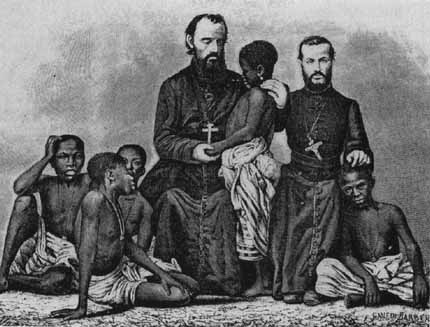
It is ironic how Christian missionaries claim to save the souls lost to humanity through Christ in their anti-slavery movements, however, it was European Christians who continued to enslave people, particularly Africans, well into the early 20th century. The Basel Mission in 20th century Ghana, demonstrated this irony through their forced family separation practices in which they prevented young children in their care from seeing their families.[x] These young children were also forced to plant and cultivate crops for the mission’s profit.[xi] Their families were compensated for the children’s labor as these children worked under harsh conditions. However, subjecting underage children to labor, especially harsh labor, is morally problematic.
The moral dilemma here is that early Christian humanitarians have subjected children to hard labor for profit. This is a violation of today’s human rights practice of respecting children’s rights in which Christian humanitarians were one its early proponents. Nineteenth century Christian humanitarians were abolitionists, however, their actions re-institutionalized slavery and reinforced the racialized concept of humanity. The good that they sought to do in Ghana was overshadowed by the harm they did to the very same people they wanted to help. This is a violation of today’s principle of “Do No Harm.” The “Do No Harm” principle ensures that humanitarian and development actors strive to minimize the harm they may inadvertently have on the populations they serve.[xii] Although this is a recent principle, it continues to demonstrate the ethical considerations that must be incorporated in humanitarian practice such as missionary work that early Christian humanitarians conducted. The racialized concept of humanity led the Christian missionaries to believe that native Ghanaians needed “salvation” for their souls while subjecting them to inhumane treatment, a violation of “Do No Harm.” I used the Basel Mission as an example of how the racialized concept of humanity that resulted in what we now call human rights violations and subsequently, the irony of humanitarianism.
Christian humanitarians may have had admirable moral motivations in working towards the welfare of the people they were serving in the colonies, but the concept of race and the implementation of the European colonial system undermined the anti-slavery initiatives of missionaries between the late 19th and early 20th centuries. This argument is based on the philosophical origins of race that seek to determine human nature and the role of humanity in not only how we think about the world but also how world history unfolds. In this paper, I draw upon the work of philosophers, scholars and practitioners of human rights, humanitarian work, and political scientists to understand the complex dynamics between race, human rights, and humanitarian service in the broader context of world history.
The Racialized Concept of Humanity
Philosophers from the Renaissance era and European explorers concluded that the differences between themselves, and the people of these new lands were fundamental in laying the foundation for the colonization, or “civilization” of these people and their lands. The Europeans’ misperceptions of the people of these new worlds fostered the misconceptions of the concepts of the humanity that the people European Christians would serve in the 19th and early 20th centuries. The misperceptions of people of the New World such as the use of the words, “savages,” and “uncivilized” contributed to the Europeans’ conceptualization of race. The distinguishing differences between the civilized populations of Europe and the “savages” of the colonized world would include race and the notion of the salvation of lost souls that lacked the necessary civility to invoke their sense of humanity.
Philosophers such as Justin E. Smith analyzed the role of race in the debate on human nature, specifically human nature as part of an individual’s soul and their perceived ability to be “a thinking thing.”[xiii] Justin E. Smith’s definition of dualism highlighted the relationship between the soul, mind, and body of which makes a human being. [xiv] Smith hypothesized that “the emergence of the modern race concept was the collapse of a certain universalism about human nature, which had been sustained by the belief in the transcendent essence of the human soul.”[xv] Therefore, dualism is significant in analyzing the irony of humanitarian imperialism as Christian missionaries sought to save the lost souls of Black Africans whom they perceived as inhumane. Smith’s hypothesis demonstrates the use of race in the European’s conceptualization of the soul and eventually, humanity, which began when European explorers invaded non-European lands.
According to Smith, the study of human beings as natural entities created the study of dualism by the end of the 18th century and made essentialist racial thinking possible. In arguing that the human was as diverse as nature, Smith stated that “the naturalization of the human being and the corollary rise of racial thinking involved an overextension of systematic scientific thought, in particular of taxonomic methods fruitfully applied in botany and to a lesser extent in zoology, chemistry, and other domains, to the human species.”[xvi] Although Smith was referring to racial thinking as part of the scientific method in distinguishing races of people as species, I would also include this as the contributing factor in the European Christian humanitarian mindset that led to their efforts in “humanizing” the “savages” of the colonized world. In the theory of Cartesian human-animal dualism, “the finer gradations of race where race is understood as marking out physical differences between human groups that in turn correspond to differences of mental capacity.”[xvii] This scientific method in observing and theorizing the differences between humans further dehumanized non-Europeans as they were reduced to lower degradations of race and attributed animal-like characteristics and features.
Smith noted the controversy of Daniel Descartes’ use of Cartesian human-animal dualism and the mind-body dualism when he wrote,
“Daniel writes as if the distinction between human races had been a concern of philosophers all along, and as if Descartes is breaking with long tradition in implying that an African’s soul is a thinking thing as much as any other, whereas in fact it would be more accurate to say that Daniel, writing at the very end of the seventeenth century, belongs to the first generation, or very near to it, that would consider it necessary to distinguish between races at all.”[xviii]
Consequently, dualism’s role in racial thinking further legitimized the belief in racial inferiority between Europeans and colonized people. Their belief in saving the souls and the humanity of Africans, certainly came from the racialized thinking of European Christian humanitarians that originated from the role of dualism in disregarding Africans’ sense of human agency.
Thus, European colonial administrations used the belief in the salvation of souls as a justification to invade and conquer non-European lands. Similarly, European Christian missionaries of the late 19th and early 20th centuries forced the conversion of Africans to Christianity to further their own imperialist ambitions, alongside their colonial governments.
Humanitarian Imperialism
Early Christian humanitarian work emerged towards the end of the 18th century and continued throughout the 19th but transformed into a profession during the 20th century.[xix] The 18th and 19th century type of humanitarianism focused on anti-slavery efforts to abolish the international Transatlantic Slave Trade and later, the institution of slavery in America.[xx] After the Transatlantic Slave Trade ended, Europeans looked to the African continent to further exploit natural resources and black bodies through the institution of colonialism. Along with colonialism came the flood of Christian missionaries who also sought to civilize Africa and its people. Colonialists forcibly exploited Africans through violent genocidal practices, such as enslavement, rape, and more. Christian missionaries committed cultural genocide as they forcibly converted mass populations of Africans by separating children from their families and subjecting these children to hard labor in salvaging and preserving their humanity in the name of God. Both Christian missionaries and European colonialists believed they had the spiritual and moral responsibility to save the souls of colonized peoples, through forced religious conversion and enslavement. Whatever their motivations may have been, humanitarian or capitalist, they were imperialist by nature. The forced religious conversion and enslavement of colonized people under the guise of humanitarianism has come to be known as “humanitarian imperialism.”[xxi]
According to Amalia Ribi Forclaz, the revival of anti-slavery activism in the late 1880s continued imperial and humanitarian trends during 20th century globalization.[xxii] Forclaz stated that “Slavery in Africa became a transnational problem which induced a wide range of actors to engage in strategic and often selective cooperation across national borders, based on a shared belief in their own advanced ‘civilization’ and in the moral legitimacy of humanitarian imperialism.”[xxiii] Forclaz correctly argued that the concept of a global community growing closer and united by moral and cultural progress was illusory seeing as mass human rights violations were being committed by European colonialists. For example, King Leopold’s colonialists in Belgian Congo chopping off the hands of Congolese laborers when their daily quotas were not met in the early 1900s.[xxiv] The irony of humanitarian imperialism is the fact that European colonialists committed violence against the very same people they sought to protect and save from the evils of savagery and heathenism.
Katie Cannon further captured this controversial concept by stating, “the imperial elites who controlled the military, political, economic, cultural, and ecclesiastical institutions deliberately exalted white superiority with self-deifying pronouncements, while simultaneously working to nullify Africans as fully recognizable human beings.”[xxv] The reality was that these “evils of savagery and heathenism” were not produced by the hands of Africans, but instead were demonstrated through the actions of European colonial masters who disregarded the humanity of black bodies through forced hard labor while at the same time attempted to save these souls with the word of the Bible.
Cannon further explains the irony of humanitarian imperialism as she argued for the mainstreaming of two ethical concepts in the literature on slave-based societies. She particularly highlighted the use of Christianity as a civilizing agent for forcing converts into slaves by identifying these two ethical concepts as the “missiologic of imminent Parousia” and the “theologic of racialized normativity.”[xxvi] She described the “missiologic of imminent parousia” as the link created between biblical urgency and cultural reasoning that legitimized the mission strategies of Christian imperialists.[xxvii] She described these strategies as the beginning of European engagement with Africans that would see European government officials force the first African rulers to convert to Christianity.[xxviii]
The forced conversion to Christianity was sanctified by the Papal Crown at the Vatican and made legal by the European colonial kingdoms that served the Pope during that era.[xxix] The violence that resulted from Africans’ refusal to convert was legitimized by European laws and sanctioned by God.[xxx] The use of force in these conversion practices included murder, starvation, rape, disease, and slavery to save and “rescue inferior benighted brethren” who were at the mercy of Christ’s enemies. These practices are now considered crimes against humanity and were fueled by self-serving colonizers. Cannon stated that Europeans believed:
the lies and manipulations that their soul salvation depended on the ceaseless replication of systemic violence in converting non-Christians, controlling their territorial lands, and exploiting their natural resources, which supposedly would result in establishing God’s kingdom on earth as soon as possible…The more heathens saved prior to the second coming of Christ, the more one could rest assured of their right to the tree of eternal life.[xxxi]
Cannon perfectly summarized the controversy of the forced conversion of Africans to Christianity as not only the mission of Christian humanitarians but also as a weapon for the control of African territorial lands and exploitation of natural resources by European colonialists.
Cannon’s second concept, the “theologic of racialized normativity” refers to the future arrival of the manifested final day in which Christ’s return to Earth would end history, bring the current world to an end, and create an everlasting new world.[xxxii] Cannon explained that this concept originated from the New Testament writers who foresaw the imminent return of Christ as the first step in ushering in the New Age.[xxxiii] Cannon further explained the irony of humanitarian imperialism, through Christianity and colonization when she stated:
Thus, we find that based on the mere wickedness and warped defensible warrants of a gospel mandate, the enslavers of Africans used missiologic imminent parousia as a convenient rhetorical weapon for deepening the conjunction between evangelism and judgement. Their logic was rooted in the belief that whoever is a disciple of Jesus Christ must go into the entire world and ‘make disciples of all nations, baptizing them in the name of the Father, the Son, and the Holy Spirit.’ And since no one knows the exact day or the hour when Jesus will return, these patrons of the governors’ trading companies decided that they would enhance their nation’s economic, political, and spiritual health by accelerating the spread of Christianity.[xxxiv]
Scottish missionary, John Mackenzie and his humanitarian aspirations exemplified Cannon’s “theologically racialized normativity” concept. Kenneth O. Hall argued that Mackenzie’s humanitarian initiatives to protect Africans as his primary objective were misleading.[xxxv] Hall stated that Mackenzie rejected the concept of racial inferiority and saw the “native problem” in South Africa as a cultural issue which could be remedied.[xxxvi] Hall stated that according to Mackenzie, ‘the inferior races’ of each period have always been those who were behind others in high moral attainments; and such are the ‘inferior races’ of today.’ He also repudiated the division of society based on color.”[xxxvii] It is ironic that a missionary like Mackenzie would advocate for a multiracial society through Christian humanitarianism and reject racial inferiority, while also advocating for governmental institutions in the territory to be in the hands of white Europeans. Hall went on to add that “Africans might eventually receive the franchise, but they were expected to use it to elect ‘liberal’ Englishmen who ostensibly knew what was best for Africans.”[xxxviii] Although Christian humanitarian missionaries thought a cultural revolution under the moral obligations and duties were necessary to save the African population, the racist mindset severely undermined the “good” that they were trying to implement as they sought white European domination. This is in fact, the negation of humanitarianism in which the purpose is to respect the dignity of every human being. The irony of the term, “humanitarianism” is evident in the minds and actions of Christian missionaries but also the justification for European colonizers to use violence and other crimes against humanity to control African land and natural resources.
Saving Humanity
The Basel Evangelical Mission Society, a German and Swiss Christian missionary society in colonial Ghana during the 19th century and early 20th century[xxxix] exemplifies the irony of Christianity and colonialism in the concept of humanitarian imperialism. Catherine Koonar’s analysis of the Basel Mission’s use of child labor serves as an example of the concept of racialized humanity in humanitarian imperialism.[xl] Koonar argued that “childhood in colonial Ghana can be viewed as a site of contestation between the competing interests of patriarchy, race, and colonial and missionary authority, in which the labor of children was used to achieve a larger degree of control and influence in the region.”[xli] Slavery did not spare African children from exploitation and neither did Christianity, as children were the source of all important labor for mission construction, maintenance, agriculture, and the production of trade commodities.[xlii] Koonar explored the themes of racialized labor, the gender division of labor, and complications of children’s ability to negotiate and shape the terms of their labor.[xliii] The Basel Mission’s efforts in colonial Ghana demonstrated the irony of their anti-slavery initiatives as they subjected children to complete hard labor along with religious conversion by separating them completely from their families and placing them in boarding schools.
The Basel missionaries understood that access to African children and the implementation of religious conversion would recreate a European morally-based society in African communities, reminiscent of their homes in Europe.[xliv] According to Koonar, “The gendering of education and training reflects European conceptions of labor division based on gender roles that were not necessarily reflective of African ideas and practices.”[xlv] The Basel Mission reconstructed gender roles amongst child laborers to further achieve their goal of African communities mimicking their European colonizer’s societies in their home country.
Although European colonial governments controlled African territories and the production of natural resources, it was the Christian missionaries’ efforts to implement Christian values and incorporate them in the law of the land that allowed the imperialist ruling elites to re-organize traditional African communities. As Sylvia Wynter said, analyzing Marx’ work on capitalist societies: “the ruling ideas of any society are the ideas of the ruling group, this is because a ruling group can only be a ruling group as long as it continues to actualize and embody in itself the name of what is good, that is, the code of symbolic life or criterion of being human about whose structuring good/evil principle the specific social order then self-organizes itself.”[xlvi] The European colonial elites and the Christian missionaries’ ideas actualized and were embodied by the Christian morals and values of what is good. This, in turn, was bad for African victims of crimes against humanity that were committed by these ruling groups.
In colonial Ghana, particularly among the Akan communities, extended members of the family were part of the organization of shared labor, such as clearing forests and planting crops for their family’s consumption.[xlvii] It was often that unrelated people were brought into these extended families as it was common for slaves to be assimilated into the family group.[xlviii] The Basel Mission Society became heavily involved in the debate on domestic slavery and its continued existence in British colonial Ghana.[xlix] Prior to the late 18th century, slaves during the slave trade were encouraged to participate in Christian religious activities but there was not a heavy presence of missionaries among the local populations during that time.[l] In the late 19th century, Christian missions had a heavy presence in Africa, such as members of the Basel Mission Society who advocated for the abolition of slavery within African communities due to their humanitarian sense of shared humanity. Christian missionaries felt an obligation to convert former slaves in which the movement to civilize Africans became a fundamental part of European, particularly British, religious societies.[li]
According to Michael Barnett, abolitionist and missionary interests drew upon and learned from each other as part of a larger humanitarian imperialist effort.[lii] The irony in the Christian humanitarian imperialist work on the abolition of slavery lies in the fact that the capitalist nature of slavery was legitimized by Christian values, yet its uncivilized Africans through chains and forced hard labor. In turn, Christians wanted to enforce imperialist moral values on Africans to (re)civilize Africans. This is the irony of humanitarian imperialism.
Although the British colonial government controlled most of the territory, particularly the interior, parts of the region outside of the territory were still subjected to the Emancipation Ordinance and abolition of slavery which was where the Basel Mission operated.[liii] As a result, systems of debt and dependency existed in which the Basel Mission tried to relieve enslaved Africans of this debt by purchasing slaves who could live as “free” Africans at the mission stations.[liv] Koonar noted the irony of this when she stated,
Blinded by their own prejudices, the missionaries were unable to draw parallels between their expectation that these newly ‘freed’ Africans should be required to work for them, and that of the African system of debt bondage. There are numerous complaints in the Basel Mission correspondence regarding ‘ungrateful subjects’ who did not want to work for the missionaries and simply ‘ran off’ or ‘returned to the households of their former masters’.[lv]
Koonar further indicates the irony of this situation:
Correspondence among a number of Basel missionaries stationed in the colony in 1893 indicates that they had seriously considered buying a large number of slave children and allowing them to live at the mission station as ‘free people, provided that they paid off the cost of their purchase with their labor.[lvi]
The irony of this is that enslaved Africans were sold from one master to another under the assumption of being saved from a group of immoral and uncivilized people whom these “rescued,” and freed people often ran back to. Friedrich Ramseyer preferred the idea of mission station serving as a refuge for runaway slaves, because he believed that former slaves seeking protection was better than purchasing slaves.
In analyzing missionaries’ efforts to reshape African childhood, Michael N. Barnett’s work on the history of humanitarianism offered insight on European missionaries’ varying opinion on non-Western and nonwhite peoples.[lvii] He argued that they did recognize a shared sense of humanity.[lviii] If this is true then the actions of Christian missionaries contradict this truth as they subjected “freed” slaves and eventually, African children, to hard labor. Koonar stated that “Nineteenth-century imperial humanitarians believed that colonialism, Christianity, and commerce ‘could provide the will and the way to emancipate slaves, save sinners and souls, and position backward societies on the path to civilization.’”[lix] The relationship between Christianity, colonialism, and commerce did not emancipate slaves, sinners, nor souls. In fact, it promoted this controversial implementation of humanitarianism and prolonged the enslavement and subsequent suffering of Africans who endured such treatment for another century.
The establishment of separate Christian quarters within the African communities that the Basel Mission served allowed these missionaries to create and maintain good Christian families.[lx] Missionaries were concerned about the relationship between African parents and their children, because Africans traditionally thought that children were viewed as monetary value to their families.[lxi] Haas, a missionary, believed that “raising children in an environment that more closely mimicked the social and cultural practices of Western Europe was essential to the successful development of Protestantism in the colony,” and the fostering of ideals of Christian family life in colonial Ghana in which “it was necessary to break down existing African family structures.”[lxii] By keeping African children away from their parents, the Basel Mission sought to gain more control over the type of labor African children undertook and ensured it was to the Mission’s advantage.[lxiii] As previously stated, freed slaves and now children were passed from one master to another but the effort that the Mission took to prevent children from returning home to their parents and their subjection to hard labor is a human rights violation. Such a violation would now be labeled as child trafficking and child labor, which demonstrates the irony in not only the action of missionaries but the change in perspective of rights between each historical era.
The freed adult laborers often ran away from the mission station, which made it difficult for the Basel Mission to utilize and pay for adult labor so they turned to children.[lxiv] The Mission trained and taught children trades such as carpentry, weaving, and farming to bind them to the Mission.[lxv] The Basel Mission focused on planting coffee and cocoa in which the cultivation and planting was completed by students who were subjected to do a significant amount of labor at the mission schools.[lxvi] According to Koonar, the Basel Missionaries chose to plant coffee and cocoa in the colony due to the larger expansion of the cash-crop economy from the growing demand of external markets.[lxvii] This demonstrates how the relationship between Christianity and commerce further subjected African children to hard labor.
The Basel Mission’s efforts to abolish slavery were controversial and revealed the irony of humanitarian imperialism, as they subjected African children to human rights violations such as hard labor. Furthermore, the mission forcibly displaced children from their families, which is child trafficking in today’s world. Christianity, colonialism, commerce, and the racist and prejudiced mindset of missionaries negated the concept of humanitarianism. Missionaries attempted to save the souls of Africans and their communities through the act of .“civilization.” Yet Africans became uncivilized through Christianity’s role in the slave trade and the continuity of slavery on the continent in the late 19th century.
Conclusion
The European explorers of the 15th centuries returned to their European homes with grandiose stories of “savages,” “heathens,” and “uncivilized” people. In wanting to save these “savages” and “heathens” that they were hearing about, European Christian missionaries embarked on their own journeys to these same places in the hopes of sending saved souls to heaven including themselves. The racialized concept of humanity in humanitarian imperialism is the combination of the concept of race and the implementation of the European colonial administration which undermined the anti-slavery initiatives of Christian missionaries between the late 19th and early 20th centuries. Despite the unethical practice of humanitarianism that the European Christian missionaries implemented in these non-European communities, their work laid the foundation for today’s humanitarianism as not only a profession but as a way of life.
Today’s practice of humanitarianism developed and evolved from the good intentions that early Christian missionaries had towards spreading the gospel and improving the lives of the people and communities they served. The development and evolution of humanitarian practice led to an international system that legitimized principles and values to prevent the harm that scholars and practitioners realized were causing the communities that they served.
In the evolution of this practice, the current international system legitimized the fundamental principles of the International Committee of the Red Cross that included the values of humanity, impartiality, neutrality, and independence. These principles represented the values required for a culturally informed and ethically developed humanitarian practice that prevents and reduces the risk of harm to the people and communities that humanitarians serve. If these principles and values had been legitimized and included in the practice of early Christian humanitarianism, the suffering of Africans could have actually been alleviated through slavery’s abolition. The conquest, colonization, and control that European colonial administrations implemented on their occupied territories were inherently violent and furthered by the practice of humanitarianism that early Christian missionaries implemented. Both the European colonial administrations and early Christian missionaries violated today’s principles of humanitarianism, particularly the “Do No Harm” principle that resulted in what we now consider as human rights violations. The irony of humanitarian imperialism is that doing good can cause harm if ethical considerations such as cultural awareness and structures and dynamics of power are not acknowledged appropriately in the practice of serving people and their communities.
Bibliography
Barnett, Michael. “Introduction: The Crooked Timber of Humanitarianism.” Essay. In Empire of Humanity: A History of Humanitarianism, 1–18. Ithaca, NY: Cornell University Press, 2011.
Cannon, Katie Geneva. “Christian Imperialism and the Transatlantic Slave Trade.” Journal of Feminist Studies in Religion 24, no. 1 (April 2008): 127–34.
Forclaz, Amalia Ribi. “The Crisis of Anti-Slavery Activism.” Humanitarian Imperialism, (2015): 1–13.
Hall, Kenneth O. “Humanitarianism and Racial Subordination: John Mackenzie and the Transformation of Tswana Society.” The International Journal of African Historical Studies 8, no. 1 (1975): 97–110.
Heritage and Cultural Society of Africa Foundation. “The Arrival of Christianity in Ghana – Google Arts & Culture.” Google. Accessed April 11, 2024. https://artsandculture.google.com/story/the-arrival-of-christianity-in-ghana-hacsa-foundation/pgVxfrT6RPdrcg?hl=en.
International Committee of the Red Cross (ICRC). The Fundamental Principles of the International Red Cross and Red Crescent Movement. Geneva, Switzerland: International Committee of the Red Cross (ICRC), 2015.
International Federation of the Red Cross and Red Crescent Societies. Applying Better Programming Initiative-Do No Harm. Geneva, Switzerland: International Federation of the Red Cross and Red Crescent Societies, 2016.
Isenberg, Nancy. “Chapter 1-Taking Out the Trash: Waste People in the New World.” Essay. In White Trash: The 400-Year Untold History of Class in America, 1–27. New York, New York: Viking, 2016.
Koonar, Catherine. “‘Christianity, Commerce and Civilization’: Child Labor and the Basel Mission in Colonial Ghana, 1855–1914.” International Labor and Working-Class History 86 (2014): 72–88.
Omi, Michael, and Howard Winant. “Chapter4: The Theory of Racial Formation.” Essay. In Racial Formation in the United States, 105–136. New York, New York: Routledge, 2015.
Scott, Pippa, and Oreet Rees, directors. “King Leopold’s Ghost”. Linden Productions, 2006. 1 hr., 48 min. https://www.amazon.com/King-Leopolds-Ghost-Don-Cheadle/dp/B074ZDKFJ8
Smith, Justin. “Chapter 1: Curious Kinks.” Essay. In Nature, Human Nature, and Human Difference: Race in Early Modern Philosophy, 24–55. Princeton, NJ: Princeton University Press, 2015.
Smith, Justin E.H. “Chapter 2: Toward a Historical Ontology of Race.” Essay. In Nature, Human Nature, and Human Difference: Race in Early Modern Philosophy, 56–69. Princeton, NJ: Princeton University Press, 2015.
Smith, Justin E.H. “Chapter 3: New Worlds.” Essay. In Nature, Human Nature, and Human Difference: Race in Early Modern Philosophy,, 70–91. Princeton, NJ: Princeton University Press, 2015.
Smith, Justin. “Chapter 8: Anton Wilhelm Amo.” Essay. In Nature, Human Nature, and Human Difference: Race in Early Modern Philosophy, 207–30. Princeton, NJ: Princeton University Press, 2015.
[i] Barnett “Introduction: The Crooked Timber of Humanitarianism” 1
[ii] Ibid, 1
[iii] Ibid, 1
[iv] Barnett “Introduction: The Crooked Timber of Humanitarianism” 9
[v] Isenberg, Nancy. “Chapter 1-Taking Out the Trash: Waste People in the New World.” Essay. In White Trash: The 400-Year Untold History of Class in America, 1–27. New York, New York: Viking, 2016.
[vi] Omi and Winant “Ch.4 The Theory of Racial Formation,” 111
[vii] Ibid, 111
[viii] ICRC “The Fundamental Principles of the International Red Cross and Red Crescent,” 4
[ix] Cannon, Katie Geneva. “Christian Imperialism and the Transatlantic Slave Trade.” Journal of Feminist Studies in Religion 24, no. 1 (April 2008): 127–34.
[x] Koonar “Christianity, Commerce and Civilization,” 78
[xi] Ibid, 82
[xii] International Federation of the Red Cross and Red Crescent Societies “Applying Better Programming Initiative-Do No Harm,” 10
[xiii] Smith “Chapter 2: Toward a Historical Ontology of Race,” 67
[xiv] Smith, Justin. “Chapter 1: Curious Kinks.” Essay. In Nature, Human Nature, and Human Difference: Race in Early Modern Philosophy, 24–55. Princeton, NJ: Princeton University Press, 2015.
[xv] Smith “Chapter 1: Curious Kinks.”, 8
[xvi] Ibid, 18
[xvii] Ibid, 67
[xviii] Smith “Chapter 2: Toward a Historical Ontology of Race,” 68.
[xix] Forclaz, Amalia Ribi. “The Crisis of Anti-Slavery Activism.” Humanitarian Imperialism, (2015): 1–13.
[xx] Ibid.
[xxi] Ibid.
[xxii] Ribi Forclas Humanitarian Imperialism: The Politics of Anti-Slavery Activism,,” 1
[xxiii] Ibid, 1
[xxiv] Scott, Pippa, and Oreet Rees, directors. “King Leopold’s Ghost”. Linden Productions, 2006. 1 hr., 48 min. https://www.amazon.com/King-Leopolds-Ghost-Don-Cheadle/dp/B074ZDKFJ8
[xxv] Cannon “Christian Imperialism and the Transatlantic Slave Trade.,” 132
[xxvi] Ibid, 128
[xxvii] Cannon, Katie Geneva. “Christian Imperialism and the Transatlantic Slave Trade.” Journal of Feminist Studies in Religion 24, no. 1 (April 2008): 127–34.
[xxviii] Ibid.
[xxix] Ibid, 127-128
[xxx] Ibid.
[xxxi] Ibid, 130
[xxxii] Cannon, Katie Geneva. “Christian Imperialism and the Transatlantic Slave Trade.” Journal of Feminist Studies in Religion 24, no. 1 (April 2008): 127–34.
[xxxiii] Ibid.
[xxxiv] Ibid, 129
[xxxv] Hall, Kenneth O. “Humanitarianism and Racial Subordination: John Mackenzie and the Transformation of Tswana Society.” The International Journal of African Historical Studies 8, no. 1 (1975): 97–110.
[xxxvi] Ibid.
[xxxvii] Ibid, 103
[xxxviii] Ibid, 104
[xxxix] Heritage and Cultural Society of Africa Foundation. “The Arrival of Christianity in Ghana – Google Arts & Culture.” Google. Accessed April 11, 2024. https://artsandculture.google.com/story/the-arrival-of-christianity-in-ghana-hacsa-foundation/pgVxfrT6RPdrcg?hl=en.
[xl] Koonar, Catherine. “‘Christianity, Commerce and Civilization’: Child Labor and the Basel Mission in Colonial Ghana, 1855–1914.” International Labor and Working-Class History 86 (2014): 72–88.
[xli] Koonar “Christianity, Commerce and Civilization,” 72
[xlii] Koonar, Catherine. “‘Christianity, Commerce and Civilization’: Child Labor and the Basel Mission in Colonial Ghana, 1855–1914.” International Labor and Working-Class History 86 (2014): 72–88.
[xliii] Ibid.
[xliv] Ibid.
[xlv] Ibid, 83
[xlvi] Scott “The Re-Enchantment of Humanism: An Interview with Sylvia Wynter.,” 199
[xlvii] Koonar, Catherine. “‘Christianity, Commerce and Civilization’: Child Labor and the Basel Mission in Colonial Ghana, 1855–1914.” International Labor and Working-Class History 86 (2014): 72–88.
[xlviii] Ibid.
[xlix] Ibid.
[l] Ibid.
[li] Ibid.
[lii] Ibid.
[liii] Ibid.
[liv] Ibid.
[lv] Ibid, 68.
[lvi] Ibid, 76.
[lvii] Ibid.
[lviii] Ibid.
[lix] Ibid, 77
[lx] Ibid.
[lxi] Ibid.
[lxii] Ibid, 78
[lxiii] Ibid.
[lxiv] Ibid.
[lxv] Ibid.
[lxvi] Ibid.
[lxvii] Ibid.
Bibliography
Barnett, Michael. “Introduction: The Crooked Timber of Humanitarianism.” Essay. In Empire of Humanity: A History of Humanitarianism, 1–18. Ithaca, NY: Cornell University Press, 2011.
Cannon, Katie Geneva. “Christian Imperialism and the Transatlantic Slave Trade.” Journal of Feminist Studies in Religion 24, no. 1 (April 2008): 127–34.
Forclaz, Amalia Ribi. “The Crisis of Anti-Slavery Activism.” Humanitarian Imperialism, (2015): 1–13.
Hall, Kenneth O. “Humanitarianism and Racial Subordination: John Mackenzie and the Transformation of Tswana Society.” The International Journal of African Historical Studies 8, no. 1 (1975): 97–110.
Heritage and Cultural Society of Africa Foundation. “The Arrival of Christianity in Ghana – Google Arts & Culture.” Google. Accessed April 11, 2024. https://artsandculture.google.com/story/the-arrival-of-christianity-in-ghana-hacsa-foundation/pgVxfrT6RPdrcg?hl=en.
International Committee of the Red Cross (ICRC). The Fundamental Principles of the International Red Cross and Red Crescent Movement. Geneva, Switzerland: International Committee of the Red Cross (ICRC), 2015.
International Federation of the Red Cross and Red Crescent Societies. Applying Better Programming Initiative-Do No Harm. Geneva, Switzerland: International Federation of the Red Cross and Red Crescent Societies, 2016.
Isenberg, Nancy. “Chapter 1-Taking Out the Trash: Waste People in the New World.” Essay. In White Trash: The 400-Year Untold History of Class in America, 1–27. New York, New York: Viking, 2016.
Koonar, Catherine. “‘Christianity, Commerce and Civilization’: Child Labor and the Basel Mission in Colonial Ghana, 1855–1914.” International Labor and Working-Class History 86 (2014): 72–88.
Omi, Michael, and Howard Winant. “Chapter4: The Theory of Racial Formation.” Essay. In Racial Formation in the United States, 105–136. New York, New York: Routledge, 2015.
Scott, Pippa, and Oreet Rees, directors. “King Leopold’s Ghost”. Linden Productions, 2006. 1 hr., 48 min. https://www.amazon.com/King-Leopolds-Ghost-Don-Cheadle/dp/B074ZDKFJ8
Smith, Justin. “Chapter 1: Curious Kinks.” Essay. In Nature, Human Nature, and Human Difference: Race in Early Modern Philosophy, 24–55. Princeton, NJ: Princeton University Press, 2015.
Smith, Justin E.H. “Chapter 2: Toward a Historical Ontology of Race.” Essay. In Nature, Human Nature, and Human Difference: Race in Early Modern Philosophy, 56–69. Princeton, NJ: Princeton University Press, 2015.
Smith, Justin E.H. “Chapter 3: New Worlds.” Essay. In Nature, Human Nature, and Human Difference: Race in Early Modern Philosophy,, 70–91. Princeton, NJ: Princeton University Press, 2015.
Smith, Justin. “Chapter 8: Anton Wilhelm Amo.” Essay. In Nature, Human Nature, and Human Difference: Race in Early Modern Philosophy, 207–30. Princeton, NJ: Princeton University Press, 2015.
Leave a Reply