
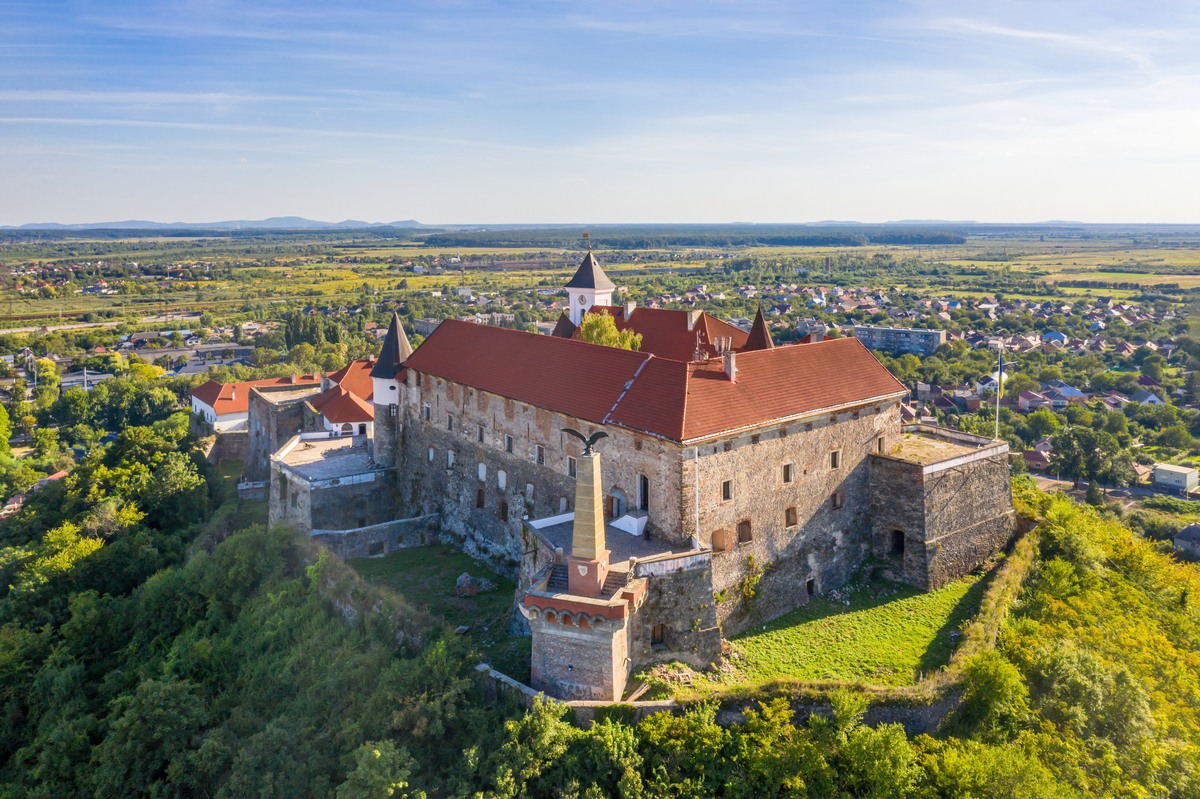
Munkácsi Castle (Palanok Castle) rises above Mukachevo, Ukraine, symbolizing the historic presence of the Hungarian minority in the region. (Image Source: Wikimedia Commons. https://commons.wikimedia.org/wiki/File:Munkacsivar.jpg. Licensed under CC-BY-SA-4.0.)

By Luca Mórocz (”Lucy”)
Why do ethnic Hungarians in Transcarpathia, Ukraine, continue to maintain a strong national Hungarian identity and attachment to Hungary within the context of conflict and historical shifts?
Introduction
Today, Hungarians in Transcarpathia maintain their ethnic identity despite political upheaval, cultural pressure, and dramatic shifts in governance. Transcarpathia is a region that has changed hands multiple times, from the Kingdom of Hungary to Czechoslovakia, and the Soviet Union, before becoming part of independent Ukraine in 1991. This paper explores how non-state resources can support national attachment among kin minorities, complementing traditional state-run education systems. Focusing on cultural resources like vernacular literature and religious practices in Transcarpathia, the paper contributes to debates on fluid and fixed national identities, particularly in preserving Hungarian identity amidst shifting sovereignties.
The geopolitical shifts make the resilience of Hungarian ethnicity in the region unique, as the community has retained a strong sense of national identity and attachment to Hungary. The Russo-Ukrainian War brought renewed attention to the status of ethnic minorities in Eastern Europe, underscoring the potential for domestic ethnic tensions to spill over into international conflicts. The case of the Hungarian minority in Transcarpathia is particularly salient in this regard, given Hungary’s ongoing disputes with Ukraine over minority rights.
The long-standing presence of Hungarians allowed for deep cultural roots to develop, since Hungarians have inhabited the Transcarpathian region for over a thousand years. Mass schooling also had a significant impact during the Dual Monarchy of Austria-Hungary (1867-1918). This system of governance, under a single monarch, played a pivotal role in shaping educational policies and cultural identity in the region. The aforementioned tools reinforced and preserved these traits, particularly where diverse ethnic groups faced competing nationalisms and as external geopolitical pressures increased over time. This suggests that while schooling preserves a foundational framework, additional resources must also be actively practiced and accessible to sustain identity over time. Mechanisms of identity preservation, including Hungarian cultural resources—vernacular literature, newspapers, and symbols—played a significant role in reinforcing national identity, even in the absence of assimilationist or suppressive schooling frameworks. Additionally, religious institutions, including Greek, Catholic and Protestant practices conducted in Hungarian, reinforced cultural identity by providing continuity and belonging, countering assimilationist pressures. This paper will conclude by summarizing the role of these cultural and religious resources in preserving Hungarian national identity as a minority population tied to a kin-state.
Historical Background
Governance Transitions of Transcarpathia: Hungary → Austro-Hungarian Monarchy → Czechoslovakia → Soviet Union → Ukraine
Hungarians settled, with an estimated average population of 150,000 people, in Transcarpathia at the turn of the 9th and 10th centuries, during a period referred to as the “Honfoglalás,” or the conquest of the homeland.[i] However, they are not considered an indigenous population of Transcarpathia. Shortly after the “Honfoglalás,” the Hungarian Christian Kingdom was established in the year 1000. Subsequently, Transcarpathia remained part of the Austro-Hungarian Monarchy until 1918.[ii] The Dual Monarchy was a transformative period for the Hungarian identity, as ‘Magyars’ the Hungarian ethnic group, gained significant control over domestic policies, such as education, language, and cultural affairs.[iii] The Austro-Hungarian Compromise of 1867 set the stage for Magyarization, which included policies that attempted to assimilate non-Hungarian ethnic groups into the larger Hungarian identity. These policies aimed to “Magyarize” non-Hungarians by increasing the prevalence of the Hungarian language and culture. These efforts set the stage for identity struggles in Transcarpathia, as the promotion of Magyarization clashed with the region’s diverse ethnic composition.
The region became semi-autonomous between 1918 and 1920 but was annexed by Czechoslovakia in 1920 under the Treaty of Trianon. The administrative separation of the Jewish community in 1921 reduced Transcarpathia’s Hungarian minority population, preventing it from reaching the 20% threshold required for the legal usage of Hungarian in the region.[iv] While Czechoslovak authorities supported educational and cultural initiatives in East Slavic languages, education in Hungarian was limited. There was only one Hungarian high school in the region at the time, the Gymnasium in Beregszász.[v]
In 1938-39, following the dissolution of Czechoslovakia, the territory was returned to Hungary. However, this period was brief, as Transcarpathia came under Hungarian control during Hungary’s alliance with Nazi Germany. The region remained part of Hungary until the autumn of 1944.v Efforts to establish organizations for minority rights protection or intellectual movements were largely interrupted by the rapid changes in governance.
Following World War II, Transcarpathia came under the jurisdiction of the Soviet Union. Although the Soviet Union aimed to promote Russian and Ukrainian dominance, it established frameworks for minority recognition, including Hungarian-language schools and cultural institutions, particularly in areas with significant Hungarian populations.[vi]
Following Ukraine’s declaration of independence on December 1, 1991, and the disintegration of the Soviet Union that same month, Transcarpathia became a part of independent Ukraine and Hungary was one of the first countries to recognize Ukraine’s sovereignty. During this time, the Hungarian minority in Transcarpathia faced numerous legal challenges regarding the usage of Hungarian. The Kivalov-Kolesnichenko Law (2012) eased regulations on Hungarian, allowing regional languages to be officially used in areas where minorities exceeded 10% of the population.[vii] For Transcarpathian Hungarians, it was a significant victory for a short period of time, until the law was repealed in 2014.
The Ukrainian government’s policies, especially since 2014, have emphasized national unity and the primacy of the Ukrainian language. This has sometimes come at the expense of minority language rights, including those of Hungarians. The adoption of the Education Law in 2017 restricted minority-language education beyond primary school, requiring secondary and higher education to be conducted in Ukrainian. The Language Law, passed in 2019, mandated the usage of Ukrainian in public life and limited the role of minority languages in education and official communications. This sparked significant opposition from the Hungarian minority and the Hungarian government, which viewed these language laws as discriminatory. Furthermore, Russia’s invasion in 2022 shifted Ukraine’s priorities, placing a stronger focus on strengthening national unity, prioritizing Ukrainian language against all other languages spoken in Ukraine. However, Hungarians in Transcarpathia continue to advocate for the preservation of their cultural and linguistic rights amid the ongoing conflict.[viii]
Hungary’s Support Mechanisms for Transcarpathian Hungarians
Nearly 3 million ethnic Hungarians reside outside Hungary’s borders,[ix] collectively comprising the largest national minority in Central Europe, concentrated primarily near Hungary’s borders, with some communities scattered across Europe. The existence of numerous ethnic kin communities throughout the Carpathian Basin provides these minorities with a broader network of cultural solidarity and a basis for transnational identification. Hungary’s simplified naturalization process for ethnic Hungarians abroad has made it easier for Transcarpathian Hungarians to obtain Hungarian citizenship, further strengthening family ties across the border.
Hungary is a consistent supporter of Transcarpathia as a kin-state, advocating for the rights of Ukraine’s Hungarian minority, especially in the areas of education, culture, and religion. Examples of education initiatives include funding Hungarian-language schools, providing scholarships for students to study in Hungary and implementing programs like the Petőfi Program to help preserve Hungarian culture in Transcarpathia.[x] Lastly, religious institutions in Transcarpathia receive financial assistance for church renovations and religious studies.
Theoretical Framework
The persistence of ethnic and national identities has been the focus of extensive scholarly debate, with arguments spanning a spectrum from fluidity to fixity. On the fluid end of this spectrum, several scholars emphasize the contingent, constructed, and situational nature of identity. Rogers Brubaker defines nationalism as a practical category, emphasizing its contingent and constructed nature, rather than a deep-seated loyalty or inherent trait.[xi] Similarly, Wedeen argues that national identity is something people ‘perform’ rather than something that is inherently fixed and suggests that solidarity emerges from cultural celebrations and rituals.[xii] James C. Scott defines ethnic identity as situational and strategic, referring to ethnicity as something that is performed based on status and material benefit. Scott further asserts that ethnicity can serve as a means of negotiating power to secure rights or representation.[xiii] The fluid end of the spectrum is supported by David Laitin, who refers to ethnicity as a choice instead of blood and inheritance. Laitin argues that individuals may adopt the language and cultural markers of the dominant group if it provides greater social or economic benefits. Laitin also notes that ethnicity is often a “situational” choice, reflecting the cost-benefit calculations in response to external pressures.[xiv] According to Daniel Posner, a fluid identity may be shaped by social incentives and situationally activated, adapting to what is most advantageous in a given environment.[xv]
The fixed end of the identity spectrum underscores structural and historical mechanisms such as education, religion, and compact geographic locations that embed and sustain ethnic identities over time. Anthony D. Smith takes an instrumentalist approach to ethnicity, arguing that ethnic persistence is rooted in ‘ethnic roots,’ which include shared myths, memories, symbols, and traditions. Smith suggests that these roots determine the nature and boundaries of modern nationalisms and nations, and they must be respected by elites to achieve short-term objectives. Smith also emphasizes that ethnic persistence fosters self-awareness and loyalty among its members.[xvi] Benedict Anderson discusses how minority groups can preserve their distinct identities through vernacular media, cultural symbols, and alternative narratives that resist assimilation pressures. This process of identity preservation gave rise to the concept of ‘imagined communities,’ where individuals could perceive themselves as part of a shared national identity, even without direct interaction with most of their compatriots.[xvii]
Similarly, Ernest Gellner argues that modern industrial societies require a standardized and literate population, which is achieved through mass education. Gellner connects schooling to the demands of industrial economies, emphasizing that it creates a shared cultural framework necessary for national cohesion.[xviii] Other thinkers, such as Eric Hobsbawm and Barry Posen, highlight the role of state institutions, including education, in fostering national identity. Eric Hobsbawm views the public education system as a tool to create national loyalties, especially during the late 19th and early 20th centuries.[xix] Barry Posen adds that mass education helps establish the loyalty and collective identity necessary to mobilize a population.[xx] Keith Darden argues that durability of a national identity is strengthened if tied to a sovereign nation and this connection can inspire individuals to defend their nation instead of switching their nationalities and loyalties. Darden argues that nation-states with strong educational and cultural policies embed national attachment at a young age, making identity less flexible and more resistant to external influences.[xxi]
The Russo-Ukrainian War created new challenges for ethnic Hungarians in Transcarpathia, forcing them to navigate competing loyalties and negotiate their place within a rapidly changing geopolitical landscape. These dynamics highlight how external shocks can reshape ethnic allegiances.
Alternative explanations for Hungarian Identity Resilience in Transcarpathia
Marginality as an Explanation for Identity Persistence
The persistence of Hungarian national identity in Transcarpathia can be partially explained by its unique geographical position, situated between two nations with distinct political, linguistic, and cultural traditions. Marginality being on the periphery of a dominant societal system often entails limited access to resources, power, and representation. According to Laitin’s framework, ethnic Hungarians might maintain their identity through strategic adaptation to this marginal position within Ukraine.[xxii] This perspective suggests that marginality could serve as a strategic tool, enabling individuals to leverage resources from both systems and adopt flexible identity strategies. For instance, residents of Transcarpathia might emphasize their Hungarian identity in cultural or educational contexts while conforming to Ukrainian norms when necessary.
Though Laitin’s theory offers theoretical appeal, its application to Transcarpathia lacks sufficient empirical support. There is no evidence that ethnic Hungarians strategically choose or modify their identity based on calculations tied to marginality. If Laitin’s concept is fully applicable, then Hungarian identity in Transcarpathia would likely exhibit greater fluidity, with individuals shifting between Hungarian and Ukrainian identities depending on perceived strategic advantages.[xxiii] However, this research shows that Hungarian identity in Transcarpathia is characterized by persistence and resistance, rather than a rational or calculated choice, reflecting an ingrained and cohesive commitment to Hungarian culture.[xxiv]
This commitment is further demonstrated by Hungarian resistance to Ukrainian state policies that prioritize the Ukrainian language over minority languages. For example, the 2017 Ukrainian Instruction Law, which restricted minority-language instruction beyond primary school, prompted ongoing protests and strong opposition from the Hungarian community across Transcarpathia.vi Despite such external pressures, Hungarian-language schools in Transcarpathia remain as centers of cultural resistance, fostering linguistic and cultural identities
Moreover, census data from 1850 to 2001 reveal little changes to the Hungarian-speaking population, challenging the idea of purely situational identity.[xxv] Many ethnic Hungarians choose to remain in Transcarpathia during periods of uncertainty, preserving their community structures and cultural practices.[xxvi] I argue that their identity preservation efforts intensified in response to these challenges, reflecting a strong commitment to maintaining a distinct identity.
In conclusion, the resilience of Hungarian national identity in Transcarpathia cannot be adequately explained by Laitin’s theory of marginality and strategic adaptation. Unlike the fluid, situational identities described by Laitin, the Hungarian identity in Transcarpathia demonstrates a persistence that is rooted in cultural solidarity, historical continuity, and a collective response to external pressures. This identity endures not because it offers tangible benefits, but because it embodies a deeply felt connection to their heritage and community.
Primordialism as an Explanation for Identity Persistence
A primordial approach suggests an alternative explanation for ethnic Hungarians living in Transcarpathia sticking to their Hungarian national identity. Primordialism belongs to the fixed side of the spectrum, conceptualizing identity as enduring. Clifford Geertz highlights the importance of cultural ‘givens,’ such as language, blood ties, and traditions.[xxvii] His approach aligns with the primordial perspective, which posits that national identities are inherently deep-rooted and enduring. Geertz’s argument suggests that Hungarians have emotional ties to their national identity, which are strengthened by cultural, historical, and linguistic attachments. Additionally, Edward Shils’ concept of primordial attachments emphasizes enduring and emotionally significant ties to cultural ‘givens’.[xxviii] This perspective supports the argument that Hungarian language and cultural practices in Transcarpathia function as inherent and unchangeable elements of national identity.
The Hungarian language and cultural heritage, distinct from those of neighboring ethnic groups, reinforces the resilience of the Hungarian identity in Transcarpathia. As part of the Finno-Ugric language family, Hungarian is unrelated to most neighboring languages, such as Ukrainian and Slovak, which belong to the Indo-European language family. This linguistic uniqueness supports the argument that Hungarians are intrinsically distinct from most ethnic groups.[xxix] Additionally, historical continuity dating back to the establishment of the Hungarian Kingdom in 1,000 AD aligns with the primordial perspective, emphasizing a solidified and enduring national identity.[xxx]
However, the primordial notion of national identification as fixed and immutable may be challenged by the case of the Rusyns in Transcarpathia. This suggests that national identification in Transcarpathia is not as inherent as Geertz might argue.[xxxi] During the Austro-Hungarian era, the Rusyns were politically and culturally aligned with Hungary and Hungary’s policy of Magyarization—the promotion of Hungarian language and culture—encouraged their assimilation. After Transcarpathia’s annexation, the Rusyns continued to identify with the Hungarian nation, despite being a distinct ethnic group.[xxxii] Additionally, shared religious practices, particularly within Roman Catholicism and Greek Catholicism, may have blurred ethnic boundaries, fostering mutual affiliation and facilitating the Rusyns’ assimilation.[xxxiii] These historical examples challenge the primordial perspective of unchangeable ethnic boundaries.
Another way to contest primordialism is by emphasizing the importance of family traditions and the role of informal education in preserving Hungarian national identity in Transcarpathia. During periods when formal education in Hungarian was restricted, such as Soviet-era policies or suppressive Ukrainian laws on minority languages, families played a critical role in sustaining linguistic and cultural heritage. This process underscores the active role of families as agents of cultural resilience, showing that identity persistence is not merely the result of immutable traits or cultural ‘givens.’ Instead of being passively inherited, Hungarian identity in Transcarpathia is actively maintained through intergenerational transmission, ensuring its survival.
While inherent traits such as language and traditions play a role, this case highlights the importance of considering the interplay between intrinsic cultural markers and outside influence. Hungarian identity in Transcarpathia is often actively reinforced through cultural programs, education funding, and political support, suggesting that external support plays a significant role alongside intrinsic resilience.
Proposed Explanation for Hungarian Identity Resilience in Transcarpathia
The proposed explanation highlights the interplay between intrinsic cultural factors, like language and traditions, and external structures, including Hungarian-language education, media, and religious organizations, which altogether sustain and deepen national loyalty over time. I argue that the resilience of Hungarian identity in Transcarpathia arises from this dynamic combination, providing a more nuanced understanding of its persistence.
Anderson supports this argument by emphasizing the role of vernacular literature in fostering national identity, which directly applies to the resilience of Hungarian identity. Hungarian newspapers and literature sustain cultural ties, even during periods when state structures prioritized assimilation into the dominant national identity.[xxxiv] Similarly, Gellner’s work on the connection between schooling and national cohesion reinforces the critical interplay between education and cultural resources in sustaining identity.[xxxv] My argument also accentuates the importance of non-state mechanisms, such as the deliberate cultivation of cultural practices and symbols, in preserving identity. Hobsbawm demonstrates how the invention of tradition is pivotal in sustaining national identity.[xxxvi]
Darden’s perspective partially aligns with this, arguing that mass education is a fundamental resource for establishing durable national identity, as vernacular literature and media are only effective if people are educated to read.[xxxvii] He emphasizes that schooling supports the durability of nationalism by embedding it within families in ways that are not easily reversed. This is particularly true for first-generation school attendees, where less educated parents typically pass on a relatively weaker sense of national identity to their children, as compared to more educated parents, creating national loyalties that lie across an education divide. Schools utilize mass literacy to spread ideas and convey nationalist ideals directly, often having a more significant impact on individuals than other institutions.
However, in the case of Transcarpathian Hungarians, I argue that identity persists not solely because of schooling but due to the availability of vernacular cultural resources (e.g., newspapers, religious services) that reinforce national identity across generations. While schools play an important role in national identity formation, particularly for first-generation students, Hungarian minorities in Ukraine were already educated by the time they were separated from Hungary. Thus, schools did not create new national identities but focused on preserving existing ones.
The Hungarian minority faced disruptions and inconsistencies in Hungarian-language education for ethnic Hungarian families in Transcarpathia, particularly during periods of political change. Hungarians did not assimilate into Ukrainian identity over this period. Instead, tools like newspapers, books, and cultural programs played a critical role in preserving Hungarian ethnicity. Literacy among Hungarian families enabled them to maintain their identity even when education in Hungarian was inconsistent. Furthermore, over the past 100 years, educated Hungarian minorities did not show a willingness to adopt Ukrainian or Soviet national identities. Interestingly, even the local East Slavic intelligentsia often chose to assimilate into Hungarian culture, undergoing Magyarization.[xxxviii]
Mechanisms of Identity Preservation
State-Controlled Resource: Mass-schooling
The 1868 National Education Act played a crucial role in Hungary’s education reform during the Austro-Hungarian Dual Monarchy, establishing mass education as a nation-building tool and shaping cultural identity during the Dualism period.[xxxix]
During the interwar period (1919–1939), the Czechoslovak administration expanded education in Transcarpathia, with 475 elementary schools operating by 1919 and 803 elementary schools by 1938, offering instruction in Ukrainian (Rusyn), Hungarian, Czech, Slovak, German, Romanian, and bilingual formats. However, rural areas faced shortages of teachers and resources, and school distribution favored Czech and Slovak populations, reflecting a policy of “Czechization”.[xl]
Under Soviet control, Hungarian-language education declined as policies prioritized Russian and Ukrainian instruction. This shift promoted the perception that Russian or Ukrainian was essential for future success. In Hungarian-majority areas, 35% of Hungarian students attended Ukrainian schools and 60.8% attended Russian schools, highlighting the impact of mixed-language integration.[xli]
Table 2. Hungarian-Language School enrollment Over time (1945-2002)
Hungarian-language education in Transcarpathia fluctuated significantly post-WWII. In 1945-46, 82 elementary and 16 seven-grade schools reopened, serving 12,000 students. Enrollment rose by 1948 but declined by 1953. The first Hungarian secondary schools were established in 1953 and 1954, yet enrollment dropped from 21,800 in the mid-1960s to 17,100 by the late 1980s.[xlii]
The early Soviet period faced a shortage of qualified Hungarian-speaking teachers. By 1957, only 115 of 1,060 teachers held higher education degrees. The establishment of a teacher training college in Huszt (1947) and the Hungarian Language and Literature program at Uzhhorod University (1963) helped address this education gap.[xliii]
After Ukraine’s independence in 1991, national policies prioritized Ukrainian, limiting minority-language education. By the late 20th century, Hungarian-language school numbers stagnated, and higher education opportunities remained scarce, pushing many students to study abroad or switch to Ukrainian institutions. In 2001-02, 209,400 students attended 726 public schools in Transcarpathia, with Ukrainian-language schools dominating. Hungarian-language schools ranked second, with enrollment rising from 17,275 (8.4%) in 1989 to 21,034 (10.4%) in 2000. However, only 4% of higher education students studied in Hungarian, primarily at the Transcarpathian Hungarian Teacher Training College and Uzhhorod National University.[xliv]
Despite these efforts, language barriers hindered Hungarian participation in higher education. The establishment of the Transcarpathian Hungarian Teacher Training College in 1996 provided a second option after Uzhhorod’s Hungarian program, but job opportunities in Hungary led to a brain drain, depleting Transcarpathia’s Hungarian intellectual elite.[xlv] Cross-border educational support creates interdependencies that impact bilateral relations, as evidenced when educational policies become points of diplomatic tension between the two states.
Non-State Cultural Resources
Newspapers and literature in Hungarian
Today’s Transcarpathian literature traces its roots to the Czechoslovak era following World War I, marking the region’s initial steps toward its current identity. This era laid the groundwork for Transcarpathian intellectual and cultural life, which transformed significantly over the 20th century.v Writers and intellectuals stimulated a vibrant and dynamic literary community through the newspapers, periodicals, and publication houses at the local and national levels.
Vilmos Kovács and András Benedek identify three major periods during Soviet rule: 1945–1951, termed a “zero morpheme” due to the absence of Hungarian publications; 1951–1957; and 1957–1965, with a continuation beyond 1965[xlvi]. Kovács also played a key role in establishing the Hungarian Studies program in 1963. Despite Soviet restrictions, Hungarian newspapers and literature persisted, providing cultural continuity for Hungarian families.
During the 20th century, Vaszil Hrendzsa-Donszkij emerged as a core figure in Transcarpathian Ukrainian literature. With over 39 published books, including Tövises virágok [Thorny Flowers] (1923) and Kárpáti Ukrajna boldogsága és bánata [The Joys and Sorrows of Carpathian Ukraine], Hrendzsa-Donszkij shaped the region’s literary identity by reflecting local history and culture in his works.[xlvii] His example inspired many writers, such as Borsos-Kumjatszkij Julij and Márkus Olekszandr, to adopt Ukrainian as their literary language, integrating the region’s literary output into the national canon.[xlviii]
The Hungarian-language press and literary activities continued to thrive despite challenges. From 1965, wisdespread popularity of publications like Kárpáti Igaz Szó (daily), Kárpátontúli Ifjúság (weekly), and Vörös Zászló (with Hungarian literature) played important roles in sustaining Hungarian identity.[xlix] Monthly publications like Új Hajtás and Hungarian-language television programs further supported cultural expression.
The 1980s marked the emergence of Hungarian literature clubs, such as the Illyés Gyula Literary Club, which promoted intellectual traditions and contemporary Hungarian literature. Initiatives like the installation of a Rákóczi statue by the Móricz Zsigmond Literary Club renewed a focus on national symbols. Clubs like the II. Rákóczi Ferenc Cultural Circle in Munkács and the Hollósy Simon Circle in Técső contributed significantly to the cultural landscape.[l] These efforts culminated in the publication of Hatodik Síp (The Sixth Reed) in 1989, the first independent Hungarian literary journal in Transcarpathia, symbolizing the region’s cultural aspirations during a transformative period.[li]
In summary, Transcarpathia’s literary evolution reflects the complex interplay of historical, cultural, and linguistic influences unique to the region. Despite political challenges, Hungarian cultural institutions and media endured, ensuring the preservation of Hungarian identity. Through supporting these cultural institutions, Hungary exercises influence in its neighborhood, demonstrating how cultural policy becomes an extension of foreign policy.
Religious Practices: Role of religion in preserving national identity
Religion plays a crucial role in preserving national language and identity in Transcarpathia, serving as a vehicle for cultural heritage and community cohesion, particularly under external pressures and political shifts. Protestantism is the dominant religion in Transcarpathia and is led by the Reformed Church of Transcarpathia, which was established in 1552.[lii] By the 1960s, the Reformed Church had 81 congregations, focusing on increasing Hungarian-speaking clergy to meet local cultural needs. In the 1980s, the community restored 44 churches through individual contributions, reflecting its resilience in maintaining religious and cultural identity.[liii]
The region also hosts Catholic, Adventist, and Baptist communities, though records of their activities are sparse. The Union of Uzhhorod in 1646 established the Greek Catholic Church, integrating Orthodox Rusyns and Romanians under the Vatican. This union fostered linguistic and cultural integration, as Greek Catholics increasingly adopted Hungarian as a liturgical language, leading to the Magyarization of Rusyn and Romanian communities in the 18th and 19th centuries.[liv]
Despite Rome’s resistance to Hungarian liturgy, its usage expanded, particularly after the Treaty of Trianon (1920), leading most Greek Catholics in Hungary and Széklerland to speak Hungarian. However, the Communist era severely disrupted religious life. The Eparchy of Mukachevo, with 450,000 believers (28,000 Hungarians), faced nationalization of church property, bans on religious education, and forced mergers with Orthodox parishes, altering the region’s ethnic makeup and weakened local identity. After World War II, Hungarian Greek Catholics experienced Latinization following the closure of Greek Catholic churches outside Hungary, further solidifying their connection to the Hungarian nation. The suppression and forced integration of Romanian, Slovak, and Ukrainian Greek Catholic churches into Orthodox institutions complicated the religious and cultural landscape.[lv]
Democratic transition across Ukraine in the 1990s sparked a religious revival, with 37 denominations and over 429 new religious buildings by 2007, reflecting both diversity and competition. The Ukrainian Orthodox Church of the Moscow Patriarchate (MP UPE) and the Greek Catholic Church of Transcarpathia (GKE) remain dominant, but recent political shifts, including the creation of the Orthodox Church of Ukraine, challenge MP UPE’s influence in the region.[lvi]
From the integration of Rusyns and Hungarians under Greek Catholicism to the perseverance of Protestant and Catholic institutions during Communist repression, religion has been vital in safeguarding language, culture, and identity in Transcarpathia’s multiethnic landscape. Religious institutions in Transcarpathia continue to function as transnational actors that maintain cultural connections independent of state boundaries. Religious networks transcend political boundaries, creating solidarity that can both complement and challenge state-level diplomatic initiatives.
Conclusion
The longevity of Hungarian national identity in Transcarpathia demonstrates the enduring power of cultural and institutional resources in preserving ethnic identity in the face of geopolitical changes and assimilation pressures. This study illustrates that Hungarian identity survives not only as a result of historical circumstances, but also as a dynamic interaction of cultural practices, education, and religious continuity that actively maintain a sense of belonging and legacy.
Education emerged as both a foundational and adaptive tool in shaping identity. While the Austro-Hungarian Dual Monarchy’s mass schooling initiatives established Hungarian literacy and cultural awareness, the preservation of identity in later periods relied on non-state mechanisms. Hungarian-language newspapers, literature, and cultural programs became critical in maintaining national attachment. Religious organizations further reinforced identity preservation. Greek Catholic and Protestant congregations provided both spiritual and cultural anchors, sustaining a sense of connection even during periods of suppression under Soviet rule.
This persistence challenges the view that identity is entirely fluid or situational. Darden’s emphasis on the critical importance of early institutionalization of national identity is particularly relevant here. The foundational framework established by education, religion, and cultural practices ensured that Hungarian identity remained durable over generations. Access to mass education, vernacular literature, and Hungary’s support through cultural diplomacy continues to provide the Hungarian minority with opportunities to preserve their national identity. Soft power tools, such as cultural exchange programs, media initiatives, and education systems, are becoming increasingly significant in this effort.
The case of Hungarians in Transcarpathia exemplifies how a minority population can integrate both intrinsic cultural markers and external support systems to sustain its identity over time. Other minority communities can draw on these strategies by fostering strong transnational ties with kin-states or diasporas and leveraging non-state cultural resources to maintain their heritage. For example, the use of digital platforms to archive language, literature, and traditions could be particularly effective in preserving identity in the modern era. Additionally, religious and community organizations can act as cultural anchors by promoting intergenerational transmission of values and practices
This supports a nuanced understanding of identity that transcends the binary of fluid versus fixed, instead, illustrating a complex interplay of cultural adaptation, historical continuity, and institutional reinforcement. By emphasizing the ongoing importance of cultural continuity, education, and religion, this study contributes to broader discussions about nationalism and identity, offering insights into the resilience of minority populations in preserving their heritage amidst adversity.
Bibliography
Theoretical framework of construction of national identities, minority dynamics, and nationhood
- Anderson, Benedict. (1991) Imagined Communities. New York: Verso, pp. 1-64.
- Brubaker, R. (1996). Nationalism reframed: Nationhood and the national question in the new Europe. Cambridge University Press.
- Darden, Keith (2023) Resisting Occupation in Eurasia: Mass Schooling and the Formation of Durable National Loyalties (Yale University)
- Csergo, Z., & Goldgeier, J. M. (2004). Nationalist Strategies and European Integration. Perspectives on Politics, 2(1), 21–37. http://www.jstor.org/stable/3688338
- Gellner, Ernest (1983) Nations and Nationalism, Ithaca: Corness University Press, p.8-62.
- Geertz, C. (1973). The interpretation of cultures: Selected essays. Basic Books
- Hobsbawm, E. J. (1990). Nations and Nationalism Since 1780: Programme, Myth, Reality. Cambridge University Press.
- Laitin, David D. (1995) “Marginality: A Microperspective,” Rationality and Society, Vol.7, No. 1: 31-57
- Lieberson, S., & Blalock, H. M. (1968). [Review of Toward a Theory of Minority-Group Relations.]. American Journal of Sociology, 74(1), 83–84. http://www.jstor.org/stable/2775645
- Mylonas, Harris (2012) The Politics of Nation-Building: Making Co-nationals, Refugees, and Minorities. New York: Cambridge University Press, Chapters 1 and 6
- Posen, B. R. (1993). Nationalism, the Mass Army, and Military Power. International Security, 18(2), 80-124.
- Posner, D. N. (2017). When and why do some social cleavages become politically salient rather than others? Ethnic and Racial Studies, 40(12), 2001-2019. https://doi.org/10.1080/01419870.2017.1277033
- Schmitt, Graham et al.(1998) Nation-building in the Post-Soviet Borderlands: The politics of national identities (Cambridge, Cambridge University Press, p 122
- Scott, J. C. (2009). The art of not being governed: An anarchist history of upland Southeast Asia. Yale University Press.
- Shils, E. (1975). Center and periphery: Essays in macrosociology. University of Chicago Press
- Shulman, S. (2004). The Contours of Civic and Ethnic National Identification in Ukraine. Europe-Asia Studies, 56(1), 35–56. http://www.jstor.org/stable/4147437
- Smith, Anthony D. (1987) The Ethnic Origins of Nations, Basil Blackwell
- Weeden, L. (2008). Peripheral visions: Publics, power, and performance in Yemen. University of Chicago Press
- Wimmer, Andreas and Min, Brian (2006) “From empire to nation-states. Explaining wars in the modern world”, in American Sociological Review 71(6): 867-897
Legal regulations, education policies, and minority rights affecting Hungarian communities in Ukraine
- Bozoki, A. (2013) Access to Electoral Rights Hungary. EUDO Citizenship Observatory, European University Institute, June. https://hdl.handle.net/1814/29814
- Committee of Ministers. (2020) Resolutioncm/ResCMN(2020)13 on the Implementation of the Framework Convention for the Protection of National Minorities by Ukraine. 8 December 2020, p. 1. https://search.coe.int/cm/pages/result_details.aspx?ObjectId=0900001680a07742
- Cultural Alliance of Hungarians in Sub-Carpathia (KMSKSZ) and the Democratic Alliance of Hungarians in Ukraine (UMDSZ). (2022) “Joint Statement Regarding the Law on National Minorities (Communities) of Ukraine, 14 December 2022.” https://kmksz.com.ua/2022/12/22/joint-statement-of-the-cultural-alliance-of-hungarians-in-sub-carpathia-and-the-democratic-alliance-of-hungarians-in-ukraine-regarding-the-law-on-national-minorities-communities-of-ukraine/
- Prina, F., & Pentassuglia, G. (2023). Ukraine’s Law on National Minorities and ‘Effective’ Participation: Expanding or Diluting Standards?. International Journal on Minority and Group Rights, 30(5), 880-930. https://doi.org/10.1163/15718115-bja10138
Historical and geopolitical aspects of Hungarian national identity in Ukraine’s Transcarpathia region
- Balla Gyula 1988 “Karpataljai magyarsag 1918-1988.” [The Hungarian population of Transcarpathia 1918-1988] In Medvetanc ELTE, Budapest 317-334.
- Borbély, Mátyás & Csécsi, Dávid & Peti, Marton. (2022). “A Kárpát-medencei külhoni magyarság társadalmi-gazdasági pozícióinak vizsgálatára alkalmas adatkörök összehasonlító elemzése.” [Comparative analysis of data sets suitable for examining the socio-economic positions of Hungarians living abroad in the Carpathian Basin] Statisztikai Szemle. 100. 749-782. 10.20311/stat2022.8.hu0749. http://real.mtak.hu/id/eprint/105482 https://doi.org/10.20311/stat2022.8.hu0749
- Botlik J. and Dupka Gy, (1991) “Ez hát a hon…: tények, adatok, dokumentumok a kárpátaljai magyarság életéböl 1918-1991” [This is our homeland…: Facts, figures, and documents about the life of Hungarians in Transcarpathia from 1918-1991] (Budapest and Szeged) Mandatum Universum https://kmmi.org.ua/uploads/attachments/books/books-pdf/Ez-hat-a-hon.pdf
- Csernicskó, I., & Fedinec, C. (2016). Four Language Laws of Ukraine. International Journal on Minority and Group Rights, 23(4), 560–582. https://www.jstor.org/stable/26557843
- Encyclopaedia Britannica, “Hungary: Social and Economic Developments,” https://www.britannica.com/place/Hungary/Social-and-economic-developments
- Encyclopedia of Ukraine, s.v. “Transcarpathia,” https://www.encyclopediaofukraine.com/display.asp?linkpath=pages%5CT%5CR%5CTranscarpathia.htm
- Fedinec, Csilla; Vehesh, Mykola (2010) “Kárpátalja: 1919-2009 : történelem, politika, kultúra, Argumentum” [Transcarpathia: 1919-2009: history, politics, culture, Argumentum], ISBN 963446596X, 9789634465966 https://real.mtak.hu/12998/7/karpatalja_book_hu_final.pdf
- Halemba, A. (2015). Nation and Church in Transcarpathia. In Negotiating Marian Apparitions: The Politics of Religion in Transcarpathian Ukraine (NED-New edition, 1, pp. 87–144). Central European University Press. http://www.jstor.org/stable/10.7829/j.ctt19z39d5.9
- Kelemen, E. (2001). “A magyarországi népoktatás a dualizmus korában. In P. Donáth & M. Farkas (Eds.)” [Public education in Hungary during the Dual Monarchy. In: P. Donáth & M. Farkas (Eds.)], Filozófia – Művelődés – Történet (Vol. 19, pp. 57–72). Budapest: Trezor Kiadó.
- Magocsi PR. (1996) The Hungarians in Transcarpathia (Subcarpathian Rus’). Nationalities Papers.;24(3):525-534. doi:10.1080/00905999608408464
- Magocsi, P. R. (2015). With Their Backs to the Mountains: A History of Carpathian Rus’ and Carpatho-Rusyns (NED-New edition, 1). Central European University Press. http://www.jstor.org/stable/10.7829/j.ctt19z395j
- Magocsi, P. R. (2007). Ukrainian Lands under Habsburg Rule, 1772-1914. In Ukraine: An Illustrated History (pp. 171–178). University of Toronto Press. http://www.jstor.org/stable/10.3138/j.ctt13x1qdc.34
- Magocsi, P. R. (2007). Western Ukraine during World War I. In Ukraine: An Illustrated History (pp. 191–195). University of Toronto Press. http://www.jstor.org/stable/10.3138/j.ctt13x1qdc.36\
- Magocsi, P. R. (2007). Soviet Ukraine’s Other Peoples. In Ukraine: An Illustrated History (pp. 229–238). University of Toronto Press. http://www.jstor.org/stable/10.3138/j.ctt13x1qdc.42
- Magocsi, P. R. (2007). Carpatho-Ukraine, 1938-1939. In Ukraine: An Illustrated History (pp. 263–267). University of Toronto Press. http://www.jstor.org/stable/10.3138/j.ctt13x1qdc.46
- Magocsi, P. R. (2015). Post-Communist Transcarpathia—Ukraine. In With Their Backs to the Mountains: A History of Carpathian Rus’ and Carpatho-Rusyns (NED-New edition, 1, pp. 363–378). Central European University Press. http://www.jstor.org/stable/10.7829/j.ctt19z395j.32
- Marácz, L. (2016). The Roots of Modern Hungarian Nationalism: A Case Study and a Research Agenda. In L. Jensen (Ed.), The Roots of Nationalism: National Identity Formation in Early Modern Europe, 1600-1815 (pp. 235–250). Amsterdam University Press. http://www.jstor.org/stable/j.ctv8pzcpr.15
- Molnár, József, Molnár, D. István (2005) “Kárpátalja népessége és magyarsága a népszámlálási és népmozgalmi adatok tükrében” [The population and Hungarian community of Transcarpathia in the light of census and demographic data] II. Rákóczi Ferenc Kárpátaljai Magyar Főiskola Matematika és Természettudományi Tanszék https://konyvbirodalom.at.ua/term_tud/Molnar_Jozsef_-_Karpatalja_nepessege.pdf
- Petofi Program, accessed April 5, 2025, https://www.petofiprogram.hu
- Péti, M., Szabó, L., Obádovics, C., Szabó, B., & Csécsi, D. (2021). Analyzing Ethnocentric Immigration through the Case of Hungary – Demographic Effects of Immigration from Neighboring Countries to Hungary. Journal of Ethnic and Cultural Studies, 8(4), 128–153. https://www.jstor.org/stable/48710098
- Pusztai, (2019) Collision of Identities, Assimilation and Myth-making among, Hungary’s Greek Catholics, Editura UniversitarĂ Bucureşti, 2019 https://c-rrc.org/product/collision-of-identities/
- Simonyi, A., Pisano J., (2016) Post-Soviet or Eurasian Lands? Rethinking Analytic Categories in the Ukraine–EU and Russia–China Borderlands, T. Bringa, H. Toje (eds.), Eurasian Borderlands, Ch. 2, DOI 10.1057/978-1-137-58309-3_2
- Skumin, A. (2013) Dual Citizenship and Split Identity. The Ukrainian Week, 12 April. http://ukrainianweek.com/Security/77286
- Fimyar, O. (2013). Review of the book Borderlands into Bordered Lands. Geopolitics of Identity in Post-Soviet Ukraine, by Tatiana Zhurzhenko. Ab Imperio 2013(3), 490-494. https://dx.doi.org/10.1353/imp.2013.0084
Statistical and demographic data
- All-Ukrainian Population Census 2001, National Composition of the Population, http://2001.ukrcensus.gov.ua/eng/results/general/nationality/
- All-Ukrainian Population Census 2001, Linguistic Composition of the Population, http://2001.ukrcensus.gov.ua/eng/results/general/language
- Vörös, S. (2024, February 19). “Kárpátaljai magyar geográfus: „80-90 ezren maradhattunk”” [Transcarpathian Hungarian geographer: “We may have remained 80-90 thousand”] [Interview]. Válasz Online. Retrieved from https://www.valaszonline.hu/2024/02/19/karpatalja-ukrajna-demografia-tarsadalom-magyarsag-kovaly-katalin-interju/
- Dócza, E. K. (2024, February). What lies ahead for Transcarpathian ethnic Hungarians with Ukraine acting out of necessity? Magyar Nemzet. Retrieved from https://magyarnemzet.hu/english/2024/02/what-lies-ahead-for-transcarpathian-ethnic-hungarians-with-ukraine-acting-out-of-necessity
[i] All-Ukrainian Population Census 2001, National Composition of the Population, http://2001.ukrcensus.gov.ua/eng/results/general/nationality/
[ii] Encyclopedia of Ukraine, s.v. “Transcarpathia,” https://www.encyclopediaofukraine.com/display.asp?linkpath=pages%5CT%5CR%5CTranscarpathia.htm
[iii] Encyclopaedia Britannica, “Hungary: Social and Economic Developments,” https://www.britannica.com/place/Hungary/Social-and-economic-developments
[iv] Botlik J. and Dupka Gy, (1991) “Ez hát a hon…: tények, adatok, dokumentumok a kárpátaljai magyarság életéböl 1918-1991” [This is our homeland…: Facts, figures, and documents about the life of Hungarians in Transcarpathia from 1918-1991] (Budapest and Szeged) Mandatum Universum https://kmmi.org.ua/uploads/attachments/books/books-pdf/Ez-hat-a-hon.pdf
[v] Fedinec, Csilla; Vehesh, Mykola (2010) “Kárpátalja: 1919-2009: történelem, politika, kultúra, Argumentum” [Transcarpathia: 1919-2009: history, politics, culture, Argumentum], ISBN 963446596X, 9789634465966 https://real.mtak.hu/12998/7/karpatalja_book_hu_final.pdf
[vi] Botlik and Dupka, “Ez hát a hon…,” 1991
[vii] Csernicskó and C. Fedinec, “Four Language Laws of Ukraine,” International Journal on Minority and Group Rights 23, no. 4 (2016): 560–582, https://www.jstor.org/stable/26557843.
[viii] Dócza, E. K. (2024, February). What lies ahead for Transcarpathian ethnic Hungarians with Ukraine acting out of necessity? Magyar Nemzet. Retrieved from https://magyarnemzet.hu/english/2024/02/what-lies-ahead-for-transcarpathian-ethnic-hungarians-with-ukraine-acting-out-of-necessity
[ix] Csergő, Z., & Goldgeier, J. M. (2004). Nationalist Strategies and European Integration. Perspectives on Politics, 2(1), 21–37. http://www.jstor.org/stable/3688338
[x] “Petőfi Program,” accessed April 5, 2025, https://www.petofiprogram.hu.
[xi] Brubaker, R. (1996). Nationalism reframed: Nationhood and the national question in the new Europe. Cambridge University Press.
[xii] Wedeen, L. (2008). Peripheral visions: Publics, power, and performance in Yemen. University of Chicago Press
[xiii] Scott, J. C. (2009). The art of not being governed: An anarchist history of upland Southeast Asia. Yale University Press.
[xiv] Laitin, David D. (1995) “Marginality: A Microperspective,” Rationality and Society, Vol.7, No. 1: 31-57
[xv] Posner, D. N. (2017). When and why do some social cleavages become politically salient rather than others? Ethnic and Racial Studies, 40(12), 2001-2019. https://doi.org/10.1080/01419870.2017.1277033
[xvi] Smith, Anthony D. (1987) The Ethnic Origins of Nations, Basil Blackwell
[xvii] Anderson, Benedict. (1991) Imagined Communities. New York: Verso, pp. 1-64.
[xviii] Gellner, Ernest (1983) Nations and Nationalism, Ithaca: Corness University Press, p.8-62.
[xix] Hobsbawm, E. J. (1990). Nations and Nationalism Since 1780: Programme, Myth, Reality. Cambridge University Press.
[xx] Posen, B. R. (1993). Nationalism, the Mass Army, and Military Power. International Security, 18(2), 80-124.
[xxi] Darden, Keith (2023) Resisting Occupation in Eurasia: Mass Schooling and the Formation of Durable National Loyalties (Yale University)
[xxii] Laitin, “Marginality,” 31–57.
[xxiii] ibid
[xxiv] ibid
[xxv] All-Ukrainian Population Census 2001, “National Composition”
[xxvi] Molnár, József, Molnár, D. István (2005) “Kárpátalja népessége és magyarsága a népszámlálási és népmozgalmi adatok tükrében” [The population and Hungarian community of Transcarpathia in the light of census and demographic data] II. Rákóczi Ferenc Kárpátaljai Magyar Főiskola Matematika és Természettudományi Tanszék https://konyvbirodalom.at.ua/term_tud/Molnar_Jozsef_-_Karpatalja_nepessege.pdf
[xxvii] Geertz, C. (1973). The interpretation of cultures: Selected essays. Basic Books
[xxviii] Shils, E. (1975). Center and periphery: Essays in macrosociology. University of Chicago Press
[xxix] Smith, Ethnic Origins, 1987
[xxx] Magocsi, P. R. (2015). With Their Backs to the Mountains: A History of Carpathian Rus’ and Carpatho-Rusyns (NED-New edition, 1). Central European University Press. http://www.jstor.org/stable/10.7829/j.ctt19z395j
[xxxi] Geertz, Interpretation of Cultures, 1973
[xxxii] Magocsi, P. R. (2007). An Illustrated History (pp. 263–267). University of Toronto Press. http://www.jstor.org/stable/10.3138/j.ctt13x1qdc.46
[xxxiii] Pusztai, (2019) Collision of Identities, Assimilation and Myth-making among, Hungary’s Greek Catholics, Editura UniversitarĂ Bucureşti, 2019 https://c-rrc.org/product/collision-of-identities/
[xxxiv] Magocsi, With Their Backs to the Mountains, 2015
[xxxv] Gellner, Nations and Nationalism, 1983
[xxxvi] Hobsbawm, Nations and Nationalism Since 1780,1990
[xxxvii] Darden, Resisting Occupation in Eurasia, 2023
[xxxviii] Pusztai, “Collision of Identities,”, 2019
[xxxix] Kelemen, E. (2001). “A magyarországi népoktatás a dualizmus korában. In P. Donáth & M. Farkas (Eds.)” [Public education in Hungary during the Dual Monarchy. In: P. Donáth & M. Farkas (Eds.)], Filozófia – Művelődés – Történet (Vol. 19, pp. 57–72). Budapest: Trezor Kiadó.
[xl] Fedinec and Vehesh, “Kárpátalja: 1919–2009,” 2010
[xli] ibid
[xlii] ibid
[xliii] ibid
[xliv] Molnár, József, Molnár, D. István (2005) “Kárpátalja népessége…” Molnár, József, Molnár, D. István (2005) “Kárpátalja népessége és magyarsága a népszámlálási és népmozgalmi adatok tükrében” [The population and Hungarian community of Transcarpathia in the light of census and demographic data] II. Rákóczi Ferenc Kárpátaljai Magyar Főiskola Matematika és Természettudományi Tanszék https://konyvbirodalom.at.ua/term_tud/Molnar_Jozsef_-_Karpatalja_nepessege.pdf
[xlv] All-Ukrainian Population Census 2001, “National Composition”
[xlvi] Magocsi, With Their Backs to the Mountains, 2015
[xlvii] All-Ukrainian Population Census 2001, “National Composition”
[xlviii] ibid
[l] Botlik J. and Dupka Gy, (1991) “Ez hát a hon…: tények, adatok, dokumentumok a kárpátaljai magyarság életéböl 1918-1991” [This is our homeland…: Facts, figures, and documents about the life of Hungarians in Transcarpathia from 1918-1991] (Budapest and Szeged) Mandatum Universum
[li] Fedinec and Vehesh, “Kárpátalja: 1919–2009,” 2010
[lii] Halemba, A. (2015). Nation and Church in Transcarpathia. In Negotiating Marian Apparitions: The Politics of Religion in Transcarpathian Ukraine (pp. 87–144). Central European University Press
[liii] Pusztai, “Collision of Identities.” (2019)
[liv] Fedinec and Vehesh, “Kárpátalja: 1919–2009,” 2010
[lv] ibid
[lvi] ibid
ABOUT AUTHOR/S

Luca Mórocz (”Lucy”)
Luca Mórocz (”Lucy”) is a former diplomat and currently a graduate student in the Global Governance, Politics, and Security (GGPS) Program, studying on a scholarship awarded by the Hungarian American Coalition. She has expertise in security policy and U.S.–Central Eastern European relations, having served at the U.S. Department of State through a Hungarian diplomatic assignment.
Leave a Reply