
By: Cory Hancock
Executive Summary
Over one million people embarked on the dangerous journey across the Aegean Sea to find refuge in Greece between 2015 and 2022 driven by displacement from the Syrian Civil War. As people continue seeking refuge, governments have taken greater measures to discourage and shut off migration. One such example is the Greek government’s implementation of the illegal and inhumane policy of pushbacks — the act of forcing migrants back across a border “without consideration of their individual circumstances and without any possibility to apply for asylum or to put forward arguments against the measures taken.”[i] This action violates an individual’s right to seek asylum as guaranteed in the United Nations Universal Declaration of Human Rights (UDHR). Non-governmental organizations (NGOs) and civil society organizations have documented these instances and called for action against government pushbacks depriving thousands of seeking asylum. This policy brief examines the violence perpetrated by the pushbacks, analyzes the policy aspects of these actions, and provides practical recommendations including the creation of an independent working group to investigate the pushbacks, allowing NGOs to operate unhindered and unobstructed, and repealing Greek law decision No. 3063.
Policy Problem
The Greek authorities — the Hellenic Coast Guard (HCG), Greek Police, and Greek Ministry of Migration and Asylum — have participated in hundreds of illegal pushbacks since the 2015 European Union (EU)-Turkey Joint Action Plan that was agreed to as the number of new arrivals from Turkey to the Greek Islands surpassed half of a million people in October 2015.[ii] The purpose of the 2015 EU-Turkey deal was to hinder the flow of migrants from Turkey to Europe, primarily by way of the Greek Islands, and predicates a one-for-one exchange whereby “every person arriving irregularly (i.e. by boat, without official permission or passage) to the Greek Islands — including asylum-seekers — would be returned to Turkey.”[iii] For each Syrian refugee returned, the EU would take one Syrian refugee being held in Turkey. The EU offered Turkey €3 billion to improve the humanitarian situation there, as well as other incentives.[iv]
The islands were ill-equipped and ill-prepared to handle another large wave of migrants when Turkey began relaxing its responsibilities from the 2015 deal as geopolitics over territorial rights between the two countries increased. The pushbacks began increasing in regularity in January 2020, and in February 2020, Turkey announced it would no longer prevent migrants from transiting to Europe, partially because the country hosts the most refugees in the world at 3.6 million.[v],[vi] In 2020, 9,741 migrants were pushed back to Turkey in 324 instances by Greek authorities.[vii] More than 3,000 of these individuals had already arrived on the Greek Islands and were arrested, forced back into the sea, and left adrift on inflatable life rafts by the HCG; more than 180 life rafts were used to deport migrants back to Turkey.[viii] In 2021, 15,890 people were pushed back by the Greek authorities in 632 instances.[ix]
The pushbacks exhibit both physical and structural violence against asylum seekers.[x] In some instances, migrants have died during pushbacks. Three people were presumed to have drowned and another died at a Turkish hospital on March 20, 2021, after being handcuffed and pushed back into the sea.[xi] Greek authorities have also forcibly removed asylum seekers from refugee camps and the islands’ shores once they have arrived and, in some cases, made their plea for asylum. By forcibly removing individuals from the lawful process of seeking asylum, the Greek authorities prevent migrants from accessing the fundamental human right of protection and security without discrimination based on race, sex, nationality, or country of origin, as granted in the UDHR.[xii] What began as a more covert means to prevent refugees from applying for asylum in Greece through an international deal has manifested itself into an example of human rights violations that are carried out with impunity on numerous levels in plain view for the world to see.
Policy Analysis
The pushbacks are a new manifestation of refoulement that began with the 2015 EU-Turkey Deal, hiding it in the framework of a legal partnership to mask the illegal act of returning asylum seekers to a state unsuitable for safe returns and set a precedent that enabled returns to Turkey to be viewed as safe and lawful. The one-for-one exchange— when the EU would receive one Syrian refugee from Turkey for each one returned from the EU after arriving irregularly — was the first iteration of refoulement between the two countries as it was accepted as a legal practice in the framework of the deal.
For asylum seekers in Greece, the deal mandated that refugees arriving before March 20, 2016, were to be detained in the camps indefinitely, and many asylum applications were denied on the first interview because the deal deemed Turkey a safe place to return refugees to.[xiii] The non-profit Choose Love noted “[t]he EU-Turkey deal has eroded the rights of refugees and migrants on the Greek Islands, prolonged their legal, physical and psychological insecurity, and used their suffering to deter others from making the crossing,” regarding the deal.[xiv] The United Nations High Commissioner for Refugees (UNHCR) identified three critical needs in light of the deal to ensure human rights protections: Improving and strengthening Greece’s reception conditions and asylum processing; those returned to Turkey must have assurances against refoulement or forced return and; resettlement opportunities for Syrian refugees must be increased.[xv] The first returns to Turkey occurred in April 2016 when 202 people were returned from the Greek islands of Lesvos and Chios. UNHCR said that at least 13 of those people had applied for asylum, but their applications were not registered.[xvi]Additionally, the European Commission (EC) urged returns to increase in December 2016, writing that, “…further efforts are needed…so that the processing of asylum applications at first instance is expedited and that the number of returns is increased and sustained.”[xvii]
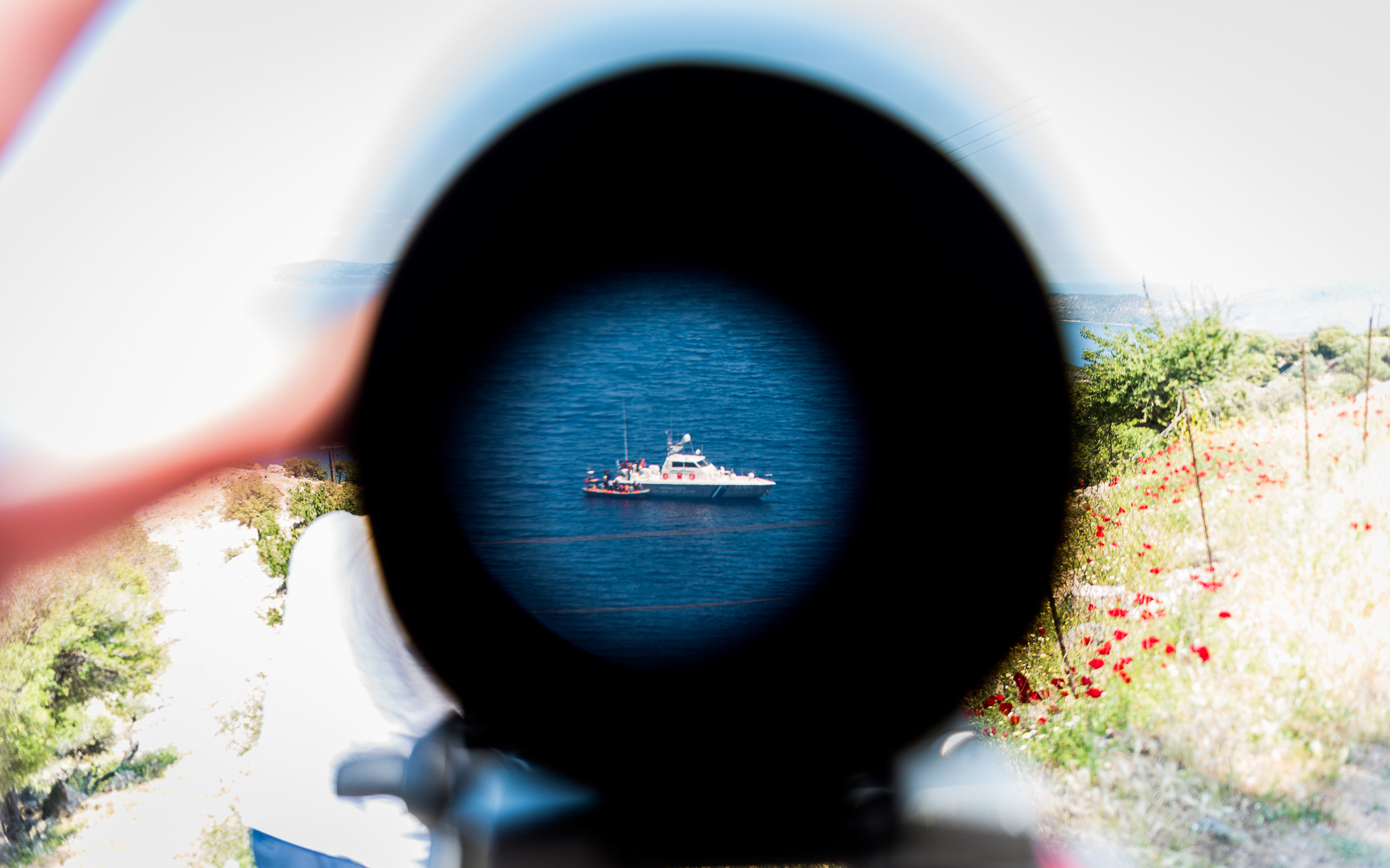
The pushbacks often see a similar routine carried out systematically and habitually. The Greek authorities consistently collect migrants’ cell phones,[xviii] and the pushbacks are commonly carried out by the HCG in conjunction with masked men in blue and black unmarked uniforms.[xix] If the migrants are found in transit in the Aegean Sea, the Greek authorities sometimes beat the migrants and puncture the inflatable dinghy they’re traveling on and its fuel line.[xx] In some instances, if the asylum seekers are already on land, they are lied to about the reason for their removal from the camp,[xxi] beaten with batons,[xxii] forced onto an HCG vessel, and driven near the Greek territorial border in the Aegean Sea before being abandoned at sea. The HCG has repeatedly used rescue equipment — life rafts — to deport migrants from the Greek Islands.[xxiii] The variety of examples cited serves to show the consistency with which the actions occur with each pushback.
Civil society actors have been outspoken about the pushbacks and have taken several actions to hold the Greek authorities accountable for these acts. In January 2021, Legal Centre Lesvos (LCL) filed its fourth application to the European Court of Human Rights concerning “collective expulsion” incidents in the Aegean Sea, and in February 2021, they published a report on the pushbacks as crimes against humanity under the same reasoning mentioned previously.[xxiv] LCL also called on Frontex — the EU’s border patrol agency — to suspend activities in the Aegean Sea region.[xxv] Frontex has allegedly been involved in pushback events, yet the organization determined it had not taken part in pushbacks after an internal investigation of 13 such events.[xxvi] However, Serious Incident Reports filed by Frontex show their complicity during pushback events by the HCG. In one case that played out on a live-stream video at Frontex’s headquarters,[xxvii] migrants were taken on board an HCG vessel, their dinghy was stripped of its engine, and the migrants were subsequently forced back onto the dinghy and left adrift.[xxviii]
Human Rights Watch, Amnesty International, UNHCR, the EU Home Affairs Commissioner, and others, have condemned the pushbacks and have called for their investigation and cessation. UNCHR’s stance on the pushbacks has evolved from urging the Greek government to investigate the incidents in June 2020[xxix] to reaffirming concern in August 2020[xxx] to declaring that asylum is under attack in Europe in January 2021.[xxxi]
The Greek government is the only body denying these actions are taking place. The Council of Europe’s Special Representative of the Secretary-General on Migration and Refugees on Greece has not published any reports on the pushback incidents; it only conducted a fact-finding mission in 2016 to assess how the Council of Europe could assist with addressing the flow of migrants.[xxxii] Greece’s Prime Minister Kyriakos Mitsotakis has denied allegations of pushbacks conducted by the Greek authorities and said Greek border management policy is “tough but fair”.[xxxiii]Migration Minister Notis Mitarachi echoes these statements and has denied that Greece has ever been involved in pushbacks.[xxxiv]
Policy Recommendations
The EU must create an independent working group to investigate and examine the reports of pushbacks by the HCG, the police, and other authorities since the EC does not have the power to investigate.[xxxv] This working group should be dispatched to the Greek Islands and complete their investigation within four months of its creation to ensure enough time is allocated to finish an investigation while also ensuring that the report is disseminated in a timely fashion. This effort should at least yield a requirement that the Greek authorities publish accurate numbers on migrants they have received, transferred, denied asylum, granted asylum, and pushed back through a transparent process with an emphasis on curbing pushbacks and ensuring all who are seeking asylum are afforded the legal right to do so safely and unhindered. The European Court of Human Rights must initiate the Pilot-Judgment Procedure to hasten the ruling on numerous reports filed by organizations like Legal Centre Lesvos that explicitly detail the human rights violations Greek authorities are committing via the pushbacks. The Pilot-Judgement Procedure was created to “[deal] with large groups of identical cases that derive from the same underlying problem.” [xxxvi] The Court can select one or more cases exhibiting the same cause to prioritize with the goal of achieving a solution “that extends beyond the particular case or cases to cover all similar cases raising the same issue.”[xxxvii] This overarching solution is the pilot judgment. This procedure will enable an expedited solution to be achieved in addressing the pushbacks. However, each case has its nuances and may not align with the pilot judgment, and this should be taken as setting a precedent for investigating and acting against the pushbacks.
The EU must step in to ensure that all NGOs and non-profits are allowed to operate on the Greek Islands and in the refugee camps unhindered and unobstructed. For example, the NGO Lighthouse Relief was forced to cease emergency response operations on the north shore of Lesvos in 2020, not only due to COVID-19, but also due to increased tension, insecurity, and human rights violations against new arrivals. “The practice of pushbacks has significantly increased in the Aegean Sea, greatly reducing the number of arrivals. The role of NGOs like ours in the context of arrivals has become extremely limited,” Lighthouse Relief wrote in a statement regarding their departure.[xxxviii] Organizations like Lighthouse Relief fill critical gaps within the Greek asylum system by providing life-saving work in providing asylum seekers with protection, well-being, and information crucial to their asylum applications.
One step to ensuring these organizations can operate fully and freely would be to repeal decision No. 3063 which requires NGOs “active in matters of international protection, immigration and social integration within the Greek Territory” to register in the Register of Greek and Foreign Non-Governmental Organizations under stringent measures.[xxxix] This registry could enable the Greek authorities to enforce harsh regulations on how they operate, severely restricting their ability to provide vital services and support to asylum seekers. The Greek government could empower groups like the European Council on Refugees and Exiles to operate as a monitoring group on the islands that receive migrants, transports them safely and securely to suitable housing, and ensures that “land-pushbacks” do not occur as well. Migrants must be provided the right to seek asylum without the possibility of being deposited back into the sea from which they sought refuge.
Endnotes
[1] European Center for Constitutional and Human Rights. (2021). ECCHR: Push-back. ECCHR.EU. https://www.ecchr.eu/en/glossary/push-back/
[1] Amnesty International. (2017). A blueprint for despair: Human rights impact of the EU-Turkey deal.https://reliefweb.int/sites/reliefweb.int/files/resources/EUR2556642017ENGLISH.PDF
[1] Long, Olivia. (2018, April 5). The EU-Turkey Deal: Explained. Choose Love. https://helprefugees.org/news/eu-turkey-deal-explained/
[1] Ibid.
[1] Deutsche Welle. (2020, February, 28). Turkey will not stop refugees ‘who want to go to Europe’. Deutsche Welle. https://www.dw.com/en/turkey-will-not-stop-refugees-who-want-to-go-to-europe/a-52568981
[1] United Nations High Commissioner for Refugees. (2020). Figures at a Glance. [Infographic]. UNHCR.org. https://www.unhcr.org/en-us/figures-at-a-glance.html
[1] Aegean Boat Report. (2020). Aegean Boat Report Annual Report 2020. https://aegeanboatreport.files.wordpress.com/2021/01/annual-report-2020.pdf
[1] Ibid.
[1] Aegean Boat Report. (2020). Aegan Boat Report Data Studio. https://datastudio.google.com/u/0/reporting/1CiKR1_R7-1UbMHKhzZe_Ji_cvqF7xlfH/page/A5Q0
[1] Border Violence Monitoring Network. (2020, June 5). “[They told us] we don’t care…die…We want you to die”. [Testimony]. borderviolence.eu. https://www.borderviolence.eu/violence-reports/june-5-2020-1000-aegean-sea-lesvos-turkey/
[1] Aegean Boat Report. (2021, March 20). Yesterday the Turkish coast guard released a video, showing a rescue operation they report took place outside Cesme, Turkey, involving… Facebook. https://fb.watch/54ayHphH4p/
[1] United Nations. (1948). Universal Declaration of Human Rights. https://www.un.org/sites/un2.un.org/files/udhr.pdf
[1] Long, The EU-Turkey Deal: Explained.
[1] Ibid.
[1] United Nations High Commissioner for Refugees. (2016, March 18). UNHCR on EU-Turkey deal: Asylum safeguards must prevail in implementation. UNHCR.https://www.unhcr.org/en-us/news/press/2016/3/56ec533e9/unhcr-eu-turkey-deal-asylum-safeguards-must-prevail-implementation.html
[1] Amnesty International. (2017). A blueprint for despair: Human rights impact of the EU-Turkey deal.https://reliefweb.int/sites/reliefweb.int/files/resources/EUR2556642017ENGLISH.PDF
[1] European Commission. (2016). Communication from the Commission to the European Parliament, the European Council and the Council: Fourth report on the progress made in the implementation of the EU-Turkey statement. https://eur-lex.europa.eu/resource.html?uri=cellar:46418ee2-bd30-11e6-a237-01aa75ed71a1.0001.02/DOC_1&format=PDF
[1] Border Violence Monitoring Network. (2020, November 10). “When they put us inside the vessel they put us at gunpoint again”. [Testimony]. https://www.borderviolence.eu/violence-reports/november-10-2020-0100-south-of-mytilene-left-at-sea-between-turkey-and-lesvos-39-043526-26-750051/
[1] Border Violence Monitoring Network. (2020, July 11). “They had no mercy at all. Isn’t it against all mercy and humanity what they do?”. [Testimony]. https://www.borderviolence.eu/violence-reports/july-11-2020-0000-coast-off-lesvos/
[1] Border Violence Monitoring Network. (2020, June 5). “[They told us] we don’t care…die…We want you to die”. [Testimony]. borderviolence.eu. https://www.borderviolence.eu/violence-reports/june-5-2020-1000-aegean-sea-lesvos-turkey/
[1] Olsen, Tommy. (2021, February 22). Small Children Left Drifting In Life Rafts In The Aegean Sea!. Aegean Boat Report. https://aegeanboatreport.com/2021/02/22/small-children-left-drifting-in-a-life-raft-in-the-aegean-sea-approved-by-notis-mitarachi/
[1] Olsen, Tommy. (2021, March 28). The Pushbacks Continue. Aegean Boat Report. https://aegeanboatreport.com/2021/03/28/the-pushbacks-continues/
[1] Border Violence Monitoring Network. (2020, December 3). “We are refugees, we want to apply for asylum”. [Testimony]. https://www.borderviolence.eu/violence-reports/december-3-2020-1200-lesvos/
[1] Legal Centre Lesvos. (2021). Legal Centre Lesvos Quarterly Newsletter: January – March 2021. http://legalcentrelesvos.org/wp-content/uploads/2021/04/LCL-Quarterly-Newsletter-January-–-March-2021.pdf
[1] Ibid.
[1] Frontex. (2021). Conclusions of the Management Board’s meeting on 5 March 2021 on the report of its Working Group on Fundamental Rights and Legal Operational Aspects of Operations in the Aegean Sea. https://frontex.europa.eu/media-centre/management-board-updates/conclusions-of-the-management-board-s-meeting-on-5-march-2021-on-the-report-of-its-working-group-on-fundamental-rights-and-legal-operational-aspects-of-operations-in-the-aegean-sea-aFewSI
[1] Nielsen, Nikolaj. (2021, March 8). Frontex’s ‘serious incident reports’ – revealed. EU Observer. https://euobserver.com/migration/151148
[1] Frontex. (2020). Serious incident report no.11095/2020. [Document]. https://fragdenstaat.de/dokumente/8932-11095/
[1] United Nations High Commissioner for Refugees. (2020, June 12). UNHCR calls on Greece to investigate pushbacks at sea and land borders with Turkey. UNHCR.https://www.unhcr.org/en-us/news/briefing/2020/6/5ee33a6f4/unhcr-calls-greece-investigate-pushbacks-sea-land-borders-turkey.html
[1] United Nations High Commissioner for Refugees. (2020, August 21). UNHCR concerned by pushback reports, calls for protection of refugees and asylum-seekers. UNHCR.https://www.unhcr.org/gr/en/16207-unhcr-concerned-by-pushback-reports-calls-for-protection-of-refugees-and-asylum-seekers.html
[1] United Nations High Commissioner for Refugees. (2021, January 28). UNHCR warns asylum under attack at Europe’s borders, urges end to pushbacks and violence against refugees. UNHCR. https://www.unhcr.org/en-us/news/press/2021/1/601121344/unhcr-warns-asylum-under-attack-europes-borders-urges-end-pushbacks-violence.html.
[1] Council of Europe. (2021). Country Reports. Council of Europe: Special Representative of the Secretary General on Migration and Refugees. https://www.coe.int/en/web/special-representative-secretary-general-migration-refugees/country-reports
[1] ANSA. (2020, August 21). Greek PM to CNN, we do not push refugees back.
InfoMigrants. https://www.infomigrants.net/en/post/26766/greek-pm-to-cnn-we-do-not-push-refugees-back
[1] Reuters Staff. (2021, March 29). EU official urges Greece to investigate reports of asylum-seeker pushbacks. Reuters. https://www.reuters.com/article/us-europe-migrants-greece-lesbos/eu-official-urges-greece-to-investigate-reports-of-asylum-seeker-pushbacks-idUSKBN2BL231
[1] Johansson, Y. European Commission. (2020, July 6). Intervention in the European Parliament LIBE Committee on the situation at the Greek/Turkish border and respect for fundamental rights [Address]. LIBE Committee Meeting, Strasbourg, France. https://ec.europa.eu/commission/commissioners/2019-2024/johansson/announcements/intervention-european-parliament-libe-committee-situation-greekturkish-border-and-respect_en
[1] European Court of Human Rights. (2011). The Pilot-Judgment Procedure. https://www.echr.coe.int/documents/pilot_judgment_procedure_eng.pdf
[1] Ibid.
[1] Lighthouse Relief. (2020, October 3). A Farewell to the North: Our decision to leave Skala Sikamineas after five years of Emergency Response Operations in the north of Lesvos. Lighthouse Relief. https://medium.com/lighthouse-relief/a-farewell-to-the-north-17959cf33ae8
[1] Greece: Law No. 3063 On the operation of the “Register of Greek and Foreign Non-Governmental Organizations (NGOs)” and the “Register of Members of Non-Governmental Organizations (NGOs)”, which are active in matters of international protection, immigration and social integration within the Greek Territory. (2020). https://drive.google.com/file/d/1rgbjjv1MWrFA1ilTxi-L3sJw9TXvFzof/view
Leave a Reply