
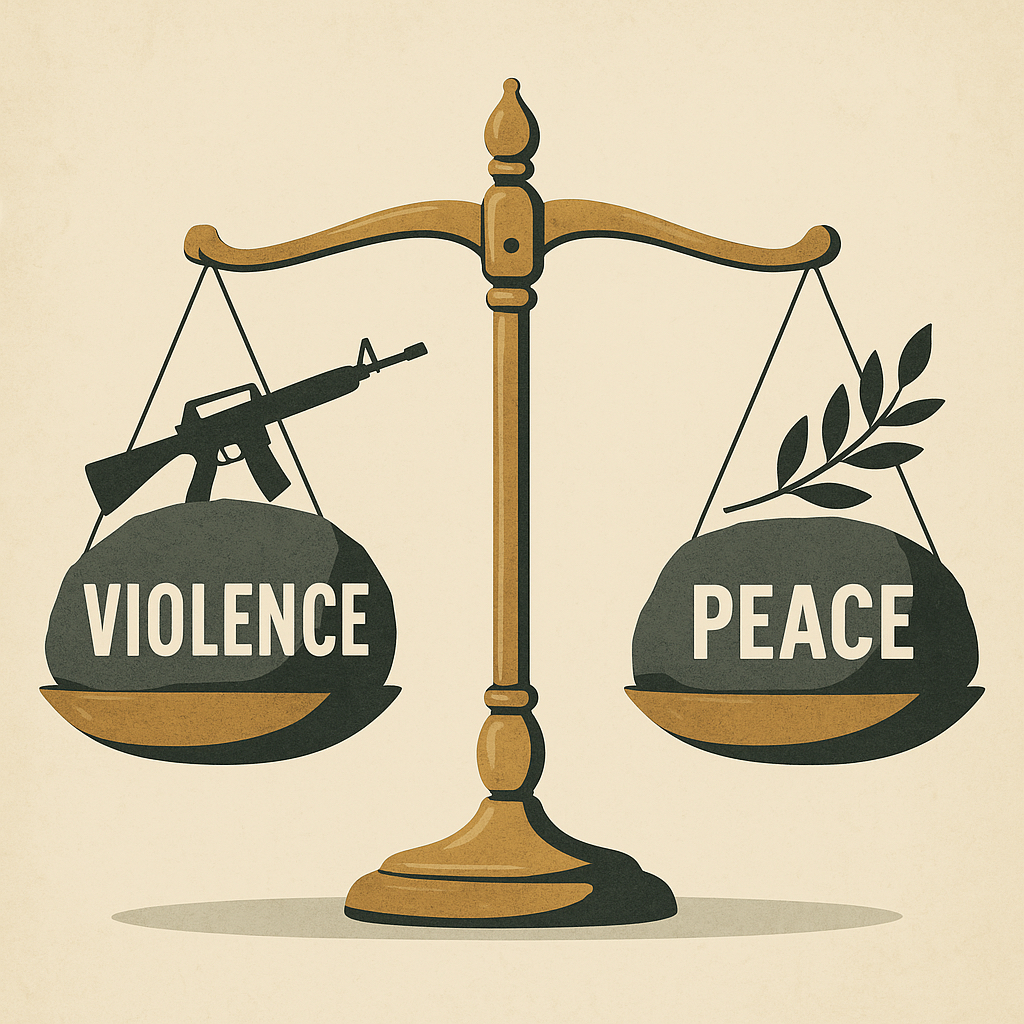
This image is a conceptual illustration that emphasizes the struggle between violent conflict and the pursuit of peaceful resolution. The symbols of the rifle and olive branch represent the traditional imagery linked to war and peace, effectively capturing this tension and our choices. (Source: AI-assisted rendering)
By Kathleen Snyder and Evan Padilla
Abstract
Actors in the political marketplace worldwide are rational beings who make choices based on the costs they expect to pay and the expected utility they anticipate receiving. The following paper reviews the existing literature on such costs as they influence actors to choose a path of peace or violence. In doing so, it proposes the reconceptualization of peace and violence as existing on a grid defined by 1) the types of violence and peace manifesting and 2) their intensities. Three suggestions for future work are made for scholars and policymakers: 1) adopting the proposed spectrum for peace and violence, 2) considering long-term costs of conflict, even if they are observed in post-conflict conditions, as costs of the conflict itself, and 3) conducting research to address a lacuna in the literature on peacemaking and conflict: how costs affect choices made by third-party actors, such as international organizations, non-governmental organizations, and multinational corporations.
Introduction
Within international relations and conflict studies, the explorations of peace and conflict are often characterized by examining two binary opposites, dividing the landscape into the absence of violence as peace and the presence of conflict as a breakdown of peace.[i] Political scientist Stathis N. Kalyvas writes on this, saying: “The study of the onset of each type of political violence tends to be automatically contrasted with the absence of political violence as a whole, which is conceptualized as some kind of ‘peace,’ domestic or international.”[ii] However, we the authors take the position that scholars who resort to this approach often miss the complex nature of violence and the nuanced existence of peace. A less complete conceptualization of peace and conflict, including the interactions between the two, narrows the scope of possible strategies for conflict resolution and, when such strategies are enacted, their efficacy.
This paper examines what scholars have written on both violent conflict and peace with a focus on insights from authors who applied a cost-based approach to frame how actors within the political marketplace choose violence or peace based on their calculations of the most cost-efficient way to achieve their goals. In the process, we argue for a new framework where violence and peace exist on a grid that is defined by types and intensity of manifestation. While this review is non-exhaustive due to the scope and depth of research that exists, it includes a range of approaches scholars have applied to the study of conflict and peace. The conclusion contains future policy suggestions based on insights gained during this investigation. We hope to create a resource for future academic work and policymakers aiming to design more effective and comprehensive peace strategies.
Defining Violence and Peace: The Topics at Hand
The meanings of “violence” and “peace” must be established before examining the extant literature. This paper finds that within the context of international relations, violence is best defined in terms of structural and physical violence. Political scientist John Galtung coined the concept of structural, or indirect, violence. Structural violence refers to violence perpetuated by the system, not by an individual.[iii] One manifestation of structural violence is when gender roles result in one gender facing higher levels of poverty, as can be seen in G. Nokukhanya Ndhlovu’s work on women in South Africa.[iv] Susan Forde, Stefanie Kappler, and Annika Björkdahl provide another example in their writing on the way that the historical economic violence against Black and Coloured South Africans under Apartheid created an economic disparity that remains despite Apartheid’s end.[v] Structural violence is static and embedded into the society in which it occurs, making it difficult to observe. Galtung, however, identifies six mechanisms by which structural violence is committed: 1) linear ranking, 2) acyclical interaction pattern, 3) correlation between rank and centrality, 4) congruence between the systems, 5) concordance between the ranks, and 6) high rank coupling between levels. Linear ranking is when one member of society has a clear and higher status than the other, while an acyclical interaction pattern refers to systems in which there is only one permissible way for actors to interact with each other. A correlation between rank and centrality within a society refers to higher ranked individuals being more centered in the system. Congruence between the systems is when all networks in which individuals can interact have similar structures, and concordance between the ranks refers to when an actor is likely to be high within a system because he is also high in another system within the same society. Finally, high rank coupling between levels is when the highest actor at a certain level is able to represent similar actors at a level higher than the level they exist on.[vi]
Violence can also manifest as physical violence. This is direct violence, meaning it requires an individual to commit an act that inflicts physical harm, including death, to another human.[vii] We take the stance here that at the international level, physical violence manifests as political violence. Political violence is defined by the United Nations Office of Disaster Risk Reduction as “hostile, aggressive or violent acts motivated by political objectives or a desire to directly or indirectly affect political change or change in governance.”[viii] Several types of conflicts exist within this definition. Kalyvas identifies this challenge, noting that such conflicts are studied across various fields and disciplines. To address this problem, he created a typology using two different dimensions: state and non-state perpetrators of violence and state and non-state victims of violence. The typology conceptualizes 11 types of political violence: 1) interstate war, 2) organized crime/cartels, 3) mass protests/rebellion, 4) military coup, 5) political assassination, 6) state repression, 7) genocide, 8) ethnic cleansing, 9) inter-communal violence, 10) civil war, and 11) terrorism. Therefore, the absence of any single form of political violence should not be interpreted as a guarantee of peace, as one or more alternative forms of political violence may still exist.[ix] We find this to be apparent in the case of Myanmar, where a military coup took place in 2021. Peace, however, did not exist before that, as the military was engaged in ethnic cleansing against the Rohingya.[x] Structural violence and political violence are not exclusive, as shown by the conditions created by structural violence leading to mass protests and state repression.[xi]
However, if neither structural nor physical violence is present, then we believe the logical conclusion is that the far end of the spectrum is characterized by peace. Discussions about the definition of peace have been ongoing since the emergence of studies on peace.[xii] Galtung argues that peace is two-fold, which includes positive and negative variations. Positive peace is a peace that works against structural violence, while negative peace refers to a lack of direct and actor-focused violence.[xiii] The Institute for Economics & Peace analyzed datasets for factors associated with peaceful societies, leading it to identify eight Pillars of Positive Peace. These are eight pillars of society that work against structural violence and towards positive peace: 1) low levels of corruption, 2) sound business environment, 3) well-functioning government, 4) acceptance of the rights of others, 5) equitable distribution of resources, 6) free flow of information, 7) good relations with neighbors, and 8) high levels of human capital. While all eight pillars work towards positive peace, positive peace is the strongest when all pillars are present.[xiv] While the mechanism through which this is accomplished is not explicitly identified by the Institute for Economics & Peace, we find it notable that these traits can be categorized as falling under respect for the rights of others and a high standard of living.
The preceding facts form the framework to conceptualize peace as a spectrum, defined by the presence of one, both, or neither form of peace. Therefore, we propose peace and violence as two ends of one spectrum, as illustrated in Figure 1. The presence of both structural and physical violence defines one end, while the presence of both positive and negative peace defines the other end. Within the spectrum is the possibility of either a) structural violence and negative peace or b) physical violence and positive peace, but not both at once.

A clearer grasp of the concepts requires examining the intensity of violence; only the extreme end of the spectrum that contains both positive and negative peace would have no violence of either type. To accomplish this, the process is broken down into steps. Figure 2 shows the intensity of physical violence and negative peace. Kalyvas’s 11 types of political violence are used, which can occur simultaneously. The most extreme form of physical violence exists when all 11 forms are present, with the far end of negative peace existing when none are present. No element of negative peace, however, exists beyond when physical violence is at a zero.

Figure 3 visualizes the intensity of structural violence and positive peace. The embedded nature of structural violence makes it inherently imperceptible and thus difficult to observe when present. Instead, the six mechanisms through which structural violence occurs is used to assess the intensity of structural violence, with all six occurring at the most extreme. We used the eight pillars identified by the Institute for Economics & Peace to define the intensity of positive peace, with all eight being present when positive peace is at its greatest intensity. Other combinations of the mechanisms of structural violence and peace pillars exist between the two extremes, including 1) the absence of all mechanisms, but the presence of some pillars and 2) the absence of all pillars, but the presence of some mechanisms.

After illustrating the intensities of violence and peace, Figure 4 constructs a grid to visualize the spectrum of violence and peace, allowing one to see which form(s) of violence or peace are present and at what intensity. A critical point here results from the fact that negative peace can only exist when the intensity of physical violence is zero, which is not the case with positive peace and structural violence.

Conflict or Cooperation: The Political Marketplace and Behavioral Economic Framework
Linking economic motivations to politics is an established idea. Mary Kaldor and Alex de Waal refer to the political marketplace as a manifestation of politics in which political relations are monetized. Power in various forms, such as political offices themselves or alliances, is bought and sold among political actors.[xv]
However, the authors argue that Kaldor and de Waal’s definition is unnecessarily restrictive. Gary Shiffman, who applies behavioral science and an economic framework to violence, theorizes that individuals who choose violence are competing to achieve their goals within marketplaces characterized by scarcity.[xvi] Jack Hirshleifer applies this same logic when looking at the causes of war under a bioeconomic framework, concluding that war and peace are strategies rather than simply societal conditions. An actor’s preference for a strategy is based on which is better suited for survival in a marketplace of scarcity.[xvii]
Shiffman’s framework and approach gives more insight when he goes on to note that political entrepreneurs also seek to influence or enter the market. Even when an actor enters the marketplace through violent means, such as a cartel member or terrorist, the rationale behind the violence is strategic. All political entrepreneurs aim to gain power and influence others through rational choices. These choices are made within contexts that minimize costs for the greatest expected utility. If the actor involved believes that a violent strategy will be the most cost-effective way to achieve their goals, then violence becomes the logical choice. Even organizational structures, such as organized crime, gangs, or terrorist groups, can decrease transaction costs for their members.[xviii]
These effects can apply to more traditional political structures when considering Benedict Anderson’s definition of a nation. In Anderson’s work on nationalism, he concluded that nations exist within the imaginations of their members. Since one cannot know every member, the ties of kinship between nation members form a bond, which can result in a willingness to die for the nation.[xix] These ties of kinship are the same ties described by Shiffman, who argues that prison gangs are structured along racial lines due to the established kingship ties, decreasing the transaction costs of attaining support needed to survive within the prison structure.[xx]
With this in mind, we have taken the approach in this review that international and domestic politics are inherently a marketplace where actors compete amidst scarcity. Actual transactions need not be monetized as in Kaldor and de Waal’s definition. Instead, we argue that actors may compete for power, similar to how candidates compete for votes in a democracy. This reflects Daniel N. Posner’s conclusion that politicians choose conflict or cooperation-oriented strategies between groups of voters based on the politicians’ needs to survive in the market.[xxi]
The theoretical concept of a political entrepreneur seeking to gain control of a country is used for illustrative purposes. That control is essential to the actor in question, who rates obtaining control as a benefit of 100. To achieve this control, the actor can use a violent or peaceful strategy, as shown in Figure 5.
Both strategies require time to achieve the goal of control. Every passing year incurs a cost of -10 to the political entrepreneur, and thus, the expected utility will decrease by -10. For this example, using a violent strategy means the goal can be achieved in two years, whereas using a peaceful strategy will take six years, as shown in Figure 6.
The scenario demonstrates that the actor does not have the same expected utility from a violent strategy as he has from a peaceful one. After accounting for costs, the expected utility of a violent strategy is 80. A peaceful strategy, however, will only provide an expected utility of 40, as shown in Figure 7.

Therefore, the logic holds that the influence of costs can sway an actor to choose violence over peace or vice versa, depending on which strategy offers the greater expected utility.
Strategic Rationality in the Political Marketplace
Applying a behavioral economic lens to the political marketplace assumes that rational choice drives the operation of actors in the marketplace. Rational choice implies that actors make decisions logically. However, this does not mean that their choices will always result in the achievement of their intended goal.[xxii]
Some might initially assume this to mean that this perspective precludes the inclusion of terrorists or other violent actors that target civilians. While the use of violence is widely condemned, actors who choose to use violence are still behaving logically. Bryan Caplan explains violent actors’ rationality with the idea of “rational irrationality.”[xxiii] While actors may hold irrational beliefs that influence their view on what actions are acceptable or where they place value, their choices based on those beliefs are logical, with reasonable expectations of what costs will be paid. For terrorists, the costs are predominantly paid by others—the civilians they are targeting.[xxiv]
Caplan’s rational irrationality is similar to one argument for why leaders wage war: they do not pay the bulk of the costs for doing so while benefiting from the choice.[xxv] Ashutosh Varshney adds to this by introducing “value-rationality,” where conscious beliefs affect the choices made by those who hold the beliefs. The more valuable the belief is to those who hold it, the less willing they are to give it up. As a result, they are willing to pay more significant costs to see that belief through.[xxvi]
Influences of Costs on Political Violence and Peace Dynamics
Economic interdependence between states has been observed to correlate with peaceful relations due to the economic opportunity cost of conflict: war disrupts trade and actors choose peace to avoid that loss, as noted in Kantian peace theory.[xxvii] The nature of economic development and opportunity, however, can strongly influence actors choosing violent conflict or peace. Phillips Nelson finds that one way this can be achieved is through the availability of consumption opportunities—the availability of the ability to consume and achieve “a realizable economic dream in order to buy into the existing political and economic order”[xxviii]—for individuals in a state. He identifies economic development presence or absence as a potent predictor of civil war onset, finding that it is not simply the existence of economic development that matters; how widespread its benefits are proves to be causal, too.. For those who lack consumption opportunities, there is little loss in disrupting or destroying the system in which they live.[xxix] When the existing system fails to offer adequate consumption opportunities to all, actors are faced with the choice to either accept the status quo or challenge it via conflict in hopes of creating new opportunities for themselves.[xxx] Unfortunately, the same lack of consumption opportunities that can lead individuals to disrupt the system also makes it more likely that they will choose violence in doing so, as they pay lower opportunity costs in the process, as argued by Joshua Eastin’s and Steven T. Zech.[xxxi]
Jack S. Levy and William Mulligan note that great powers compete amongst themselves to influence smaller states, further illustrating how economically disadvantaged states may escalate to militarized strategies to assert influence. Some great powers have an advantage in the international economy that leads them to choose economic means as they compete for influence. However, great powers lacking in economic advantages may turn to strategies using their military power against smaller states they aim to influence. When this happens, the emerging conflict can engulf other actors, including other great powers.[xxxii] Militarized conflict, therefore, becomes a rational strategic choice for states who fail at achieving their goals through economic diplomacy; they do not face enough of an economic opportunity cost from violent strategies to sway them towards peaceful ones.[xxxiii]
Individuals who join pro-government militias (PGMs) provide additional evidence of how opportunity cost decisions can lead actors to engage in conflict. Eastin and Zech conclude that when there are fewer legitimate, peaceful economic opportunities available, individuals find that the opportunity costs of violence decrease and have less reasons to avoid violence when faced with the need to survive. As opposed to insurgency groups, PGMs greatly benefit from having a legal status with a government, further reducing the costs recruits may pay for turning to violence as their trade.[xxxiv]
Eastin and Zech do not only write on how a cost assessment regarding PGMs impacts the choice of the individual to join a military. They hold that a similar assessment is performed by the governments that use PGMs as a method of achieving their goals. Part of a government’s analysis is formed by the fact that its costs are reduced in several ways by using PGMs. When civilians face lower opportunity costs by joining a PGM, the government’s costs for supporting the PGM are reduced.[xxxv] Ore Koren and Carey, Colaresi, and Mitchell separately note that PGMs provide governments with plausible deniability when militia members, rather than the state military, are the ones violently targeting civilians. This deniability may help states avoid or delay impacts from international backlash, such as sanctions and reputation damage.[xxxvi] For example, in the 2010s, the ICC attempted to arrest the president of Sudan and hold him responsible for violence in Darfur. While the president of Sudan claimed to lack control of the militias that had committed the violence, the ICC noted that all of the militias reported to him directly. Likewise, in the 1990s, Serbian officials were able to achieve an acquittal for war crimes against Bosnians committed by militia members, as Serbia could not be proven to give the explicit orders for the violence.[xxxvii] Despite growing evidence to the contrary, Rwandan President Paul Kagame denies that Rwanda is supporting M23, a militia that has been attacking the Democratic Republic of the Congo.[xxxviii] However, when a Rwandan general was sanctioned for his associations with the group in February 2025, the Rwandan government expressed support for him.[xxxix] Ore Koren notes additional benefits from PGMs as well. PGMs give state militaries the ability to focus their attention on more serious and external threats, such as invasion by an enemy state, rather than internal conflicts. Finally, the cost to form or co-opt PGMs is lower compared to other groups, such as expanding formal military numbers.[xl]
However, governments that view PGMs as a cost-effective choice ignore the long-term costs. PGMs consistently serve as a predictor to mass killings, leading Koren to refer to them as a tipping point.[xli] Souleimanov and Siroky agree with this, finding that mass killings then risk prolonged or renewed conflict. Governments and government-aligned forces indiscriminately targeting civilians has been found to increase the likelihood of retaliatory attacks from insurgent groups, exacerbating domestic stability.[xlii]
Steinert, Steinert, and Carey conclude that renewed conflict involving PGMs stems from two key factors: (1) the PGM members’ interest in continuing the conflict and (2) the PGM’s capacity to engage in conflict. Governments face difficulties disarming such groups when they are no longer needed. Disarmament, demobilization, and reintegration (DDR) programs are a critical part of post-conflict peace building, but PGM members lack official combatant standing. They, therefore, tend to be passed over or explicitly excluded by DDR programs, as was the case in Afghanistan and Libya. PGM members, meanwhile, receive beneficial treatment from the government, such as a lack of punishment for violent or illegal acts, while the conflict is ongoing. This treatment can be lost when the state no longer needs PGMs. Further, militia members are rarely included in peace negotiations that governments conduct with insurgent groups, resulting in their interests not being represented.[xliii] Steinert, Steinert, and Carey note that PGMs are “outside spoilers of peace agreements” for this reason.[xliv] In other words, when a government permits PGMs to fight in civil conflicts and regain state domestic control, the opportunity cost a government may face is the ability to sustain that control over PGMs once the initial fight is won. The short-term benefits, economic or strategic, have long-term costs.
For researchers and practitioners in peacemaking, it is critical to understand how costs can do more than bring about violence; costs can end violence or prevent it from ever occurring. T. David Mason and Patrick Fett provide insights into these costs by examining the conditions of civil war that steer actors toward negotiated settlements or military victories. Mason and Fett find that more prolonged conflicts are more likely to end with the parties involved negotiating a peace settlement, indicating that strategies can shift over time as costs accumulate.[xlv]
The costs an actor pays for their decisions need not be explicitly economic. In the realm of interstate conflict and peace, Casey Crisman-Cox and Michael Gibilisco found audience cost, the price a leader pays should he back down from conflict with a rival state, plays a role in leaders’ choices.[xlvi] We believe their finding aligns with the economic framework used by this paper. Leaders may not explicitly think they are operating within a political marketplace characterized by scarcity and open to entry by new entrepreneurs at any moment. They are, however, aware that backing down is likely to make them look weak to audiences at home and abroad, and that the appearance of vulnerability can invite challenges by competitors.
According to Crisman-Cox and Gibilisco, higher audience costs will lead to more conflict at first glance. The causal mechanism is two-fold, with the leader being 1) more likely to initiate conflict when facing higher audience costs and 2) less likely to back down from a dispute with another state when faced with paying higher audience costs. However, the net result when looking at interstate dyads is a likelihood of more peace. The increase in peace results from the fact that the state leader with the lower audience cost is 1) more likely to back down from conflict and 2) less likely to initiate conflict.[xlvii]
Conclusion
Our review of existing literature compiled several ways scholars have examined conflict and peace from a behavioral economic framework based on the costs actors expect to pay for choosing violence or peace. In doing so, it established why peace and violence are best conceptualized as two ends of one spectrum. This view allows for a more nuanced discussion of the causes and consequences of conflict, essential for both theoretical advancements and practical applications in peace studies and policy formulation.
The above analysis highlights the critical need for a comprehensive understanding of the motivations of political entrepreneurs and leaders who choose to enact political violence or peace based on the costs they expect to pay. By integrating insights from behavioral economics, economics, political science, and international relations, scholars and policymakers can better devise strategies that address the root causes of conflict and foster durable peace. Emphasizing how the rational choices of actors and their interests result in choices of peaceful or violent strategies will enhance the efficacy of peace strategies, ultimately contributing to a more stable and just global order characterized by a more comprehensive peace.
Suggestions for Future Works: Lacunas, Expansions, and Reconceptualization
Following this review, we propose three principal recommendations to advance both academic work in the field and practical applications:
- To adopt a conceptual framework that views political violence and peace as opposing ends of a spectrum;
- To broaden and reconceptualize the understanding of the costs associated with violence or conflict to include the effects of violence or conflict that are observed during post-conflict or peace conditions; and
- To conduct research using the framework proposed in this paper on the role of third-party actors in peace-violence analysis.
First, scholars are urged to consider adopting the idea of peace and violence as a spectrum. Several authors have already taken the inclusion of both violence and peace in their works.[xlviii] Others, however, focus far more on violence than peace.[xlix] Despite traditional divides between the subfields, we believe that research on both topics can make greater strides if scholars were to incorporate a spectrum view of peace and violence into their approaches.
Second, scholars and policymakers should use the insights presented here to enact a normative approach and peace strategy. The proposed spectrum of violence and peace should be conveyed to actors in the political market with costs of violence. Strategies toward peace should account for long-term effects, even if the effects are primarily noted once a post-conflict or peace state is reached. Such effects should be considered as the cost of war or conflict itself. For example, economic damages from war can extend into post-conflict periods, as Juergen Breuer and John P. Dunne relay, noting that “the end of war implies neither economic nor personal security […].”[l] Actors who might engage in political violence on the assumption that economic recovery will be quickly achieved once the violence ends might be dissuaded from this course of action if they are faced with having to pay political or economic costs after active conflict ends.
Such potential costs are essential for scholars studying conflict and peace dynamics to keep in mind for producing comprehensive and thorough academic works. However, they also provide the potential for a peace strategy in and of themselves. As illustrated above, governments may consider PGMs to be a cost-effective manner of accomplishing their goals in the short-term, but an assessment that includes the likelihood of conflict reemergence from PGMs makes it clear that it is a temporary benefit with long-term costs to pay. If governments considering such a choice were made aware of the full assessment of costs and that PGM use now is likely, in one way or another, to be paid for in the future, political entrepreneurs would have to adjust their conceptualization of the cost a violent strategy would require.
Third, scholars should work to address a lacuna identified by this review, that being the role of third-party actors in conflicts when considering actors and cost analysis. While this may include third-party nation-states, this is primarily used here in reference to non-state actors (such as, but not limited to, international organizations, non-governmental organizations, domestic or regional organizations, and multinational corporations) in their works when considering costs. In researching this paper, we were unable to find substantial works addressing the impact of costs and interests upon such third-party actors despite multiple scholars’ acknowledgment that such actors have been noted as playing a role in conflict mediation and negotiation.[li] Depending on their strategies and objectives, these actors often wield significant power that can either mitigate or exacerbate tensions. Our analysis shows how significant the interests of such third-party groups in cultivating peace when the use of PGMs makes conflict reemergence more likely.[lii] Future research should explore how the interests and costs of third-party actors affect their roles and strategies in peace or violence.
[i] Paul F. Diehl, “Exploring Peace: Looking Beyond War and Negative Peace,” International Studies Quarterly 60, no. 1 (2016): 1–10, https://www.jstor.org/stable/43868301.
[ii] Stathis N. Kalyvas, “The Landscape of Political Violence,” in The Oxford Handbook of Terrorism, ed. Erica Chenoweth et al., First edition, Oxford Handbooks (Oxford: University Press, 2019): 12, 13.
[iii] Johan Galtung, “Violence, Peace, and Peace Research,” Journal of Peace Research 6, no. 3 (1969): 170, 171, http://www.jstor.org/stable/422690.
[iv] G. Nokukhanya Ndhlovu, “Structural Violence and the Perpetuation of Women’s Poverty: Exploring the Issue of Child Maintenance in South Africa,” Development Studies Research 11, no. 1 (December 31, 2024): 1-12, https://doi.org/10.1080/21665095.2024.2400895.
[v]Susan Forde, Stefanie Kappler, and Annika Björkdahl, “Peacebuilding, Structural Violence and Spatial Reparations in Post-Colonial South Africa,” Journal of Intervention and Statebuilding 15, no. 3 (May 27, 2021): 327–46, https://doi.org/10.1080/17502977.2021.1909297.
[vi] Johan Galtung, “Violence, Peace, and Peace Research,” Journal of Peace Research 6, no. 3 (1969): 173, 176, http://www.jstor.org/stable/422690.
[vii] Ibid.: 169, 170.
[viii] “Violence,” UNDRR, June 7, 2023, https://www.undrr.org/understanding-disaster-risk/terminology/hips/so0006.
[ix] Stathis N. Kalyvas, “The Landscape of Political Violence,” in The Oxford Handbook of Terrorism, ed. Erica Chenoweth et al., First edition, Oxford Handbooks (Oxford: University Press, 2019): 11-13, 27.
[x] Lindsay Maizland, “Myanmar’s Troubled History: Coups, Military Rule, and Ethnic Conflict,” Council on Foreign Relations, January 31, 2022, https://www.cfr.org/backgrounder/myanmar-history-coup-military-rule-ethnic-conflict-rohingya.
[xi] Mienah Zulfacar Sharif et al., “Racism and Structural Violence: Interconnected Threats to Health Equity,” Frontiers in Public Health 9 (February 3, 2022): 1-5, https://doi.org/10.3389/fpubh.2021.676783.
[xii] Nils Petter Gleditsch, Jonas Nordkvelle, and Håvard Strand, “Peace Research – Just the Study of War?,” Journal of Peace Research 51, no. 2 (March 1, 2014): 145, https://doi.org/10.1177/0022343313514074.
[xiii] Ibid.: 149; Johan Galtung, “An Editorial,” Journal of Peace Research 1, no. 1 (1964): 1–4, https://www.jstor.org/stable/422802.
[xiv] Institute for Economics & Peace, Positive Peace Report 2024: Analysing the factors that build, predict and sustain peace, Sydney, March 2024: 1-4, 6, 8, 9. Available from: http://visionofhumanity.org/resources.
[xv] Mary Kaldor and Alex de Waal, “Identity Formation and the Political Marketplace,” Conflict, Security & Development 20, no. 5 (September 2, 2020): 519, https://doi.org/10.1080/14678802.2020.1833519.
[xvi] Gary M. Shiffman, The Economics of Violence: How Behavioral Science Can Transform Our View of Crime, Insurgency, and Terrorism (Cambridge: Cambridge University Press, 2020): 4, 10.
[xvii] Jack Hirshleifer, “The Bioeconomic Causes of War,” Managerial and Decision Economics 19, no. 7/8 (1998): 457, 464, https://www.jstor.org/stable/3108125.
[xviii] Gary M. Shiffman, The Economics of Violence: How Behavioral Science Can Transform Our View of Crime, Insurgency, and Terrorism (Cambridge: Cambridge University Press, 2020): 9-42.
[xix] Benedict Anderson, Imagined Communities Reflections on the Origin and Spread of Nationalism (London: Verso, 1983): 6, 7.
[xx] Gary M. Shiffman, The Economics of Violence: How Behavioral Science Can Transform Our View of Crime, Insurgency, and Terrorism (Cambridge: Cambridge University Press, 2020): 31.
[xxi] Daniel N. Posner, “The Political Salience of Cultural Difference: Why Chewas and Tumbukas Are Allies in Zambia and Adversaries in Malawi,” The American Political Science Review 98, no. 4 (2004): 529, 530, 543, https://www.jstor.org/stable/4145323
[xxii] Gary M. Shiffman, The Economics of Violence: How Behavioral Science Can Transform Our View of Crime, Insurgency, and Terrorism (Cambridge: Cambridge University Press, 2020): 197.
[xxiii] Bryan Caplan, “Terrorism: The Relevance of the Rational Choice Model,” Public Choice 128, no. 1/2 (2006): 99, https://www.jstor.org/stable/30026635.
[xxiv] Ibid.: 98-100.
[xxv] James D. Fearon, “Rationalist Explanations for War,” International Organization 49, no. 3 (1995): 379, https://www.jstor.org/stable/2706903.
[xxvi] Ashutosh Varshney, “Nationalism, Ethnic Conflict, and Rationality,” Perspectives on Politics 1, no. 1 (March 2003): 86, https://www.jstor.org/stable/3687814.
[xxvii] Solomon Polachek and Jun Xiang, “How Opportunity Costs Decrease the Probability of War in an Incomplete Information Game,” International Organization 64, no. 1 (Winter 2010): 133, 134, https://www.jstor.com/stable/40607983; Erik Gartzke, Quan Li, and Charles Boehmer, “Investing in the Peace: Economic Interdependence and International Conflict,” International Organization 55, no. 2 (2001): 391, https://www.jstor.org/stable/3078636.
[xxviii]Phillip Nelson, “The Indivisible Hand of Peace? Consumption Opportunities and Civil War,” Defence and Peace Economics 32, no. 5 (July 4, 2021): 533, https://doi.org/10.1080/10242694.2019.1703441.
[xxix] Ibid.
[xxx] Ibid.: 541-47.
[xxxi] Joshua Eastin and Steven T. Zech, “Environmental Pressures and Pro-Government Militias: Evidence from the Philippines,” Conflict Management and Peace Science 40, no. 5 (September 1, 2023): 490, https://doi.org/10.1177/07388942221110128.
[xxxii] Jack S. Levy and William Mulligan, “Systemic Effects of Economic Interdependence and the Militarisation of Diplomacy: 1914 and Beyond,” Journal of Strategic Studies 46, no. 5 (July 29, 2023): 895, https://doi.org/10.1080/01402390.2021.1984896.
[xxxiii]Ibid.: 901, 905.
[xxxiv] Joshua Eastin and Steven T. Zech, “Environmental Pressures and Pro-Government Militias: Evidence from the Philippines,” Conflict Management and Peace Science 40, no. 5 (September 1, 2023): 490, 491, 503, https://doi.org/10.1177/07388942221110128.
[xxxv] Ibid.: 491.
[xxxvi] Ore Koren, “Means to an End: Pro-Government Militias as a Predictive Indicator of Strategic Mass Killing,” Conflict Management and Peace Science 34, no. 5 (2017): 466, https://www.jstor.org/stable/26271476; Sabine C. Carey, Michael P. Colaresi, and Neil J. Mitchell, “Governments, Informal Links to Militias, and Accountability,” The Journal of Conflict Resolution 59, no. 5 (2015): 852-54, https://www.jstor.org/stable/24546330.
[xxxvii] Sabine C. Carey, Michael P. Colaresi, and Neil J. Mitchell, “Governments, Informal Links to Militias, and Accountability,” The Journal of Conflict Resolution 59, no. 5 (2015): 855, 856, https://www.jstor.org/stable/24546330.
[xxxviii] Ian Wafula, “DR Congo Fighting: The Evidence That Shows Rwanda Is Backing M23 Rebels,” BBC, January 29, 2025, https://www.bbc.com/news/articles/ckgyzl1mlkvo.
[xxxix] Evelyne Musambi and Rodney Muhumuza, “Rwanda Expresses Solidarity with Military General Sanctioned by the US over Violence in Congo,” CBS47 and KSEE24 | News from YourCentralValley.Com (blog), February 21, 2025, https://www.yourcentralvalley.com/news/u-s-world/ap-rwanda-expresses-solidarity-with-military-general-sanctioned-by-the-us-over-violence-in-congo/.
[xl] Ore Koren, “Means to an End: Pro-Government Militias as a Predictive Indicator of Strategic Mass Killing,” Conflict Management and Peace Science 34, no. 5 (2017): 466, https://www.jstor.org/stable/26271476.
[xli] Ibid.: 471-479.
[xlii] Emil Aslan Souleimanov and David S. Siroky, “Random or Retributive: Indiscriminate Violence in the Chechen Wars,” World Politics 68, no. 4 (October 2016): 677, 678, https://www.jstor.org/stable/26347366.
[xliii] Christoph V. Steinert, Janina I. Steinert, and Sabine C. Carey, “Spoilers of Peace: Pro-Government Militias as Risk Factors for Conflict Recurrence,” Journal of Peace Research 56, no. 2 (March 1, 2019): 252-254, https://doi.org/10.1177/0022343318800524.
[xliv] Ibid.: 253.
[xlv] T. David Mason and Patrick J. Fett, “How Civil Wars End: A Rational Choice Approach,” The Journal of Conflict Resolution 40, no. 4 (1996): 546, https://www.jstor.org/stable/174457.
[xlvi] Casey Crisman-Cox and Michael Gibilisco, “Audience Costs and the Dynamics of War and Peace,” American Journal of Political Science 62, no. 3 (2018): 566, https://doi.org/10.1111/ajps.12347.
[xlvii] Ibid.: 574-578.
[xlviii] Phillip Nelson, “The Indivisible Hand of Peace? Consumption Opportunities and Civil War,” Defence and Peace Economics 32 (December 27, 2019): 1–17, https://doi.org/10.1080/10242694.2019.1703441; Jack Hirshleifer, “The Bioeconomic Causes of War,” Managerial and Decision Economics 19, no. 7/8 (1998): 457–66, https://www.jstor.org/stable/3108125; Jurgen Brauer and John P. Dunne, “On the Cost of Violence and the Benefit of Peace,” Peace Economics, Peace Science and Public Policy 16, no. 2 (January 6, 2011): 1–12, https://doi.org/10.2202/1554-8597.1209.
[xlix] Joshua Eastin and Steven T. Zech, “Environmental Pressures and Pro-Government Militias: Evidence from the Philippines,” Conflict Management and Peace Science 40, no. 5 (September 1, 2023): 489–510, https://doi.org/10.1177/07388942221110128; Emil Aslan Souleimanov and David S. Siroky, “Random or Retributive: Indiscriminate Violence in the Chechen Wars,” World Politics 68, no. 4 (October 2016): 677–712, https://www.jstor.org/stable/26347366.
[l] Jurgen Brauer and John P. Dunne, “On the Cost of Violence and the Benefit of Peace,” Peace Economics, Peace Science and Public Policy 16, no. 2 (January 6, 2011): 6, https://doi.org/10.2202/1554-8597.1209.
[li] William J. Dixon, “Third-Party Techniques for Preventing Conflict Escalation and Promoting Peaceful Settlement,” International Organization 50, no. 4 (Autumn 1996): 653, 654, https://www.jstor.org/stable/2704241.
[lii] Christoph V. Steinert, Janina I. Steinert, and Sabine C. Carey, “Spoilers of Peace: Pro-Government Militias as Risk Factors for Conflict Recurrence,” Journal of Peace Research 56, no. 2 (March 1, 2019): 252-254, https://doi.org/10.1177/0022343318800524.
Bibliography
Anderson, Benedict. Imagined Communities Reflections on the Origin and Spread of Nationalism. London: Verso, 1983.
Brauer, Jurgen, and John P. Dunne. “On the Cost of Violence and the Benefit of Peace.” Peace Economics, Peace Science and Public Policy 16, no. 2 (January 6, 2011): 1–12. https://doi.org/10.2202/1554-8597.1209.
Caplan, Bryan. “Terrorism: The Relevance of the Rational Choice Model.” Public Choice 128, no. 1/2 (2006): 91–107. https://www.jstor.org/stable/30026635.
Carey, Sabine C., Michael P. Colaresi, and Neil J. Mitchell. “Governments, Informal Links to Militias, and Accountability.” The Journal of Conflict Resolution 59, no. 5 (2015): 850–76. https://www.jstor.org/stable/24546330.
Crisman-Cox, Casey, and Michael Gibilisco. “Audience Costs and the Dynamics of War and Peace.” American Journal of Political Science 62, no. 3 (2018): 566–80. https://doi.org/10.1111/ajps.12347.
Diehl, Paul F. “Exploring Peace: Looking Beyond War and Negative Peace.” International Studies Quarterly 60, no. 1 (2016): 1–10. https://www.jstor.org/stable/43868301.
Dixon, William J. “Third-Party Techniques for Preventing Conflict Escalation and Promoting Peaceful Settlement.” International Organization 50, no. 4 (1996): 653–81. https://www.jstor.org/stable/2704241.
Eastin, Joshua, and Steven T. Zech. “Environmental Pressures and Pro-Government Militias: Evidence from the Philippines.” Conflict Management and Peace Science 40, no. 5 (September 1, 2023): 489–510. https://doi.org/10.1177/07388942221110128.
Fearon, James D. “Rationalist Explanations for War.” International Organization 49, no. 3 (1995): 379–414. https://www.jstor.org/stable/2706903.
Forde, Susan, Stefanie Kappler, and Annika Björkdahl. “Peacebuilding, Structural Violence and Spatial Reparations in Post-Colonial South Africa.” Journal of Intervention and Statebuilding 15, no. 3 (May 27, 2021): 327–46. https://doi.org/10.1080/17502977.2021.1909297.
Galtung, Johan. “An Editorial.” Journal of Peace Research 1, no. 1 (1964): 1–4. https://www.jstor.org/stable/422802.
Galtung, Johan. “Violence, Peace, and Peace Research.” Journal of Peace Research 6, no. 3 (1969): 167–91. http://www.jstor.org/stable/422690.
Gartzke, Erik. “The Capitalist Peace.” American Journal of Political Science 51, no. 1 (2007): 166–91. https://www.jstor.org/stable/4122913.
Gartzke, Erik, Quan Li, and Charles Boehmer. “Investing in the Peace: Economic Interdependence and International Conflict.” International Organization 55, no. 2 (2001): 391–438. https://www.jstor.org/stable/3078636.
Gleditsch, Nils Petter, Jonas Nordkvelle, and Håvard Strand. “Peace Research – Just the Study of War?” Journal of Peace Research 51, no. 2 (March 1, 2014): 145–58. https://doi.org/10.1177/0022343313514074.
Hirshleifer, Jack. “The Bioeconomic Causes of War.” Managerial and Decision Economics 19, no. 7/8 (1998): 457–66. https://www.jstor.org/stable/3108125.
Institute for Economics and Peace. Positive Peace Report 2024: Analysing the factors that build, predict and sustain peace, Sydney, March 2024. http://visionofhumanity.org/resources.
Kaldor, Mary, and Alex De Waal. “Identity Formation and the Political Marketplace.” Conflict, Security, and Development 20 (2020): 519–38. https://www.tandfonline.com/doi/epdf/10.1080/14678802.2020.1833519?needAccess=true.
Kalyvas, Stathis N. “The Landscape of Political Violence.” In The Oxford Handbook of Terrorism, edited by Erica Chenoweth, Richard English, Andreas Gofas, and Stathis N. Kalyvas, First edition., 11–33. Oxford Handbooks. Oxford: University Press, 2019.
Koren, Ore. “Means to an End: Pro-Government Militias as a Predictive Indicator of Strategic Mass Killing.” Conflict Management and Peace Science 34, no. 5 (2017): 461–84. https://www.jstor.org/stable/26271476.
Levy, Jack S., and William Mulligan. “Systemic Effects of Economic Interdependence and the Militarisation of Diplomacy: 1914 and Beyond.” Journal of Strategic Studies 46, no. 5 (July 29, 2023): 894–920. https://doi.org/10.1080/01402390.2021.1984896.
Maizland, Lindsay. “Myanmar’s Troubled History: Coups, Military Rule, and Ethnic Conflict.” Council on Foreign Relations, January 31, 2022. https://www.cfr.org/backgrounder/myanmar-history-coup-military-rule-ethnic-conflict-rohingya.
Mason, T. David, and Patrick J. Fett. “How Civil Wars End: A Rational Choice Approach.” The Journal of Conflict Resolution 40, no. 4 (1996): 546–68. https://www.jstor.org/stable/174457.
Musambi, Evelyne, and Rodney Muhumuza. “Rwanda Expresses Solidarity with Military General Sanctioned by the US over Violence in Congo.” CBS47 and KSEE24 | News from YourCentralValley.Com (blog), February 21, 2025. https://www.yourcentralvalley.com/news/u-s-world/ap-rwanda-expresses-solidarity-with-military-general-sanctioned-by-the-us-over-violence-in-congo/.
Ndhlovu, G. Nokukhanya. “Structural Violence and the Perpetuation of Women’s Poverty: Exploring the Issue of Child Maintenance in South Africa.” Development Studies Research 11, no. 1 (December 31, 2024): 2400895. https://doi.org/10.1080/21665095.2024.2400895.
Nelson, Phillip. “The Indivisible Hand of Peace? Consumption Opportunities and Civil War.” Defence and Peace Economics 32, no. 5 (July 4, 2021): 533–49. https://doi.org/10.1080/10242694.2019.1703441.
Polachek, Solomon, and Jun Xiang. “How Opportunity Costs Decrease the Probability of War in an Incomplete Information Game.” International Organization 64, no. 1 (Winter 2010): 133–44. https://www.jstor.com/stable/40607983.
Posner, Daniel N. “The Political Salience of Cultural Difference: Why Chewas and Tumbukas Are Allies in Zambia and Adversaries in Malawi.” The American Political Science Review 98, no. 4 (2004): 529–45. https://www.jstor.org/stable/4145323.
Sharif, Mienah Zulfacar, Jennifer J. García, Uchechi Mitchell, Elinam D. Dellor, Natalie J. Bradford, and Mandy Truong. “Racism and Structural Violence: Interconnected Threats to Health Equity.” Frontiers in Public Health 9 (February 3, 2022): 1-5, https://doi.org/10.3389/fpubh.2021.676783.
Shiffman, Gary M. The Economics of Violence: How Behavioral Science Can Transform Our View of Crime, Insurgency, and Terrorism. Cambridge: Cambridge University Press, 2020.
Souleimanov, Emil Aslan, and David S. Siroky. “Random or Retributive: Indiscriminate Violence in the Chechen Wars.” World Politics 68, no. 4 (October 2016): 677–712. https://www.jstor.org/stable/26347366.
Steinert, Christoph V., Janina I Steinert, and Sabine C. Carey. “Spoilers of Peace: Pro-Government Militias as Risk Factors for Conflict Recurrence.” Journal of Peace Research 56, no. 2 (March 1, 2019): 249–63. https://doi.org/10.1177/0022343318800524.
UNDRR. “Violence,” June 7, 2023. https://www.undrr.org/understanding-disaster-risk/terminology/hips/so0006.
Varshney, Ashutosh. “Nationalism, Ethnic Conflict, and Rationality.” Perspectives on Politics 1, no. 1 (March 2003): 85–99. https://www.jstor.org/stable/3687814.
Wafula, Ian. “DR Congo Fighting: The Evidence That Shows Rwanda Is Backing M23 Rebels.” BBC, January 29, 2025. https://www.bbc.com/news/articles/ckgyzl1mlkvo.
ABOUT AUTHOR/S

Kathleen Snyder
Kathleen Snyder is expected to graduate with her masters in Global Governance, Politics, and Security in December 2025. Her professional interests are in biosecurity, war, and East Asia.

Evan Padilla
Evan Padilla is pursuing a Master’s degree in United States Foreign Policy and National Security at American University, with a specialized focus on cyber policy. He is eager to translate his academic insights into practical solutions for challenges in international security.
Leave a Reply