
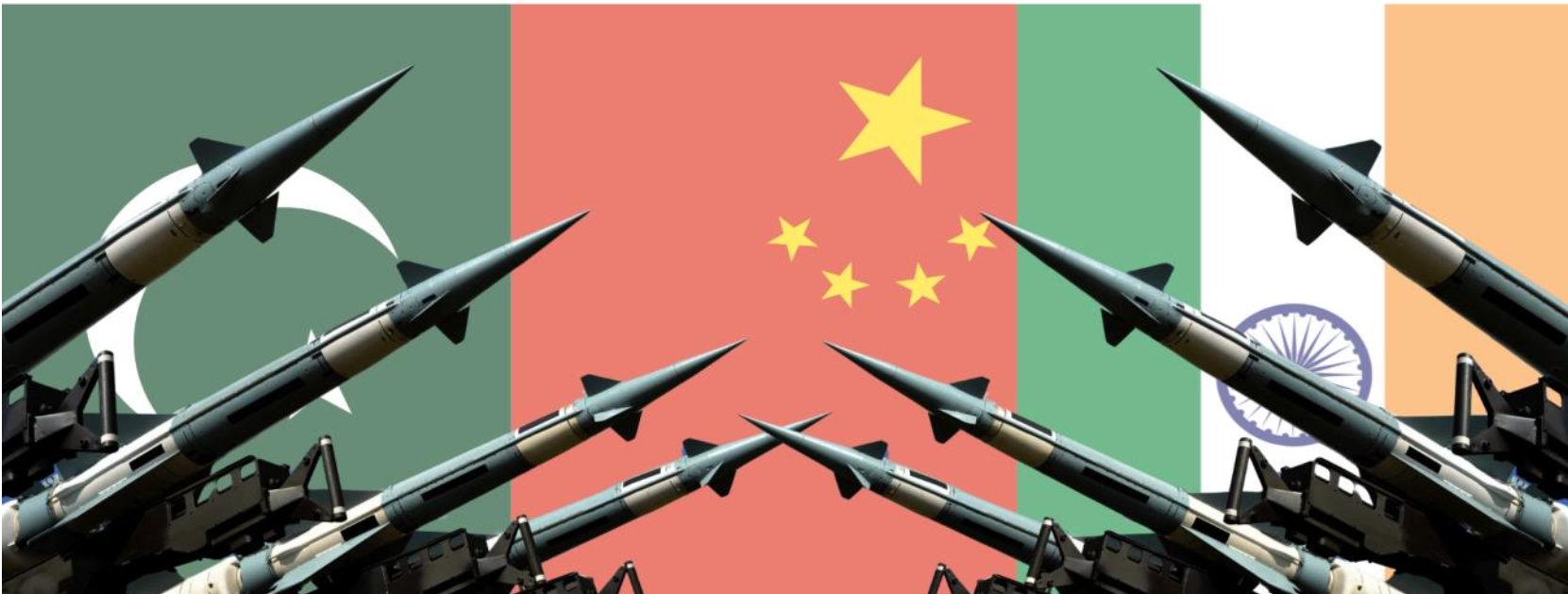
The image depicts nuclear missiles positioned on both the Pakistan and India sides, with China placed in the center. The visual is intended to highlight China’s role as a central player in the ongoing nuclear arms race between India and Pakistan (Image Source: Canva-assisted rendering).
By Mahnoor Malik
“Higher than mountains, deeper than oceans, sweeter than honey.” These words often describe the Pakistan-China bond, but beneath the surface lies a troubling reality.[i] In this piece, I examine the consequences of China’s influence on Pakistan’s nuclear posture and provide recommendations for Pakistan to regain strategic autonomy and promote regional stability in South Asia.
China’s Expanding Role in Pakistan’s Nuclear Program
Since the 1970s, China has played a pivotal role in developing Pakistan’s nuclear capabilities, providing uranium enrichment technology, bomb designs, and delivery systems, like solid-propellant missiles.[ii] Today, this collaboration includes advanced technologies, such as Multiple Independent Reentry Vehicles (MIRVs), which allow a single missile to carry multiple conventional and nuclear warheads. For instance, Pakistan’s Ababeel missile owes much to Chinese expertise.[iii] In addition, Pakistan is the only country outside of China with full access to the BeiDou navigation satellite system, which enhances the precision of Raad II and Babur cruise missiles.[iv]
From these security developments, Pakistan ranks high on China’s strategic priorities. This partnership strengthens Pakistan’s nuclear deterrence against India, establishing a strategic balance, ensuring both countries adhere to the concept of mutually assured destruction. However, the reliance risks subordinating Pakistan’s nuclear policies and national security interests to China’s broader geopolitical ambitions.
India’s Response and the Arms Race
China’s support for Pakistan’s nuclear arsenal is intensifying the India-Pakistan rivalry. As of January 2024, Pakistan maintains approximately 170 nuclear warheads, while India has increased its stockpile to an estimated 172 nuclear warheads, surpassing Pakistan for the first time.[v] Estimates suggest that India has produced enough military plutonium for 130 to 210 nuclear warheads, indicating a rapidly growing arsenal.[vi] Both nations heavily invest in nuclear modernization and continue to refrain from signing the Non-Proliferation Treaty (NPT). In 2021, each country conducted 26 missile tests, underscoring the ongoing tit-for-tat escalation. Escalating Indo-China tensions, particularly along the disputed Himalayan border, have prompted New Delhi to prepare for a potential two-front conflict, with China in the north and Pakistan in the west. This strategic recalibration has further amplified India’s defense posture. China’s advancement of Pakistan’s nuclear capabilities exacerbates regional competition pushing India to rapidly modernize, enhancing the cycle of destabilization.
The 2019 Balakot crisis exemplifies the volatility of the India-Pakistan rivalry.[vii] After a suicide bombing in Kashmir, India conducted airstrikes in Pakistan, prompting Islamabad to retaliate by shooting down an Indian fighter jet. Amid the standoff, Pakistan’s National Command Authority issued a veiled nuclear threat, warning of “dire consequences” for regional peace. Former U.S. Secretary of State Mike Pompeo later revealed that the two countries came dangerously close to nuclear war during the crisis.[viii]
What is an even greater threat than nuclear weapons? That which makes the use of them possible – entrenched animosity and mistrust between India and Pakistan. The ongoing arms race places the region on a precarious hair-trigger alert. China’s growing influence over Pakistan’s nuclear power only aggravates this volatile situation. The issue is not simply about the possession of nuclear weapons but the relentless pursuit of their advancement, bringing the region closer to a dangerous tipping point.
As both nations develop tactical nuclear weapons like Pakistan’s Nasr missile, the risk of miscalculation or preemptive strike grows, threatening billions of lives across South Asia.[ix]
China’s Contradictory Nuclear Policies
China’s nuclear policies reflect a striking contradiction. In Southeast Asia, Beijing promotes denuclearization, like the Treaty on the Southeast Asia Nuclear Weapon-Free Zone (SEANWFZ). Yet in South Asia, China actively fuels instability by bolstering Pakistan’s nuclear arsenal.
This contradiction reveals Beijing’s strategic interests. By supporting Pakistan, China ensures that India remains preoccupied with its western border, diverting attention away from their Himalayan disputes with China and international security in the Indo-Pacific. For Beijing, Pakistan serves as both a strategic ally and a counterweight to India’s growing power.
The Cost of Dependency
Besides security, Pakistan heavily relies on China’s economic assistance. Under the China-Pakistan Economic Corridor (CPEC), Pakistan accumulated approximately $26.6 billion in debt to China,[x] constituting about one-third of the country’s total external debt, which exceeds $100 billion.[xi] This financial burden limits Islamabad’s ability to diversify its alliances and undermines its policy autonomy.
Diplomatically, Pakistan’s dependency on China has strained its relations with the United States. U.S. missile sanctions laws and export control laws restrict Pakistan’s access to advanced U.S. technologies, further pushing it into Beijing’s orbit.[xii] In December 2024, the United States imposed additional sanctions on four Pakistani entities, including the state-run National Development Complex (NDC), for advancing its long-range ballistic missile program, such as the development of Shaheen missiles.[xiii]
Pakistan’s autonomy in foreign policy is also constrained, limiting its ability to diversify alliances outside of China. For example, the 2005 Treaty of Friendship, Cooperation, and Good Neighborly Relations between China and Pakistan,[xiv] stipulates:
“Neither signatory shall join any alliance or bloc detrimental to the other side’s sovereignty, security, and territorial integrity, or take any action of this nature, including signing any treaty of this nature with a third country. Neither signatory shall permit any third country to use its territory to impair the other signatory’s national sovereignty, security, and territorial integrity.”
This clause places Pakistan in a challenging position against the backdrop of growing U.S.-China competition and China’s strategic rivalry with India. For China, Pakistan serves as a counterbalance to India’s strive to influence in the Indo-Pacific and an endorsement of broader U.S. strategic interests.
Breaking the Cycle of Dependency and Escalation
To safeguard its strategic autonomy and promote regional stability, Pakistan should balance its relationship with China by diversifying its international alliances. Rebuilding ties with the United States could reduce economic and strategic dependence on Beijing. Notably, China’s Global Security Initiative (GSI) emphasizes global security cooperation but does not explicitly address the specific security concerns of Pakistan, or even South Asia.[xv] The GSI overlooks tensions in South Asia, potentially conflicting with its stated goal of promoting arms control.
Engaging India in dialogue is equally crucial. Confidence-building measures, such as no-first-use agreements or limits on tactical nuclear weapons, could reduce the risk of miscalculation and de-escalate tensions. While challenging, such measures are essential to breaking South Asia’s dangerous cycle of dependency and escalation. South Asia cannot afford another Balakot moment; the stakes are too high. Decisive action now can prevent a catastrophic future.
[i] “Pak-China Friendship Is Higher than Mountains, Deeper than Ocean and Sweeter than Honey: PM.” 2010. The Nation. December 19, 2010. https://www.nation.com.pk/19-Dec-2010/pakchina-friendship-is-higher-than-mountains-deeper-than-ocean-and-sweeter-than-honey-pm.
[ii] Lalwani, Sameer. 2023. “A Threshold Alliance: The China-Pakistan Military Relationship.” https://www.usip.org/sites/default/files/2023-03/sr-517_threshold-alliance-china-pakistan-military-relationship.pdf.
[iii] “Ababeel.” n.d. Missile Threat. https://missilethreat.csis.org/missile/ababeel/.
[iv] Lalwani, “A Threshold Alliance”, 12.
[v] Kristensen, Hans, Matt Korda, and Eliana Johns. 2023. “Pakistan Nuclear Weapons, 2023.” Bulletin of the Atomic Scientists. September 11, 2023. https://thebulletin.org/premium/2023-09/pakistan-nuclear-weapons-2023/.
[vi] Kristensen, Hans, Matt Korda, and Eliana Johns. 2023. “Indian Nuclear Weapons, 2024.” Bulletin of the Atomic Scientists. September 11, 2023. https://thebulletin.org/premium/2023-09/pakistan-nuclear-weapons-2023/.
[vii] Kristensen, Hans, Matt Korda, and Eliana Johns. 2023. “Pakistan Nuclear Weapons, 2023.” Bulletin of the Atomic Scientists. September 11, 2023. https://thebulletin.org/premium/2023-09/pakistan-nuclear-weapons-2023/.
[viii] “India, Pakistan Came close to a Nuclear War in 2019: Pompeo.” 2023. Www.aljazeera.com. January 25, 2023. https://www.aljazeera.com/news/2023/1/25/india-pakistan-came-close-to-a-nuclear-war-in-2019-pompeo.
[ix] Noor, Sitara . 2023. “Pakistan’s Evolving Nuclear Doctrine | Arms Control Association.” www.armscontrol.org. October 2023. https://www.armscontrol.org/act/2023-10/features/pakistans-evolving-nuclear-doctrine.
[x] Janjua, Haroon. 2024. “How Chinese Loans Trapped Pakistan’s Economy.” Dw.com. Deutsche Welle. August 2, 2024. https://www.dw.com/en/how-chinese-loans-trapped-pakistans-economy/a-69841139.
[xi] Amir, Adnan. 2024. “Pakistan and China’s Diplomatic Relations Reach a Low Ebb | Lowy Institute.” Lowyinstitute.org. 2024. https://www.lowyinstitute.org/the-interpreter/pakistan-china-s-diplomatic-relations-reach-low-ebb.
[xii] China, U.S Mission. 2024. “United States Continues to Impose Sanctions on Suppliers to Pakistan’s Ballistic Missile Program.” U.S. Embassy & Consulates in China. September 13, 2024. https://china.usembassy-china.org.cn/united-states-continues-to-impose-sanctions-on-suppliers-to-pakistans-ballistic-missile-program/.
[xiii] Reuters. 2024. “US Imposes More Sanctions over Pakistan’s Missile Program,” December 18, 2024. .
[xiv] Barthwal, Namita. 2024. “China-Pakistan Military Cooperation Analysis of the Alliance and Its Implication on South Asia.” https://www.claws.in/static/Web-MP-103-China-Pakistan-Military-Cooperation-21-8-24.pdf.
[xv] “Report on the Implementation Progress of the Global Security Initiative.” 2024. China Institute of International Studies.
ABOUT AUTHOR/S

Mahnoor Malik
Mahnoor Malik is a master’s student in Global Governance, Politics, and Security at American University, specializing in South Asian security. Her research highlights South Asia’s growing nuclear arms race and how it impacts regional security dynamics.
Leave a Reply