
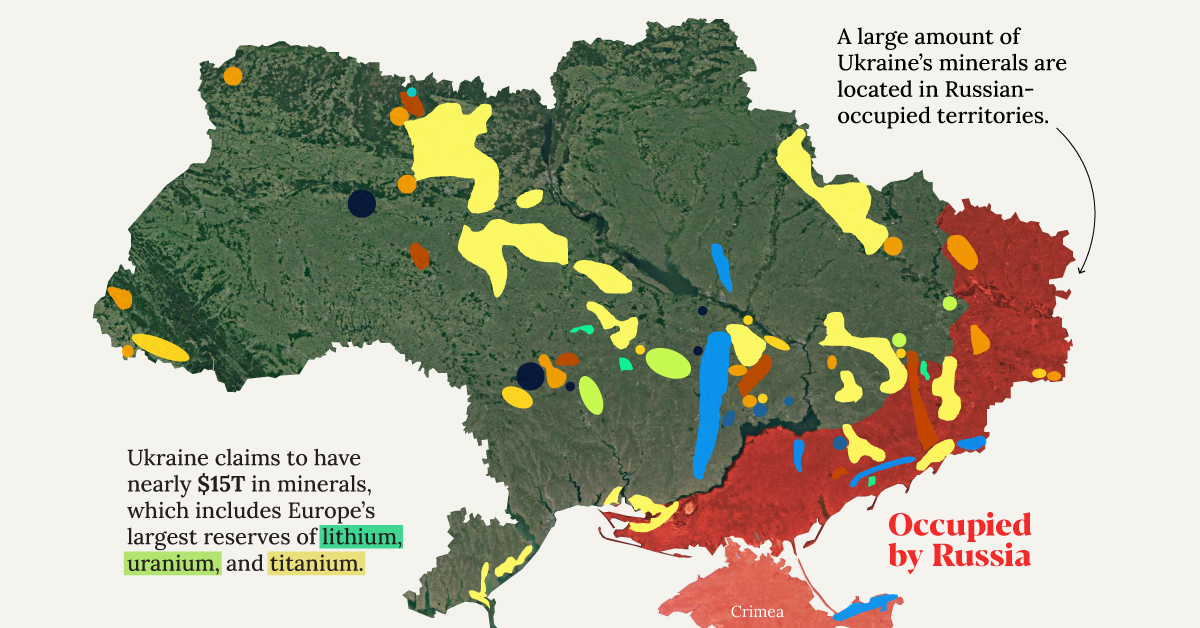
Ukraine’s vast mineral resources, including major reserves of lithium, titanium, uranium, graphite, and rare earth elements. (Image Source: Visual Capitalist; https://www.visualcapitalist.com/mapped-ukraines-mineral-resources/)
By Luca Mórocz (“Lucy”)
The Argument for Sovereignty and National Identity
The Russia-Ukraine war remains unresolved with three key factors shaping the trajectory: the balance of military power on the battlefield, economic and military support from Western allies, and Russia’s strategic plan for its occupied territories. Russia justifies its occupation of Ukrainian territories through historical claims, consistent with Carter and Abramson’s argument that old political borders create “sticky identities” influencing territorial disputes.[i] Putin’s narrative frames Ukraine as Russia’s historical sphere, asserting that the Donetsk, Luhansk, Zaporizhzhia, and Kherson oblasts naturally belong to Russia. Since 2014, Putin has used the term “Novorossiya” “New Russia” to refer to eastern and southern Ukraine, including Odesa, Crimea and the entire Black Sea region, claiming these areas as part of Russia.[ii] Putin justifies these claims by referencing Soviet-era borders and the presence of ethnic Russian populations.[iii] Ukraine, in contrast, cites its 1991 independence referendum as its borders’ legal foundation, reiterating its distinct national identity and sovereignty.[iv]
As the war progressed, Ukraine’s population unified, contradicting Russia’s assumption that it could divide Ukraine through force. According to Hensel and Mitchell, conflicts over intangible territorial stakes – such as national identity and sovereignty – tend to escalate more violently and resist diplomatic resolution.[v] Ukraine’s resistance has reinforced its national identity, making territorial concessions politically unacceptable. The intractability narrows the zone of possible agreement for a resolution as identity-driven conflict often leaves little room for mutually accepted negotiation outcomes. This has been the mainstream explanation for much of the war’s course and a core component of the intractability in recent negotiations, but this is only one aspect of the complexity of ending the war.
The Shift to Economic Diplomacy
Instead of focusing on conceding territory, Ukraine is leveraging its critical mineral resources to strengthen its bargaining power with the West. This strategy could be appealing to both the EU and the U.S., since they are heavily reliant on imports of critical minerals from China and Russia.[vi] Dependence on these nations is problematic not only due to their authoritarian regimes but also because it poses significant geopolitical risks, including supply chain disruptions and economic coercion. China controls 85-90% of rare earth element –part of the group of critical minerals– production and 92% of rare earth magnet manufacturing, granting its immense leverage over industries crucial to defense, technology, and renewable energy.[vii]
Ukraine holds 5% of the world’s total mineral reserves of 116 different types.[viii] The U.S.-Ukraine security-for-minerals agreement, proposed in February 2025 by the Trump administration, highlights the geoeconomic dimension of the war, concentrating Ukraine’s post-war reconstruction strategy on securing long-term economic benefits. The EU has been pursuing a strategic partnership with Ukraine since 2021, through an MoU, aimed at diversifying resources and aligning Ukraine mining standards with EU regulations.[ix] The security-for-minerals approach signals a strategic rebalancing between the U.S.-EU partnership, as Western actors may compete for influence over Ukraine’s resources. The deal would allow Ukraine to leverage its mineral and other resources to pay for military aid the United States previously provided, while strategic integration of Ukraine’s minerals into EU supply chains would strengthen support for EU membership aspirations.
Geoeconomic Leverage and Security Implications for the West
The strategic shift aligns with Altman’s[x] fait accompli theory, which argues that modern territorial conflicts are no longer about full-scale annexations but about securing small, irreversible advantages. Ukraine is now employing a geoeconomic version of fait accompli—leveraging its critical minerals to lock in long-term Western commitments. Rather than solely relying on military victories, Ukraine’s leadership is integrating resource diplomacy into its wartime strategy, forcing Western allies to compete for post-war economic partnerships.
Ukraine’s war is no longer just a fight for sovereignty and national identity—it is a fight for economic survival and strategic relevance. However, the West cannot expect Ukraine to supply critical minerals while leaving its security uncertain. The current framework does not include security guarantees for Ukraine.[xi] If the U.S., EU, and their allies want to benefit from Ukraine’s vast resources, they must guarantee its long-term stability with concrete security commitments. The West can commit to Ukraine’s security by going beyond short-term military aid and ensuring Ukraine is fully integrated into Western supply chains and economic alliances through coordinated effort from both the EU and the U.S. to support Ukraine’s secure economic development. A failure to do so would not only leave Ukraine economically and strategically vulnerable, but allow China and Russia to exploit the very resources that are vital to securing the West’s technological future. The struggle for Ukraine’s future is no longer just about battlefields and borders—it is about who controls the resources that will shape the future European landscape.
[i] Scott Abramson and David B. Carter, “The Historical Origins of Territorial Disputes,” American Journal of Political Science 60, no. 4 (2016): 675-680, 696.
[ii] Christina Harward, Karolina Hird, Nicole Wolkov, George Barros, and Frederick W. Kagan with William Runkel, “Russian Offensive Campaign Assessment, March 22, 2025” (Institute for the Study of War, March 22, 2025), accessed March 27, 2025, https://understandingwar.org/backgrounder/russian-offensive-campaign-assessment-march-22-2025
[iii] Intigam Mamedov, “Russian Strategic Narrative: From Viability to Fragility,” Media, War & Conflict (July 26, 2024): 1-20, https://journals.sagepub.com/doi/10.1177/17506352241264436
[iv] Commission on Security and Cooperation in Europe, The December 1, 1991 Referendum/Presidential Election in Ukraine (Washington, D.C.: Commission on Security and Cooperation in Europe, 1992), https://www.csce.gov/wp-content/uploads/2016/06/120191UkraineReferendum.pdf
[v] Hensel, Paul, and Sara Mitchell. “Issue Indivisibility and Territorial Claims.” International Studies Quarterly 49, no. 1 (2005): pp.275-278, 282-283
[vi] Bruno Venditti, “Energy Shift: Visualizing Europe’s Dependence on Chinese Resources,” Visual Capitalist, January 21, 2025. Graphics/Design by Sam Parker.
[vii] Nataliya Katser-Buchkovska, “The Future of Critical Raw Materials: How Ukraine Plays a Strategic Role in Global Supply Chains,” World Economic Forum, July 9, 2024, https://www.weforum.org/.
[viii] Nataliya Katser-Buchkovska, “The Future of Critical Raw Materials: How Ukraine Plays a Strategic Role in Global Supply Chains,” World Economic Forum, July 9, 2024, https://www.weforum.org/.
[ix] Memorandum of Understanding between the European Union and Ukraine on a Strategic Partnership on Raw Materials. PDF file. Accessed April 12, 2025. file:///Users/lucamorocz/Downloads/Memorandum%20of%20Understanding%20between%20the%20European%20Union%20and%20Ukraine%20on%20a%20Strategic%20Partnership%20on%20Raw%20Materials.pdf
[x] Altman, Dan. “The Evolution of Territorial Conquest After 1945 and the Limits of the Territorial Integrity Norm.” International Organization 74, no. 3 (2020): pp.490-518
[xi] Exclusive: The Full Text of the U.S.-Ukraine Mineral Agreement.” Kyiv Independent, February 27, 2025. https://kyivindependent.com/exclusive-the-full-text-of-the-final-us-ukraine-mineral-agreement/
ABOUT AUTHOR/S

Luca Mórocz (“Lucy“)
Luca Mórocz (“Lucy”) is a former diplomat and currently a graduate student in the Global Governance, Politics, and Security (GGPS) Program, studying on a scholarship awarded by the Hungarian American Coalition. She has expertise in security policy and U.S.–Central Eastern European relations, having served at the U.S. Department of State through a Hungarian diplomatic assignment.
Leave a Reply