
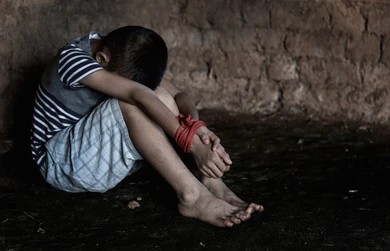
A trafficked boy tied with rope. (Image Source: Photograph by HTWE via Shutterstock; https://www.shutterstock.com/image-photo/kidnapped-little-boy-tied-rope-tortured-1523488403)
By Jeffrey M. Jordan, II
Introduction
Sex trafficking is often framed as an issue that predominantly affects women and girls, leaving a gap in legal protections and social recognition for male victims. With all the evidence and studies available today, the question must be asked; what about our boys? While women and girls remain the majority of trafficking victims, growing evidence suggests that boys and men are also trafficked in alarming numbers, yet they are frequently overlooked in both legal frameworks and advocacy efforts.[i] International law must evolve to ensure that male victims receive the same protections and resources as their female counterparts, challenging the stigma that trafficking is solely a women’s issue. This op-ed explores the necessity for legal reform and societal change, drawing on key sources to highlight the importance of inclusivity in anti-trafficking efforts.
The Underreported Reality of Male Sex Trafficking
Despite growing awareness of human trafficking, male victims remain significantly underreported and underserved. According to a report by the United Nations Office on Drugs and Crime, approximately 39% of all detected trafficking victims worldwide in 2022 were male, comprising 23% adult men and 16% boys.[ii] Cultural and societal biases contribute to this lack of recognition, as many assume that men are less vulnerable to exploitation. The stigma surrounding male victimhood, particularly in cases of sexual exploitation, often prevents men and boys from seeking help. An example of this can be identified through Jerome Elam, whose mother used him for child pornography and eventually sex trafficking. Elam stated that: “I had tried to tell at least ten people that I was being trafficked. My reward for this was having three of my ribs broken.”[iii] These acts of violence and silencing endured by male victims further reinforces the perception that sex trafficking is solely a women’s issue.
Likewise, a study published by the International Organization for Migration underscores the lack of resources available for male trafficking survivors. Many shelters, rehabilitation programs, and legal assistance services are specifically designed for women, leaving men without access to necessary support.[iv] The failure to acknowledge male victims not only limits their recovery but also allows traffickers to continue operating without sufficient deterrence. In this context, reforming international law to explicitly recognize and protect male victims is a crucial step toward developing a more equitable and effective response to trafficking.
Legal Gaps and the Need for Inclusive Policies
One of the primary challenges in addressing male sex trafficking is the inadequacy of existing international legal frameworks. The United Nations Protocol to Prevent, Suppress and Punish Trafficking in Persons, Especially Women and Children (commonly known as the Palermo Protocol) has been instrumental in shaping global anti-trafficking efforts. However, its language and implementation have disproportionately focused on women and girls, reinforcing the perception that men are not primary victims.[v]
While the Palermo Protocol acknowledges trafficking as a gender-neutral crime, many national governments interpret it narrowly, allocating resources almost exclusively to female victims. One example can be identified from Sierra Leone where trafficking experiences of men and boys have received less attention and support.[vi] This gendered focus in anti-trafficking measures means that male victims may not be adequately identified, and lack specialized services tailored to address their needs.[vii] In addition, China’s anti-trafficking laws have concentrated on the abduction and sale of women and children, often overlooking other forms of exploitation and male victims like Chinese nationals being lured to regions like Myanmar under false pretenses and coerced into trafficking.[viii] This selective application creates a dangerous precedent, leaving male victims with limited legal recourse. In addition, the Palermo Protocol states that a victim’s consent is irrelevant if any means such as coercion, fraud, or abuse of power are used.[ix] Despite this, countries like Moldova still factor in the victim’s consent, potentially hindering prosecutions.[x] Comprehensive reform should include clear guidelines on identifying and assisting male trafficking survivors, ensuring that international law protects all victims equally.
Additionally, male victims of trafficking often face unique legal barriers that hinder their ability to seek justice. In many countries, male survivors of sexual exploitation are treated as perpetrators rather than victims due to deeply ingrained gender norms. For example, in some legal systems, laws against prostitution and sodomy have been used to criminalize trafficked boys and men instead of offering them protection.[xi] This victim-blaming approach must be addressed through legal reforms that guarantee non-criminalization clauses for all trafficking survivors, regardless of gender.
Changing Societal Perceptions and Breaking the Stigma
Beyond legal reforms, shifting societal attitudes toward male trafficking victims is essential for meaningful progress. The persistent stigma surrounding male victimhood often prevents survivors from coming forward, fearing ridicule or disbelief. This stigma is particularly pronounced in cultures that equate masculinity with strength and invulnerability, making it difficult for men to admit and disclose experiences of exploitation.
A crucial step towards breaking this stigma can be taken by increasing public awareness through education and media representation. Advocacy organizations and international bodies must work actively to dispel misconceptions by highlighting real-life cases of male trafficking survivors and their experiences. Likewise, the media needs to play a significant role in challenging stereotypes and ensuring that male victims are represented in discussions on human trafficking.
Furthermore, service providers and law enforcement agencies must be trained to recognize and respond to cases of male trafficking with the same level of urgency and compassion afforded to female victims. Many front-line responders are unaware of the specific challenges male survivors face, leading to misidentification and inadequate support. International agencies should mandate specialized training programs to ensure that all victims receive the help they need, and that the same amount of care is provided.
We Can Only Win Through Recognition
The fight against human trafficking cannot be truly effective unless it recognizes and addresses the experiences of all victims, including boys and men. Reforming international law to explicitly include protections for male trafficking survivors is a necessary step in achieving justice and equity in anti-trafficking efforts in addition to fighting against narrow application in cross-border scenarios. Equally important is, breaking the societal stigma surrounding male victimhood, both to encourage survivors to seek help and ensure the fair distribution of resources. By acknowledging that sex trafficking is not exclusively a women’s issue, the global community can take meaningful strides toward a more inclusive and effective approach to combating this grave human rights violation. Our human rights goals can’t be accomplished without protecting our boys.
Works Cited
Anne T. Gallagher, The International Law of Human Trafficking (Cambridge: Cambridge University Press, 2010).
International Organization for Migration. “Policy Brief: The Gender Dimension to Trafficking in Persons.” September 2024. Accessed March 29, 2025. https://www.iom.int/sites/g/files/tmzbdl2616/files/documents/2024-09/policy-brief-the-gender-dimension-to-tip_final.pdf.
International Organization for Migration. (n.d.). Shelter and settlements. Retrieved April 14, 2025, from https://www.iom.int/shelter.
NYU Law Global. “Human Trafficking.” GlobaLex. Hauser Global Law School Program, May 2021. Accessed March 28, 2025. https://www.nyulawglobal.org/globalex/human_trafficking1.html.
United Nations Office on Drugs and Crime (UNODC). (2022). Global Report on Trafficking in Persons. Retrieved from GLOTiP_2022_web.pdf.
United Nations Office on Drugs and Crime. Global Report on Trafficking in Persons 2024. Vienna: United Nations, 2024. https://www.unodc.org/documents/data-and-analysis/glotip/2024/GLOTIP2024_BOOK.pdf.
United Nations Office on Drugs and Crime (UNODC). 2024. Human Trafficking FAQs. Accessed April 14, 2025. https://www.unodc.org/unodc/en/human-trafficking/faqs.html.
United Nations Office on Drugs and Crime. “Survivor Stories – Jerome Elam.” Last modified 2021. https://www.unodc.org/unodc/en/endht/2021/survivor-stories—jerome-elam.html.
[i] United Nations Office on Drugs and Crime (UNODC). 2024. Human Trafficking FAQs. Accessed April 14, 2025. https://www.unodc.org/unodc/en/human-trafficking/faqs.html.
[ii] United Nations Office on Drugs and Crime. Global Report on Trafficking in Persons 2024. Vienna: United Nations, 2024. https://www.unodc.org/documents/data-and-analysis/glotip/2024/GLOTIP2024_BOOK.pdf.
[iii] United Nations Office on Drugs and Crime. “Survivor Stories – Jerome Elam.” Last modified 2021. https://www.unodc.org/unodc/en/endht/2021/survivor-stories—jerome-elam.html.
[iv] International Organization for Migration. (n.d.). Shelter and settlements. Retrieved April 14, 2025, from https://www.iom.int/shelter
[v] Anne T. Gallagher, The International Law of Human Trafficking (Cambridge: Cambridge University Press, 2010).
[vi] International Organization for Migration. “Policy Brief: The Gender Dimension to Trafficking in Persons.” September 2024. Accessed March 29, 2025. https://www.iom.int/sites/g/files/tmzbdl2616/files/documents/2024-09/policy-brief-the-gender-dimension-to-tip_final.pdf.
[vii] International Organization for Migration. “Policy Brief: The Gender Dimension to Trafficking in Persons.” September 2024.
[viii] NYU Law Global. “Human Trafficking.” GlobaLex. Hauser Global Law School Program, May 2021. Accessed March 28, 2025. https://www.nyulawglobal.org/globalex/human_trafficking1.html.
[ix] Anne T. Gallagher, The International Law of Human Trafficking. 2010.
[x] United Nations Office on Drugs and Crime (UNODC), Human Trafficking FAQs. 2024.
[xi] Anne T. Gallagher, The International Law of Human Trafficking. 2010.
[xvii] “Department of Agriculture.” 2024. Doanepal.gov.np. 2024. https://doanepal.gov.np/downloadsdetail/3/2018/44178961/.
ABOUT AUTHOR/S

Jeffrey M. Jordan, II
Jeffrey M. Jordan, II is an American Lawyer and Civil Rights Policy Researcher with a M.A. in International Affairs: Global Governance, Politics, and Security at American University, Washington, D.C. He has research experience on Multilateralism in the United Nations System, International Law Reform, Pro-Democracy Advocacy, and Lobbying.
Leave a Reply