
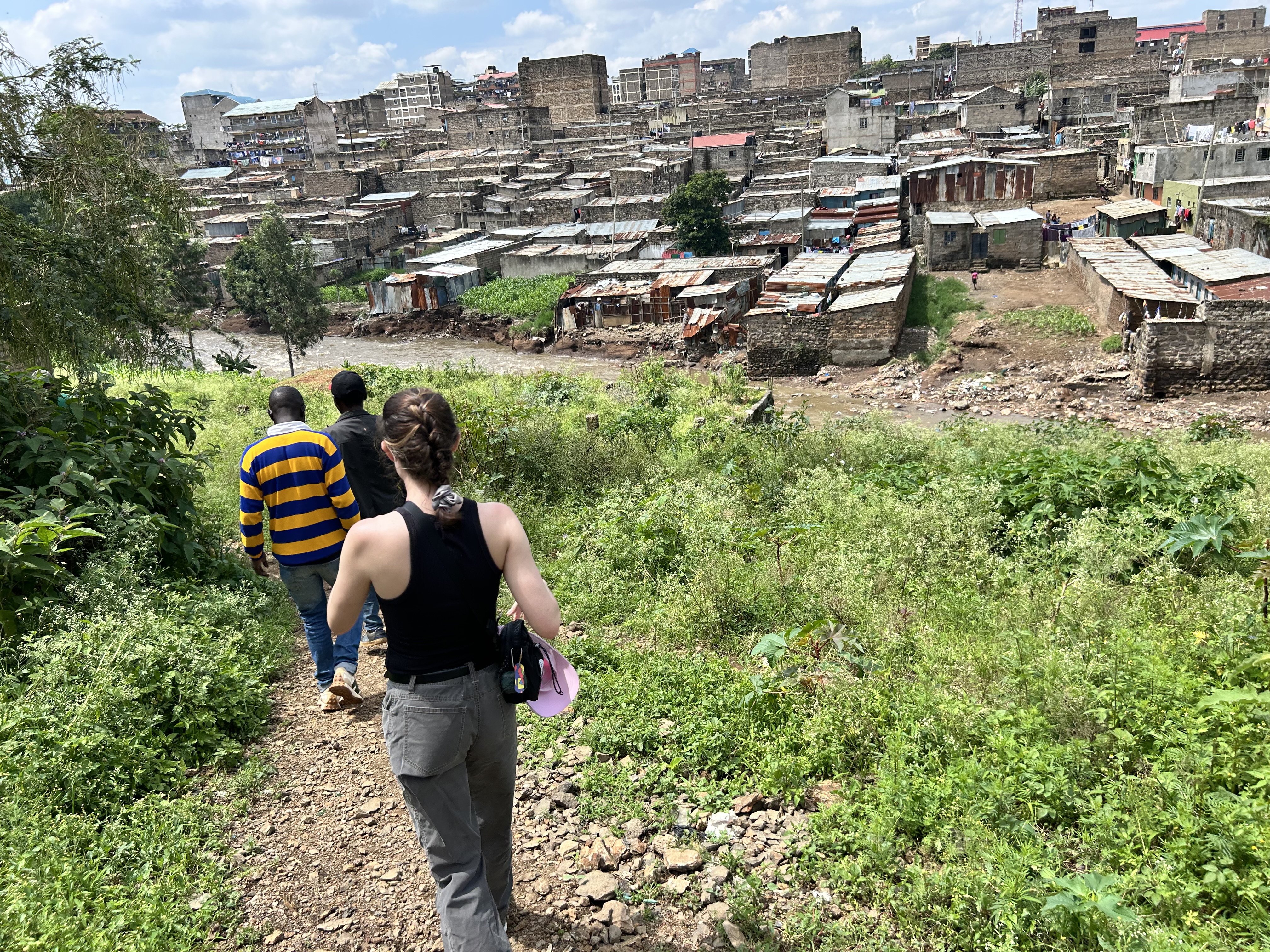
The photo is showing a section of the Lucky Summer Settlement in Nairobi, Kenya. (Source: Colleen Cohen)
“We must work together and build bridges and synergies that will turn Kenya into a country of opportunities.” – William Samoei Ruto, President of the Republic of Kenya
By Colleen Cohen
Abstract
Traditional top-down development approaches have historically failed to address Kenya’s informal settlements’ unique needs and complexities. Despite Kenya’s history of receiving foreign aid, substantive development has remained elusive, particularly in informal settlements where 71% of the urban population resides. Community-led initiatives offer a promising alternative by empowering community members to drive sustainable change. This paper demonstrates how locally driven efforts can effectively address critical issues and promote substantive development by examining the role of community-led development in enhancing climate resilience, water sustainability, and healthcare outcomes.
Introduction
Kenya, with a population of 55 million, stands as a major economic force on Africa’s east coast.[1] The port of Mombasa, along with favorable regional trade agreements, has cemented Kenya’s reputation as East Africa’s key economic and commercial hub. Since the 2008 financial crisis, Kenya has continued to experience steady economic growth, with real GDP expanding on average by about 5.6%over the last five years (2014-2018), highlighting the country’s sustained economic stability and notable advancements in its business environment.[2] However, the country faces significant challenges, particularly in its informal settlements. Informal settlements in Kenya emerged due to the need for more affordable housing and limited opportunities for African residents. According to Pashayan, informal settlements are generally defined as highly populated urban areas with no infrastructure for human habitation.[3] They are densely packed with dwelling units constructed with weak materials of poor quality. These settlements are home to thousands of people.
These issues are intensified by the impacts of climate change, which disproportionately affect vulnerable populations. Traditional top-down development approaches have often failed to address these communities’ unique needs and complexities, but local communities can turn the tide via community-led initiatives.[4] Community-led development can emerge as a promising alternative, empowering local communities to take charge of their development. It is a bottom-up approach where local communities lead in identifying, planning, and implementing projects that address their specific needs and priorities.[5] This approach is rooted in the principles of participation, inclusivity, and empowerment, ensuring that development initiatives are locally relevant and sustainable.
Historical Context
More than 34% of Kenya’s total population lives in urban areas, and more than 71% live in informal settlements.[6] Informal settlements have a history rooted in colonial policies, as during the colonial era, natives in Kenya were considered temporary residents of Nairobi and could only live there as registered laborers. According to R.A. Obudho and G.O. Aduwo, Kenyans were forced to live in dormitory-like working quarters, and despite restrictions, some managed to construct informal settlements on unused land.[7] These informal settlements were periodically destroyed, but the population continued to grow. After Kenya gained independence in 1963, Kenyans moved to Nairobi in search of employment opportunities, leading to rapid population growth. The lack of housing and basic infrastructure fueled the expansion of informal settlements. The evolution of informal settlements in Kenya’s urban centers can be traced through three periods: the colonial period, post-independence up to 1974, and the mid-1970s to the present.[8] Residents of these settlements named these neighborhoods, reflecting historical injustices and urban inequalities. The names often carry deep meaning connected to the struggles they face, as well as the marginalization and exclusion that characterize their origins. After independence, rapid urbanization without sufficient planning and equitable distribution of resources led to the growth of these informal settlements. The names given to these areas also reflect the perception of abandonment by the state, with residents often being viewed as squatters or illegal settlers despite generations of occupancy. One notable informal settlement in Nairobi is Kibera, which is one of the largest informal settlements in Africa.[9] Kibera originated in the early 20th century when British authorities granted Kenyan soldiers the right to settle on public land near the railway.[10] Today, Kibera serves as a temporary refuge for rural migrants seeking work in the city, representing the intersection between rural and urban life. Mukuru is another informal settlement that emerged due to housing shortages and migration. Its name is derived from the Kikamba word “mukurumo,” meaning “squish” or “to crowd together.”[11]
Why Push for Community-Led Development?
Kenya has a history of receiving foreign aid to address poverty and underdevelopment. However, over the years, aid has not had a sustainable impact on informal settlements. According to Müller, over the past four decades, sub-Saharan African countries, including Kenya, have received foreign aid to alleviate poverty and promote development.[12] In 2020, global foreign aid amounted to $194.1 billion, with Kenya receiving over $3 billion.[13] Yet, based on field research carried out by this author in Kenya, discussions with local people exposed that they are critical of foreign aid, and question its effectiveness and impact. They lamented that persistent underdevelopment can be attributed to (1) top-down approaches that often overlook the unique needs and contexts of the local communities, which has led to initiatives that are ill-suited to addressing ground realities; and (2) a significant portion of aid and development efforts being driven by external agendas rather than prioritizing sustainable, community-driven solutions. The disconnect between international interventions and local priorities perpetuates a cycle of dependency and underdevelopment, which prevents meaningful and sustainable progress in Kenya. Communities, however, have been championing community-led development, and evidence indicates that this may be a successful and viable means for sustainable development in Kenya.
Community-Led Development in Climate Change
In the Mukuru settlement, community-led development plays a significant role in climate resilience. Mukuru, along with other informal settlements, is vulnerable to the effects of climate change, including flooding, heat waves, and drought.[14] However, community leaders and community members work assiduously to enhance community resilience by integrating local knowledge and practices to develop context-specific adaptation strategies. According to the World Economic Forum 2023, science is equally clear that we cannot meet the goals of the Paris Climate Agreement without the conservation and restoration of nature.[15] Community members in Mukuru understand this well, as they actively cultivate land to grow crops, maintain gardens, and plant trees to restore nature as part of their efforts to combat climate change.[16] The produce from these activities is used in their community kitchens to provide meals for community members and is also sold, and earnings are reinvested into local initiatives as a means to help with food insecurity in the community.[17] Recently Kenya faced severe floods that impacted the Mukuru settlements and community garden.[18] However, the community’s determination to build back stronger enabled them to receive the support they needed to save the garden. According to the community gatekeeper, government soldiers were ordered to demolish housing and infrastructure affected by the floods near the riverbank. However, the gatekeeper stood up to the soldiers and emphasized the importance of the community garden in climate resilience. The gatekeeper’s logic reached the relevant authorities, resulting in an order to spare the garden. The community also secured approval to expand the garden along the riverbank, not only increasing food production but also serving as a natural barrier against future flood-related erosion. Nature-based solutions, such as these, offer cost-effective and readily available methods to address climate challenges, providing up to a third of the measures needed to mitigate climate change. Among these solutions, trees and forests play a pivotal role by regulating local weather patterns and influencing the global climate. Protecting existing forests, restoring those that have been lost, and rehabilitating degraded forested lands are vital steps in the global effort to combat climate change.[19] Despite the devastation and near government intervention, the resilience of the community members demonstrated their strength and influence at the local level.
Moreover, Mukuru’s commitment to community-led climate resilience projects is well-suited to be a beneficiary of the World Bank’s Community-led Climate Resilience Program in Kenya. The purpose of this program is to build sustainable and resilient communities by fostering collaboration, integrating climate strategies into local development plans, and sharing insights on best practices. It also aims to ground climate policies in local knowledge and needs, build local institutions to support preparedness and recovery, and invest in climate solutions tailored to unique circumstances and needs.[20] The World Bank recently approved a US$150 million Community-led Climate Resilience program to support community-driven, locally-led climate resilience initiatives across rural Kenya.[21] While the Mukuru settlements are situated in urban, rather than rural, Kenya, they are strong candidates for inclusion in such a program. The initiative aims to enhance the capacity of Kenya’s county and national governments to manage climate risks effectively. Given the severe impact of climate change, particularly the devastating floods frequently affecting informal urban settlements like Mukuru, these areas should also be considered for inclusion in the program to build resilience and address their unique vulnerabilities.
According to Keith Hansen, World Bank Country Director for Kenya, Kenya has demonstrated leadership in establishing a policy framework to manage climate risk though climate action is still underfunded.Therefore, the approved financing from the World Bank will support the Government of Kenya in meeting its climate commitments to increase financing for climate action and particularly ensure climate financing and actions reach local communities.[22] Moreover, through the World Bank involving local communities, Kenya will take a gigantic step toward a more sustainable and climate-resilient future (See Appendix A).
Community-Led Development in Water Sustainability and Sanitation
In addition, with 85% of its land classified as arid and semi-arid, Kenya faces significant challenges in ensuring sustainable drinking water, sanitation, and hygiene services.[23] The UNICEF and WHO Joint Monitoring Program (JMP) report does not include informal settlements but indicates inequality in access between urban and rural areas in the sphere of sanitation. 57% of urban areas and 29% of rural areas have access to safely managed essential water services.[24] Communities in informal settlements can be empowered to take action for the sustainable conservation of water resources, and building partnerships with government and local organizations can further advance these efforts.
A study by the World Bank highlights the importance of community participation in water management.[25] It emphasizes that successful engagement depends on the relationship between frontline government workers and water users. These local relationships influence how projects are initiated, leading to greater impact and they facilitate the spread of information and increase awareness about water management techniques and conservation practices. When trusted community leaders endorse and communicate project goals, it often leads to higher levels of adoption and compliance. Therefore, sustainable management becomes possible when community actors collaborate effectively with frontline service providers.[26]
One example can be found on the outskirts of Nairobi, where sustainable water management is seen in the work of Majik Water. Majik Water is a social enterprise NGO specializing in air-to-water technologies in arid and semi-arid regions.[27] Through sustainable clean water solutions, they produce over 200,000 liters of water for over 1,900 people in Kenya and other African countries like South Africa.[28] Majik Water’s innovative approach allows the company to generate water from air anywhere. The program’s affordability and accessibility contribute directly to community development by improving health, sanitation, and overall well-being. Important to note that Majik Water is addressing water scarcity in Kenya’s informal settlements by establishing decentralized water sources, which grant communities direct access to clean drinking water without relying on centralized infrastructure. According to Koigi, for the past four years, Majik Water has established a water system in Kibera to support the community in its water scarcity crisis. Majik Water’s commitment to community development increases its potential to bridge water inequality between urban communities and informal settlements. (See Appendix B)
Community-Led Development in Health
Community-led healthcare initiatives have proven highly effective in improving health outcomes as services are tailored to local communities’ specific needs and cultural contexts, increasing accessibility and acceptance of services.[29] At this intersection, the meso-level of development can play a major role in advancing healthcare in informal settlements. The meso-level in the context of development refers to the intermediate level between the macro (national or international) and the micro (individual or community) levels.[30] It involves institutions and organizations that operate within a region or a sector, playing a vital role in bridging the gap between policy and practice. To advance community-led development in informal settlements, meso-level actors such as the local government, NGOs, community-based organizations, and regional development agencies can collaborate to translate policies into actionable programs and ensure the requisite resources and support reach the community level effectively. The bottom-up approach at the meso-level of development has proven to be effective in Kenya’s informal settlements as it has identified and utilized traditional practices and local health workers to make healthcare delivery more efficient.
Findings from the field research conducted by this author at Ilara Health Center and the Ruben Health Center is a testament to how effectively blending bottom-up and meso-level approaches empowers community-led development in Kenya’s informal settlements. Ilara Health maintains a network of technology-enabled primary healthcare clinics that deliver affordable, quality healthcare to Kenya’s low to middle-income demographics. In the heart of Mathare North, another of Kenya’s informal settlements, Ilara Health has partnered with Provide Medical Center to deliver primary healthcare for community members. The residents of Mathare North stated that they feel a sense of community when they visit the medical center. This rings true, as Provide Medical Center works with community members on health initiatives that build stronger bonds and support networks between health workers and community members[31]. This cohesion has led to a more collaborative approach to tackling health challenges in Mathare North. According to Mbuthia, the center’s portable Butterfly IQ ultrasound has enabled the center to conduct its community outreach programs with ease. With this technology, the center can now serve more patients and share results directly via WhatsApp if needed. The tele-guidance feature of the innovative mobile imaging application has helped the center make accurate diagnoses with guidance from the center’s in-house Sonographer.
The Ruben Health Center in Mukuru also provides healthcare services to residents of the informal settlement in Mukuru. The center is managed by Christian brothers who built new and permanent structures to significantly improve the services they offer. The health center offers a wide range of services to the community, including outpatient services, nutrition services, an asthma clinic, a child welfare clinic, an antenatal clinic, cervical/breast cancer screening, laboratory services, ambulance services, a TB clinic, dental care, reproductive health, and a well-equipped pharmacy. In response to community needs, after a feasibility study, the health facility launched a maternity unit in May 2018, which provides free maternity services to expectant mothers in the informal settlement. The Maternal Clinic is one of the center’s most coveted initiatives. From May 2018 to May 16, 2024, the total number of mothers admitted was 6,483, the number of mothers delivered at the Ruben Center was 6,067, the number of mothers referred due to maternal issues was 462, and the number of babies delivered at Ruben Center was 6,085, (3,041 boys and 3,044 girls) with zero maternal deaths[32] The maternal clinic’s statistics from May 2018 to date prove that community-led development works. (See Appendix C)
The Ruben Health Center represents a beacon of hope in Kenya’s informal settlements, exemplifying Cooper’s [33] assertion regarding the multifaced roles of faith groups in development, such as delivering 70% of health services in African countries and advocating for human rights. The mission and objectives of the Ruben Health Center also resonate with Sen’s Capability Theory,[34] which posits that development should prioritize an individual’s ability to lead a meaningful life beyond mere wealth or well-being. Driven by a philosophy of humanity, encapsulated in Kenya’s Amnesty International #HumanIsMyIdentity campaign, the center enables the residents of Mukuru and neighboring communities to lead valuable and fulfilling lives.[35]
Kenya’s Youth for Kenya’s Development
The youth population holds the key to addressing Kenya’s development challenges, as young people can be trained and mentored in the development field to become effective community champions leading development projects. Kenya has a median age of 19 years, and about 80% of the country’s population is below the age of 35.[36] It is time for Kenya’s youth to reclaim their influence.[37] As youth advocates, they are well-positioned to lead, foster community learning to rediscover what has historically driven progress and re-envision a future that taps into the often-unseen potential within local communities.[38]
Kenyan youth are actively driving innovation, especially in fields like technology, fintech, and agriculture. Initiatives such as mobile banking (e.g., M-Pesa) and agri-tech solutions showcase how young entrepreneurs in Kenya are creating new opportunities, to tackle unemployment, and boost economic growth.[39] Moreover, Kenyan youth leaders are at the forefront of pushing for greater political and financial support for youth initiatives. Therefore, investing in young people is essential to Kenya’s growth, setting the foundation for the country to achieve a demographic dividend. The demographic dividend refers to the economic growth potential that arises when a country’s working-age population (typically ages 15-64) becomes larger than its dependent, non-working-age population (children and elderly). This shift occurs due to declines in birth and death rates, leading to a temporary period when there are relatively fewer dependents compared to working-age individuals.[40] Kenya’s demographic dividend, if effectively harnessed, can lead to accelerated economic growth, as more youths are in the workforce generating income and less is spent on dependents. Kenya can fully capitalize on this potential, by empowering youth with skills and investing in education, healthcare, economic policies, and employment opportunities.
Conclusion and Recommendations
By leveraging local knowledge, resources, and leadership to create context-specific solutions, community-led development has proven to be a sustainable and transformative approach to addressing the challenges faced by Kenya’s informal settlements. In the face of climate change, community-led development in settlements like Mukuru has proven crucial for enhancing resilience. To advance community-led development in Kenya’s informal settlements, the following bottom-up recommendations are proposed:
- Invest in capacity-building programs that empower community members with the skills and knowledge to lead development initiatives. This includes training in project management, climate resilience, water conservation, and healthcare provision.
- Encourage partnerships between local communities, government agencies, NGOs, and international organizations. These partnerships can provide the necessary support and resources to amplify the impact of community-led projects.
- Promote inclusive participation by including women, youth, and marginalized groups in decision-making processes. Inclusive participation enhances the relevance and sustainability of development interventions.
- Advocate for policies that recognize and support community-led development. This can be done by creating thriving environments for community initiatives, providing financial resources, and removing bureaucratic barriers that hinder community action.
- Implement robust monitoring and evaluation frameworks to assess the effectiveness of community-led development projects.
The case of promoting community-led development in Kenya’s informal settlements highlights how bottom-up strategies can be transformative when tackling difficult development issues. Community-driven efforts in healthcare, water sustainability, and climate resilience have shown that sustainable and context-specific solutions are possible by emphasizing local engagement. These initiatives demonstrate the ability of grassroots mobilization to create lasting influence and point to a fundamental shift in development paradigms.
From the standpoint of international development, this method exposes the unrealized potential of including communities as equal players in the development process, challenging the conventional dependence on top-down tactics. According to international relations, it represents a rebalancing of power dynamics in which local players take control of their own destiny, promoting not only progress but also resilience and social cohesion. The lessons from Kenya are particularly relevant for other countries in the region and the Global South, where similar challenges of underdevelopment persist.
Financing and incorporating community-led strategies can improve development initiatives’ flexibility, efficacy, and inclusivity. Policies and investments that empower communities and promote cooperation with national and international players must be given top priority by governments and development organizations. This paradigm shift, inspired by Kenya’s experience, can pave the way for more equitable and sustainable development across diverse contexts.
Appendix A
Community-Led Development in Climate Change

Community-Led Development in Climate Change. Photographs. Colleen Cohen, May 17, 2024. Nairobi, Kenya.
Appendix B
Community-Led Development in Water Sustainability and Sanitation

Community-Led Development in Water Sustainability and Sanitation. Photographs. Colleen Cohen, May 17, 2024. Nairobi, Kenya.
Appendix C
Community-Led Development in Health

Community-Led Development in Health. Photographs. Colleen Cohen, May 17, 2024. Nairobi, Kenya.
Bibliography
Amnesty Kenya. “Human Is My Id Quarter 1 Discrimination Index.” Amnesty Kenya, April 2, 2024. https://www.amnestykenya.org/human-is-my-id-quarter-1-discrimination-index/.
Amegah, A. K. 2021. “Slum Decay in Sub-Saharan Africa.” Environmental Epidemiology 5, no. 3: e158. https://doi.org/10.1097/ee9.0000000000000158.
BBC News Africa. 2023. “Kenya Country Profile.” BBC. https://www.bbc.com/news/world-africa-13681341.
Cooper, R. 2018. “What Is Civil Society, Its Role, and Its Value in 2018?” GOV.UK. https://assets.publishing.service.gov.uk/media/5c6c2e74e5274a72bc45240e/488_What_is_Civil_Society.pdf.
Corburn, J., and I. Karanja. 2014. “Informal Settlements and a Relational View of Health in Nairobi, Kenya: Sanitation, Gender, and Dignity.” Health Promotion International 31, no. 2: 258–269. https://doi.org/10.1093/heapro/dau100.
Crescenzi, Riccardo, and Andrés Rodríguez-Pose. 2011. “Reconciling Top-Down and Bottom-Up Development Policies.” Environment and Planning A 43, no. 4: 773–780. https://doi.org/10.1068/a43473.
Diaspora Messenger. 2021. “History of How Kibera, Mathare & Mukuru Informal Settlements Were Named.” https://diasporamessenger.com/2021/05/history-of-how-kibera-mathare-mukuru-informal-settlements-were-named/.
International Monetary Fund. 2006. “What Is Demographic Dividend?” Back to Basics – Finance & Development. September 2006.
Kanyiha, Wanjiru, and Elizaphan Ogechi. 2022. “How to Shift the Power for Durable Community-Led Development.”
Kenya: Acute Food Insecurity Situation February 2023 and Projection for March – June 2023. Integrated Food Security Phase Classification. n.d. https://www.ipcinfo.org/ipc-country-analysis/details-map/en/c/1156210/?iso3=KEN.
Koigi, Beth. “Majik Water Interview.” Personal, May 17, 2024.
Lotspeich, John. 2023. “Why Planting and Growing Trees Matters for Climate, People, and Biodiversity.” World Economic Forum. October 10, 2023. https://www.weforum.org/stories/2023/10/planting-growing-trees-climate-people-and-biodiversity/.
Majik Water. Accessed November 28, 2024. https://majikwater.co/about-majik/.
Maina, Joseph. 2023. “Climate Change: Sub-Saharan Africa Countries Suffer as Agricultural Productivity and Standards of Living Fall.”
Mas, Ignacio, and Dan Radcliffe. 2010. “Mobile Payments Go Viral: M-Pesa in Kenya.” World Bank. January 3, 2010. https://documents.worldbank.org/en/publication/documents-reports/documentdetail/638851468048259219/mobile-payments-go-viral-m-pesa-in-kenya.
Mbuthia, Eric. Interview with Provide Medical Center CEO. Personal, May 16, 2024.
Mukuru, Kenya: Ruben Maternal Clinic. 2024.
Mukuru Youth Initiative. 2024. “Mukuru under Siege: Battling Floods and Advance Effect of Climate Change.” May 2, 2024. https://www.mukuruyi.org/2024/05/02/mukuru-under-siege-battling-floods-and-advance-effect-of-climate-change/.
Müller, Chiara. 2022. “Foreign Aid and the Challenges in Kenya.” Institute of Economic Affairs Kenya. https://www.ieakenya.or.ke/publications/articles.
Mutisya, Emmanuel, and Masaru Yarime. 2011. “Understanding the Grassroots Dynamics of Slums in Nairobi: The Dilemma of Kibera Informal Settlements.” https://tuengr.com/V11B/11_B1_4.pdf.
Obudho, R. A., and G. O. Aduwo. 1989. “Slum and Squatter Settlements in Urban Centers of Kenya: Towards a Planning Strategy.” The Netherlands Journal of Housing and Environmental Research 4, no. 1: 17–29. http://www.jstor.org/stable/43932847.
Okello, Anne, and Daniel Iberi. 2023. “Dissatisfaction, Disengagement Mark Outlook of Young Kenyans.”
Pashayan, A. R. 2024. “Informal Settlements and Climate Change in the ‘Last Mile of Urbanization.’” Brookings. https://www.brookings.edu/articles/informal-settlements-and-climate-change-in-the-last-mile-of-urbanization.
Sen, Amartya. 1999. Development as Freedom. Oxford University Press.
Thapa, Dikshya. 2021. “World Bank, Governance Drivers of Rural Water Sustainability.”
United Nations Habitat. 2009. Kenya.
United States Agency for International Development (USAID). 2022–2027. Kenya High-Priority Country Plan Global Water Strategy.
United States Department of State. 2024. “United States Announces Key Investments during Africa Climate Summit.” https://www.state.gov/united-states-announces-key-investments-during-africa-climate-summit/.
The World Bank Group. 2019. Kenya Economic Update, October 2019: Securing Future Growth – Policies to Support Kenya’s Digital Transformation. Nairobi: World Bank. http://hdl.handle.net/10986/32792.
The World Bank Group. 2021. “New US$150 Million Program to Strengthen Kenya’s Resilience to Climate Change.” https://www.worldbank.org/en/news/press-release/2021/10/12/.
Endnotes
[1] BBC News Africa. 2023. “Kenya Country Profile.” BBC. https://www.bbc.com/news/world-africa-13681341.
[2] The World Bank Group. 2019. Kenya Economic Update, October 2019: Securing Future Growth – Policies to Support Kenya’s Digital Transformation. World Bank, Nairobi. http://hdl.handle.net/10986/32792.
[3] Pashayan, A. R. 2024. “Informal Settlements and Climate Change in the ‘Last Mile of Urbanization.’” Brookings. https://www.brookings.edu/articles/informal-settlements-and-climate-change-in-the-last-mile-of-urbanization.
[4] Crescenzi, Riccardo, and Andrés Rodríguez-Pose. 2011. “Reconciling Top-Down and Bottom-Up Development Policies.” Environment and Planning A 43, no. 4: 773–780. https://doi.org/10.1068/a43473
[5] Ibid.
[6] United Nations Habitat. 2009. Kenya.
[7] Obudho, R. A., and G. O. Aduwo. 1989. “Slum and Squatter Settlements in Urban Centers of Kenya: Towards a Planning Strategy.” The Netherlands Journal of Housing and Environmental Research 4, no. 1: 17–29. http://www.jstor.org/stable/43932847.
[8] Ibid.
[9] Amegah, A. K. 2021. “Slum Decay in Sub-Saharan Africa.” Environmental Epidemiology 5, no. 3: e158. https://doi.org/10.1097/ee9.0000000000000158.
[10] Mutisya, Emmanuel, and Masaru Yarime. 2011. “Understanding the Grassroots Dynamics of Slums in Nairobi: The Dilemma of Kibera Informal Settlements.” https://tuengr.com/V11B/11_B1_4.pdf.
[11] Diaspora Messenger. 2021. “History of How Kibera, Mathare & Mukuru Informal Settlements Were Named.” https://diasporamessenger.com/2021/05/history-of-how-kibera-mathare-mukuru-informal-settlements-were-named/.
[12] Müller, Chiara. 2022. “Foreign Aid and the Challenges in Kenya.” Institute of Economic Affairs Kenya. https://www.ieakenya.or.ke/publications/articles.
[13] Ibid.
[14] United States Department of State. 2024. “United States Announces Key Investments during Africa Climate Summit.” https://www.state.gov/united-states-announces-key-investments-during-africa-climate-summit/.
[15] Lotspeich, John. “Why Planting and Growing Trees Matters for Climate, People and Biodiversity.” World Economic Forum. October 10, 2023. https://www.weforum.org/stories/2023/10/planting-growing-trees-climate-people-and-biodiversity/.
[16] Maina, Joseph. 2023. “Climate Change: Sub-Saharan Africa Countries Suffer as Agricultural Productivity and Standards of Living Fall.”
[17] Kenya: Acute Food Insecurity Situation February 2023 and Projection for March – June 2023 | IPC – Integrated Food Security Phase Classification. n.d. https://www.ipcinfo.org/ipc-country-analysis/details-map/en/c/1156210/?iso3=KEN.
[18] “Mukuru under Siege: Battling Floods and Advance Effect of Climate Change.” Mukuru Youth Initiative, May 2, 2024. https://www.mukuruyi.org/2024/05/02/mukuru-under-siege-battling-floods-and-advance-effect-of-climate-change/.
[19] Lotspeich, John. “Why Planting and Growing Trees Matters for Climate, People and Biodiversity.” World Economic Forum. October 10, 2023. https://www.weforum.org/stories/2023/10/planting-growing-trees-climate-people-and-biodiversity/.
[20] The World Bank Group. 2021. “New US$150 Million Program to Strengthen Kenya’s Resilience to Climate Change.” https://www.worldbank.org/en/news/press-release/2021/10/12/
[21] Ibid.
[22] Ibid.
[23] United States Agency for International Development (USAID). 2022–2027. Kenya High-Priority Country Plan Global Water Strategy.
[24] Ibid.
[25] Thapa, Dikshya. 2021. “World Bank, Governance Drivers of Rural Water Sustainability.”
[26] The World Bank Group. 2019. Kenya Economic Update, October 2019: Securing Future Growth – Policies to Support Kenya’s Digital Transformation. World Bank, Nairobi. http://hdl.handle.net/10986/32792
[27] Majik Water. Accessed November 28, 2024. https://majikwater.co/about-majik/.
[28] Koigi, Beth. Majik Water Interview. Personal, May 17, 2024.
[29] Corburn, J., and I. Karanja. 2014. “Informal Settlements and a Relational View of Health in Nairobi, Kenya: Sanitation, Gender and Dignity.” Health Promotion International 31, no. 2: 258–269. https://doi.org/10.1093/heapro/dau100.
[30] Crescenzi, Riccardo, and Andrés Rodríguez-Pose. 2011. “Reconciling Top-Down and Bottom-Up Development Policies.” Environment and Planning A 43, no. 4: 773–780. https://doi.org/10.1068/a43473
[31] Mbuthia, Eric. Interview with Providence Medical Center CEO. Personal, May 16, 2024.
[32] Mukuru, Kenya: Ruben Maternal Clinic, 2024.
[33] Cooper, R. 2018. “What is Civil Society, Its Role, and Its Value in 2018?” GOV.UK. https://assets.publishing.service.gov.uk/media/5c6c2e74e5274a72bc45240e/488_What_is_Civil_Society.pdf.
[34] Sen, A. 1999. Development as Freedom. Oxford University Press.
[35] “Human Is My Id Quarter 1 Discrimination Index.” Amnesty Kenya, April 2, 2024. https://www.amnestykenya.org/human-is-my-id-quarter-1-discrimination-index/.
[36] The World Bank Group. 2019. Kenya Economic Update, October 2019: Securing Future Growth – Policies to Support Kenya’s Digital Transformation. World Bank, Nairobi. http://hdl.handle.net/10986/32792.
[37] Okello, Anne, and Daniel Iberi. 2023. “Dissatisfaction, Disengagement Mark Outlook of Young Kenyans.”
[38] Kanyiha, Wanjiru, and Elizaphan Ogechi. 2022. “How to Shift the Power for Durable Community-Led Development.”
[39] Mas, Ignacio, and Dan Radcliffe. “Mobile Payments Go Viral: M-Pesa in Kenya.” World Bank, January 3, 2010. https://documents.worldbank.org/en/publication/documents-reports/documentdetail/638851468048259219/mobile-payments-go-viral-m-pesa-in-kenya
[40] IMF, 2006. “What is Demographic Dividend?” Back to Basics – What Is the Demographic Dividend? – Finance & Development – September 2006

Colleen Cohen:
Colleen Cohen is a seasoned media and communication executive, and published author boasting a rich professional background spanning over 10 years. Currently pursuing a graduate degree in International Development with a concentration on Policy, Governance, and Law at the American University, Colleen is dedicated to advancing her knowledge in the field.
Leave a Reply