
By Lindsay Bacurin
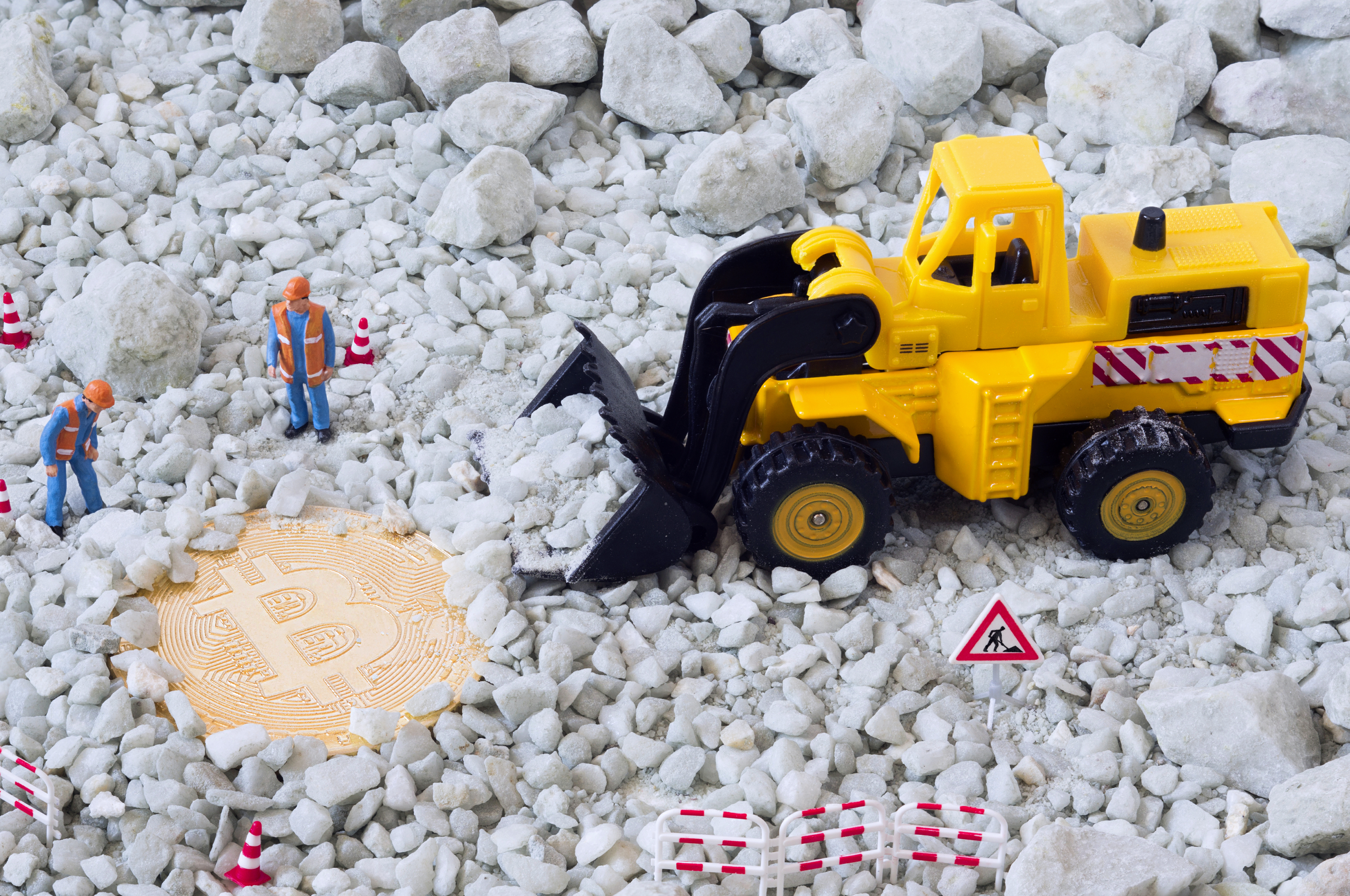
Toy bulldozer next to a Bitcoin coin surrounded by construction workers. (Source: https://urldefense.com/v3/__https://www.dreamstime.com/__;!!IaT_gp1N!zMUmUpadr1pRjDe-Mo_dF2gXwicl0GWQvZUlhnZbz6U5p6UhPQKRP603DGDEbMJbuUpKV1-r0XbslSzV2SDJQlWEl2o7$)
Executive Summary
Since 2009, the cryptocurrency industry has grown into a $1.94 trillion market, and the environmental and social costs of crypto mining—the process of creating and tracking cryptocurrency—have raised serious concerns. Powering the crypto mining computing network requires vast amounts of electricity. Although the percentage of renewable energy that crypto mining uses is growing, the industry heavily relies on fossil fuels to power its operations, contributing to elevated greenhouse gas emissions that exacerbate global warming.[i] Additionally, when local governments offer incentives to attract mining companies, residents often face higher taxes and increased electricity bills.[ii] Community members have also reported health issues associated with the presence of mining facilities.[iii] In the US, a few states like New York, have taken steps to address these problems; however, national regulations are essential to comprehensively address the industry’s environmental and social impact.[iv] Potential policy solutions could require that crypto mining transitions to more efficient consensus mechanisms, taxes electricity used for crypto mining, and imposes a tax on crypto transactions to decrease demand.
Introduction
Since the invention of cryptocurrency in 2009, over 10,000 different cryptocurrencies are publicly traded with a combined value of $1.94 trillion, and among them, Bitcoin is the largest and most well-known.[v] As the value of cryptocurrency increases, the crypto mining industry continues to expand, and the process of creating, tracking, and protecting cryptocurrency requires vast amounts of electricity. The International Monetary Fund (IMF) estimates that in three years, the electricity consumed through crypto mining could match that of Japan, one of the world’s largest consumers of electricity.[vi] However, because of the rapid growth of the industry and its decentralized nature, there has been little time and insufficient data to consider these impacts. Yet, substantial evidence now demonstrates that cryptocurrency mining causes significant damage globally and locally, [vii] and therefore it is vital that the US government takes action to address this problem. As the leader in the global cryptocurrency mining industry, and hence most responsible for its negative effects, developing and implementing regulations in the US would have significant positive effects globally and could also influence global policy on the topic.
Understanding the mechanics of crypto mining is essential to understanding the challenges it creates. One of the reasons for cryptocurrency’s popularity is its reliance on blockchain, a decentralized system described as a digital, public ledger similar to an “endless Excel spreadsheet.”[viii]. Blockchain facilitates the creation of new currency, records transactions, and protects cryptocurrency from cyberattacks. To achieve this, most cryptocurrencies use the Proof of Work (PoW) consensus mechanism. In PoW, miners solve complex mathematical problems[ix] to receive Bitcoin as a reward.[x] Consequently, the PoW mechanism intentionally consumes large amounts of energy to enhance security as more miners join the network.[xi] In the early days of crypto mining, miners could earn cryptocurrency using just a personal computer. However, today mining has developed into a global industry requiring increased processing power, and correspondingly high levels of electricity to remain competitive. The need for cheap energy drives the industry, with 60-80% of revenue allocated and reinvested into electricity costs.[xii] Even as mining becomes more energy efficient, the entry of additional miners into the network offsets any gains in energy savings.
While mining companies earn substantial profits when crypto values rise, the price of cryptocurrency does not account for the negative externalities it generates, such as energy consumption, greenhouse gas emissions, and adverse effects on surrounding communities. For instance, countries like Iran and Kazakhstan have experienced increased blackouts as their power grids struggle to meet electricity demands, and recently Putin warned that Russia’s electrical grid is not equipped to generate enough electricity to satisfy the demands of crypto mining.[xiii] Additionally, because miners can afford to pay higher electricity prices, this raises electric bills, making it unaffordable to residents, as reflected in the Democratic Republic of Congo and the US.[xiv] For example, in New York State, residents and small businesses paid nearly $300 million in additional electricity costs because of crypto miners.[xv]
Miners justify their electricity consumption because of the industry’s high use of renewable energy and because the mining industry is important for the transition to renewables. However, experts dispute this, arguing that these claims are exaggerated.[xvi] Even if all mining uses electricity from renewables, hydroelectricity—crypto mining’s main source of renewable energy—presents a range of problems. Building dams to produce hydroelectricity is costly and environmentally destructive, disrupting ecosystems, degrading land, and displacing communities.[xvii] Additionally, dams often fail to produce consistent electricity output, requiring energy from fossil fuels to fill in the gap.[xviii]
While most crypto mining occurs in only ten countries, the effects of its greenhouse gas emissions and other environmental impacts are felt globally. A UN report estimates that the emissions from Bitcoin mining alone could push the planet past the Paris Agreement goal of 2 degrees Celsius or less of global warming.[xix] Exceeding this limit would lead to droughts, water scarcity, sea level rise, flooding, extreme temperatures, mass plant and animal extinction, overall decreased quality of life, and the loss of human lives.[xx]
Communities near mining facilities also suffer from the noise pollution that mines create. The fans required to cool mining computers generate a loud, persistent hum. Residents near mining facilities in Granbury, Texas and Murphy, North Carolina report that the noise disrupts sleep and has caused hearing loss, headaches, and mental health issues, like anxiety and stress.[xxi] Similarly, residents near Seneca Lake, NY are concerned that the noise, visual impacts, and pollution from a nearby crypto mine’s coal plant could harm the local winery industry that employs 70,000 people.[xxii]
In addition to the environmental concerns, crypto mining companies often fail to deliver on their promises of job creation and economic benefits. Often, cities and states offer tax incentives and lower energy costs to attract mining companies, but residents ultimately bear the cost of paying for these incentives in the form of higher electricity rates.[xxiii] A 2022 study found that the increased electricity usage of crypto miners in upstate NY increased household electricity bills by $189 million annually.[xxiv] Additionally, mining companies often promise significant job creation, but in reality, the operations create very few jobs. Facilities in Waverly, KY, and Rockdale, TX, promised hundreds of jobs, but each created fewer than 20.[xxv] In one case, a mining company went bankrupt, leaving local taxpayers responsible for more than $700,000 of debt.[xxvi]
What has been done?
Globally, little has been done at any scale to address the problems with crypto mining. Only nineteen countries have completely banned cryptocurrency with 17 others instituting partial bans.[xxvii] Some countries, like Sweden, have eliminated tax incentives to attract mining companies,[xxviii] and the IMF recommends imposing higher taxes on crypto mining’s electricity consumption; a step that Kazakhstan has already taken.[xxix] In Canada, several provinces have banned or restricted mining,[xxx] but China’s ban is the most noteworthy since it has been home to over half of the world’s crypto mining.[xxxi] Unfortunately, until global restrictions are enacted, mining companies can simply move to countries that do not impose any restrictions. For example, after China banned mining in 2021, many mining operations moved to the US.[xxxii]
Rather than imposing restrictions or bans, many countries have instead chosen to embrace cryptocurrency. For example, in 2021, El Salvador adopted Bitcoin as its official currency to address its economic problems, and Iran uses cryptocurrency to bypass financial sanctions.[xxxiii] In the US, many states compete to offer the best incentives to attract mining operations. For example, Texas, which is one of the biggest hubs for crypto mining in the US, has offered mining incentives like tax subsidies and cheaper electricity.[xxxiv] Other states receptive to mining include Georgia, North Dakota, Wyoming, and North Carolina[xxxv]; while Rhode Island, Kentucky, Iowa, Montana, and Wyoming[xxxvi] offer tax breaks.[xxxvii]
Meanwhile, New York State is leading the way in acknowledging and addressing the problems with crypto mining. In 2022, the state introduced a two-year moratorium on all crypto mining operations that are not powered by renewable energy, while it considers further regulatory actions.[xxxviii] This is the first law of its kind in the US and could set a precedent for other states, and even other countries, to take similar actions.[xxxix] Kentucky, Oregon, and Washington are already considering similar laws.[xl]
While there are currently no federal laws limiting crypto mining, the government has begun to take steps to address the issue. In March 2022, President Biden signed an executive order that called for the creation of a federal report on cryptocurrency’s impacts on the environment. The order also requires all cryptocurrency mining companies to report their energy usage to the Energy Information Administration (EIA).[xli] In addition, in the 2024 budget, Biden proposed a 30% tax on crypto mining’s electricity use; however, this measure was not implemented.[xlii]
Proposed Policies
Cryptocurrency mining cannot continue its current trajectory, and solutions are needed to protect the environment and both US and global communities from this problematic industry. This can be accomplished through a combination of economic tools, legislation, and technological innovations detailed below. The US is home to a third of the world’s cryptocurrency mining industry and is therefore extremely influential on the global industry. Thus, policy changes enacted in the US could have far-reaching effects for the global mining industry.[xliii] While the policies proposed below focus on the US, other countries could adapt these proposals to fit their own context-specific needs:
- Stop energy subsidization/Tax electricity
State and local governments must end the subsidization of electricity as an incentive to attract mining companies and instead use economic tools to address excessive electricity consumption. Crypto mining operations should be taxed at higher rates on their electricity consumption to encourage innovation within the industry and to reduce energy consumption. Since some states are still actively trying to attract crypto miners, it is imperative that the federal government intervenes to ensure the prohibition of subsidized electricity to the crypto mining industry.
An alternative, or even complementary, option is to use legislation to address these problems. At the most stringent level, the government could pass laws to ban all crypto mining that is not powered by renewable energy, as New York State has already done. However, this approach does not resolve the problems with renewable energy mentioned earlier. The government could legislate the energy mix that mining companies must use, requiring a greater share of wind and solar energy over hydroelectricity. Yet, this still fails to address the fundamental problem of high overall energy consumption.
- Protect Communities
Communities could push to enact local legislation to protect themselves from the negative impacts of crypto mining. Mandating the construction of sound barriers is one option; however, residents in many areas report that these are insufficient measures to stop the noise. Communities could also establish zoning regulations requiring that operations be located further away from residential areas to minimize disturbances. Local governments might also strengthen civil laws to protect residents from other negative outcomes of the mining companies.
- Switch to an Efficient Consensus Mechanism
Technological innovation has been critical for the development and growth of the cryptocurrency industry and could be key to making it sustainable. Solutions must focus on reducing cryptocurrency’s energy consumption instead of merely switching to renewable energy while continuing unsustainable practices. There is already an alternative to the energy-intensive PoW model that the majority of cryptocurrency uses: The Proof of Stakes (PoS) mechanism, which requires far less computing power and consumes significantly less energy. Ethereum, the second largest form of cryptocurrency, recently switched to PoS and reported a 99% reduction in energy usage compared to PoW.[xliv]
However, many in the cryptocurrency community oppose this change. Some believe that PoS makes cryptocurrency less secure and more vulnerable to cyberattacks.[xlv] Others argue that PoS intrinsically alters cryptocurrency, allowing a few of the richest companies to consolidate power, so that it is no longer decentralized, a key feature of cryptocurrency.[xlvi] Perhaps the biggest obstacle is convincing miners to adopt the change. The majority of the mining industry’s business model hinges on the PoW mechanism, and since miners are currently profiting, they lack strong incentives to make the switch.[xlvii] Fortunately, these problems are not insurmountable. The government could subsidize research to enhance mining efficiency and could offer assistance to miners making the transition to PoS.
While many people were initially sceptical of cryptocurrency, it has now been fifteen years since its creation, and it is clear that crypto is here to stay. When the industry began, the negative side effects were not well understood, but now there is ample evidence proving the negative externalities to the environment and communities. However, there remains a lack of data that could provide deeper insights into the industry, making it essential for governments to demand greater transparency and accountability from the cryptocurrency mining industry. Although the challenges may seem daunting, there are several pathways to make the industry more sustainable, and there is great potential for the industry itself to be instrumental in solving these problems to ensure its continued existence.
Bibliography
Atlantic Council. “Cryptocurrency Regulation Tracker,” 2024. https://www.atlanticcouncil.org/programs/geoeconomics-center/cryptoregulationtracker/.
Bays, Bryan. “Cryptoasset Mining and State Tax Incentives.” The Tax Adviser, August 1, 2021. https://www.thetaxadviser.com/issues/2021/aug/cryptoasset-mining-state-tax-incentives.html.
Benetton, M., G. Compiani, and A. Morse. “When Cryptomining Comes to Town: High Electricity-Use Spillovers to the Local Economy.” SSRN, May 14, 2021. https://papers.ssrn.com/sol3/papers.cfm?abstract_id=3779720.
Buis, Alan. “A Degree of Concern: Why Global Temperatures Matter.” NASA: Climate Change: Vital Signs of the Planet, June 19, 2019. https://climate.nasa.gov/news/2865/a-degree-of-concern-why-global-temperatures-matter.
Castor, Amy. “Ethereum Moved to Proof of Stake. Why Can’t Bitcoin?” MIT Technology Review, February 28, 2023. https://www.technologyreview.com/2023/02/28/1069190/ethereum-moved-to-proof-of-stake-why-cant-bitcoin/.
Chamanara, S. “The Hidden Environmental Cost of Cryptocurrency: How Bitcoin Mining Impacts Climate, Water and Land.” United Nations University – INWEH, 2023.
Chow, A. R. “Fact-Checking 8 Claims About Crypto’s Climate Impact.” TIME, July 1, 2022. https://time.com/6193004/crypto-climate-impact-facts/.
“Climate Change Impacts | National Oceanic and Atmospheric Administration.” Accessed September 20, 2022. https://www.noaa.gov/education/resource-collections/climate/climate-change-impacts.
Daly, Lyle. “How Does Bitcoin Mining Work?” The Motley Fool, February 2, 2024. https://www.fool.com/investing/stock-market/market-sectors/financials/cryptocurrency-stocks/bitcoin-mining/.
De Alba, A. “A Constant Noise: How a Bitcoin Mining Facility Is Causing Headaches, Health Concerns for Hood County Residents.” Dallas news and tv station. WFAA, February 8, 2024. https://www.wfaa.com/article/news/local/how-bitcoin-mining-facility-causing-headaches-health-concerns-hood-county-residents/287-d763a45a-d6a3-4fcb-ab2f-5e17af94763b.
DeRoche, M., J. Fisher, N. Thorpe, and M. Wachspress. “The Energy Bomb: How Proof-of-Work Cryptocurrency Mining Worsens the Climate Crisis and Harms Communities Now.” Sierra Club, EarthJustice, September 2022.
Dhanesha, Neel. “The Daunting Task of Making Cryptocurrency Climate-Friendly.” Vox, April 18, 2022. https://www.vox.com/recode/23005493/cryptocurrency-bitcoin-climate-friendly.
Digiconomist. “Bitcoin Energy Consumption Index,” 2024. https://digiconomist.net/bitcoin-energy-consumption/.
Earthjustice. “Cryptocurrency Mining in Texas,” September 12, 2023. https://earthjustice.org/feature/cryptocurrency-mining-texas.
Estecahandy, Hugo. “Geopolitics of Cryptocurrency Mining in Kazakhstan.” Central Asian Survey 43, no. 3 (July 2, 2024): 327–45. https://doi.org/10.1080/02634937.2024.2324192.
Forbes. “Cryptocurrency Prices, Market Cap and Charts,” February 13, 2024. https://www.forbes.com/digital-assets/crypto-prices/, https://www.forbes.com/digital-assets/crypto-prices/.
Frazin, Rachel. “US to Require Cryptocurrency Mines to Report Energy Use Data.” Text. The Hill (blog), February 2, 2024. https://thehill.com/policy/energy-environment/4444715-us-to-require-cryptocurrency-mines-to-report-energy-use-data/.
French, Marie J. “New York Partially Banned Cryptocurrency Mining. Now Environmentalists Want More.” POLITICO, January 7, 2023. https://www.politico.com/news/2023/01/07/new-york-cryptocurrency-mining-ban-00072564.
Goodkind, Andrew L., Benjamin A. Jones, and Robert P. Berrens. “Cryptodamages: Monetary Value Estimates of the Air Pollution and Human Health Impacts of Cryptocurrency Mining.” Energy Research & Social Science 59 (January 2020): 101281. https://doi.org/10.1016/j.erss.2019.101281.
Greenfield, N. “Bitcoin Mining Is Bad for the Climate—and Local Communities Too,” April 27, 2022. https://www.nrdc.org/stories/bitcoin-mining-bad-climate-and-local-communities-too.
Greenpeace. “Kentucky Takes a Bold Step Against Bitcoin Mining,” August 31, 2023. https://www.greenpeace.org/usa/news/kentucky-takes-a-bold-step-against-bitcoin-mining/.
Greenpeace USA. “Countries Say No to Energy Guzzling Bitcoin Mines,” May 14, 2024. https://www.greenpeace.org/usa/countries-say-no-to-bitcoin-mines/.
Hebous, Shafik, and Nate Vernon-Lin. “Carbon Emissions from AI and Crypto Are Surging and Tax Policy Can Help.” IMF, August 15, 2024. https://www.imf.org/en/Blogs/Articles/2024/08/15/carbon-emissions-from-ai-and-crypto-are-surging-and-tax-policy-can-help.
Holmes, Frank. “Decision To Switch Ethereum To Proof-Of-Stake May Have Been Based On Misleading Energy FUD.” Forbes, September 21, 2022. https://www.forbes.com/sites/greatspeculations/2022/09/21/decision-to-switch-ethereum-to-proof-of-stake-may-have-been-based-on-misleading-energy-fud/.
Howson, Peter, and Alex De Vries. “Preying on the Poor? Opportunities and Challenges for Tackling the Social and Environmental Threats of Cryptocurrencies for Vulnerable and Low-Income Communities.” Energy Research & Social Science 84 (February 2022): 102394. https://doi.org/10.1016/j.erss.2021.102394.
Huang, Jon, Claire O’Neill, and Hiroko Tabuchi. “Bitcoin Uses More Electricity Than Many Countries. How Is That Possible?” The New York Times, September 3, 2021, sec. Climate. https://www.nytimes.com/interactive/2021/09/03/climate/bitcoin-carbon-footprint-electricity.html.
Irfan, Umair. “Bitcoin Is an Energy Hog. Where Is All That Electricity Coming From?” Vox, June 18, 2019. https://www.vox.com/2019/6/18/18642645/bitcoin-energy-price-renewable-china.
Malovic, D., H. Engelmann Pilger, N. Arsenijevic, K. B. Gassner, E. Merle-Beral, G. Monti, J. Pooley, L. K. Inouye, J. Levin, and J. Kellenberg. “Hydroelectric Power: A Guide for Developers and Investors.” International Finance Corporation: World Bank Group, January 1, 2015.
McGrath, K. “Kentucky Rejects Controversial Subsidies for Cryptomining Company.” Earthjustice, August 28, 2023. https://earthjustice.org/press/2023/kentucky-rejects-controversial-subsidies-for-cryptomining-company.
Pinkerton, J. “The History of Bitcoin, the First Cryptocurrency.” US News & World Report, November 14, 2023. https://money.usnews.com/investing/articles/the-history-of-bitcoin.
Rosic, A. “Proof of Work vs Proof of Stake: Basic Mining Guide.” Blockgeeks, November 23, 2023. https://blockgeeks.com/guides/proof-of-work-vs-proof-of-stake/.
Ruwitch, John, and Emily Feng. “How the U.S. Benefits When China Turns Its Back on Bitcoin.” NPR, February 24, 2022, sec. World. https://www.npr.org/2022/02/24/1081252187/bitcoin-cryptocurrency-china-us.
Sergeenkov, Andrey. “China Crypto Bans: A Complete History,” May 11, 2023. https://www.coindesk.com/learn/china-crypto-bans-a-complete-history/.
Sigalos, MacKenzie. “New York Governor Signs First-of-Its-Kind Law Cracking down on Bitcoin Mining — Here’s Everything That’s in It.” CNBC, November 23, 2022. https://www.cnbc.com/2022/11/23/new-york-governor-signs-law-cracking-down-on-bitcoin-mining.html.
Stewart, Emily. “Bitcoin’s ‘Ultimate Experiment in Capitalism,’ Explained.” Vox, January 3, 2018. https://www.vox.com/business-and-finance/2018/1/3/16797618/bitcoin-what-is-happening.
Stoll, C., L. Klassen, U. Gallersdoerfer, and A. Neumueller. “Climate Impacts of Bitcoin Mining in the U.S.” MIT Center for Energy and Environmental Policy Research, June 2023.
The Moscow Times. “Putin Warns of Blackouts From ‘Uncontrolled’ Crypto Mining,” July 17, 2024. https://www.themoscowtimes.com/2024/07/17/putin-warns-of-blackouts-from-uncontrolled-crypto-mining-a85745.
The White House. “FACT SHEET: Climate and Energy Implications of Crypto-Assets in the United States | OSTP,” September 8, 2022. https://www.whitehouse.gov/ostp/news-updates/2022/09/08/fact-sheet-climate-and-energy-implications-of-crypto-assets-in-the-united-states/.
World Commission on Dams, ed. Dams and Development: A New Framework for Decision-Making. London: Earthscan, 2000.
Yan, W. “The Unrelenting Roar of a Crypto Mine Tore This Town Apart.” Popular Mechanics, January 1, 2023. https://www.popularmechanics.com/science/health/a42011194/crypto-mine-noise-murphy/.
[i] Neel Dhanesha, “The Daunting Task of Making Cryptocurrency Climate-Friendly,” Vox, April 18, 2022, https://www.vox.com/recode/23005493/cryptocurrency-bitcoin-climate-friendly; Andrew L. Goodkind, Benjamin A. Jones, and Robert P. Berrens, “Cryptodamages: Monetary Value Estimates of the Air Pollution and Human Health Impacts of Cryptocurrency Mining,” Energy Research & Social Science 59 (January 2020): 101281, https://doi.org/10.1016/j.erss.2019.101281; Peter Howson and Alex De Vries, “Preying on the Poor? Opportunities and Challenges for Tackling the Social and Environmental Threats of Cryptocurrencies for Vulnerable and Low-Income Communities,” Energy Research & Social Science 84 (February 2022): 102394, https://doi.org/10.1016/j.erss.2021.102394.
[ii] A. De Alba, “A Constant Noise: How a Bitcoin Mining Facility Is Causing Headaches, Health Concerns for Hood County Residents,” Dallas news and tv station, WFAA, February 8, 2024, https://www.wfaa.com/article/news/local/how-bitcoin-mining-facility-causing-headaches-health-concerns-hood-county-residents/287-d763a45a-d6a3-4fcb-ab2f-5e17af94763b; “Cryptocurrency Mining in Texas,” Earthjustice, September 12, 2023, https://earthjustice.org/feature/cryptocurrency-mining-texas; W. Yan, “The Unrelenting Roar of a Crypto Mine Tore This Town Apart,” Popular Mechanics, January 1, 2023, https://www.popularmechanics.com/science/health/a42011194/crypto-mine-noise-murphy/.
[iii] M. Benetton, G. Compiani, and A. Morse, “When Cryptomining Comes to Town: High Electricity-Use Spillovers to the Local Economy,” SSRN, May 14, 2021, https://papers.ssrn.com/sol3/papers.cfm?abstract_id=3779720; M. DeRoche et al., “The Energy Bomb: How Proof-of-Work Cryptocurrency Mining Worsens the Climate Crisis and Harms Communities Now” (Sierra Club, EarthJustice, September 2022).
[iv] Amy Castor, “Ethereum Moved to Proof of Stake. Why Can’t Bitcoin?,” MIT Technology Review, February 28, 2023, https://www.technologyreview.com/2023/02/28/1069190/ethereum-moved-to-proof-of-stake-why-cant-bitcoin/; Marie J. French, “New York Partially Banned Cryptocurrency Mining. Now Environmentalists Want More.,” POLITICO, January 7, 2023, https://www.politico.com/news/2023/01/07/new-york-cryptocurrency-mining-ban-00072564.
[v] S. Chamanara, “The Hidden Environmental Cost of Cryptocurrency: How Bitcoin Mining Impacts Climate, Water and Land” (United Nations University – INWEH, 2023); “Cryptocurrency Prices, Market Cap and Charts,” Forbes, February 13, 2024, https://www.forbes.com/digital-assets/crypto-prices/, https://www.forbes.com/digital-assets/crypto-prices/.
[vi] Shafik Hebous and Nate Vernon-Lin, “Carbon Emissions from AI and Crypto Are Surging and Tax Policy Can Help,” IMF, August 15, 2024, https://www.imf.org/en/Blogs/Articles/2024/08/15/carbon-emissions-from-ai-and-crypto-are-surging-and-tax-policy-can-help.
[vii] Benetton, Compiani, and Morse, “When Cryptomining Comes to Town: High Electricity-Use Spillovers to the Local Economy”; Chamanara, “The Hidden Environmental Cost of Cryptocurrency: How Bitcoin Mining Impacts Climate, Water and Land”; “Bitcoin Energy Consumption Index,” Digiconomist, 2024, https://digiconomist.net/bitcoin-energy-consumption/; De Alba, “A Constant Noise”; “Bitcoin Energy Consumption Index.”
[viii] Emily Stewart, “Bitcoin’s ‘Ultimate Experiment in Capitalism,’ Explained,” Vox, January 3, 2018, https://www.vox.com/business-and-finance/2018/1/3/16797618/bitcoin-what-is-happening.
[ix] Lyle Daly, “How Does Bitcoin Mining Work?,” The Motley Fool, February 2, 2024, https://www.fool.com/investing/stock-market/market-sectors/financials/cryptocurrency-stocks/bitcoin-mining/.
[x] A. Rosic, “Proof of Work vs Proof of Stake: Basic Mining Guide,” Blockgeeks, November 23, 2023, https://blockgeeks.com/guides/proof-of-work-vs-proof-of-stake/.
[xi] Howson and De Vries, “Preying on the Poor?”; Jon Huang, Claire O’Neill, and Hiroko Tabuchi, “Bitcoin Uses More Electricity Than Many Countries. How Is That Possible?,” The New York Times, September 3, 2021, sec. Climate, https://www.nytimes.com/interactive/2021/09/03/climate/bitcoin-carbon-footprint-electricity.html.
[xii] Umair Irfan, “Bitcoin Is an Energy Hog. Where Is All That Electricity Coming From?,” Vox, June 18, 2019, https://www.vox.com/2019/6/18/18642645/bitcoin-energy-price-renewable-china.
[xiii] Hugo Estecahandy, “Geopolitics of Cryptocurrency Mining in Kazakhstan,” Central Asian Survey 43, no. 3 (July 2, 2024): 327–45, https://doi.org/10.1080/02634937.2024.2324192; “Putin Warns of Blackouts From ‘Uncontrolled’ Crypto Mining,” The Moscow Times, July 17, 2024, https://www.themoscowtimes.com/2024/07/17/putin-warns-of-blackouts-from-uncontrolled-crypto-mining-a85745; J. Pinkerton, “The History of Bitcoin, the First Cryptocurrency,” US News & World Report, November 14, 2023, https://money.usnews.com/investing/articles/the-history-of-bitcoin.
[xiv] DeRoche et al., “The Energy Bomb: How Proof-of-Work Cryptocurrency Mining Worsens the Climate Crisis and Harms Communities Now”; Howson and De Vries, “Preying on the Poor?”
[xv] Benetton, Compiani, and Morse, “When Cryptomining Comes to Town: High Electricity-Use Spillovers to the Local Economy.”
[xvi] Chamanara, “The Hidden Environmental Cost of Cryptocurrency: How Bitcoin Mining Impacts Climate, Water and Land.”
[xvii] D. Malovic et al., “Hydroelectric Power: A Guide for Developers and Investors” (International Finance Corporation: World Bank Group, January 1, 2015); World Commission on Dams, ed., Dams and Development: A New Framework for Decision-Making (London: Earthscan, 2000).
[xviii] Irfan, “Bitcoin Is an Energy Hog. Where Is All That Electricity Coming From?”
[xix] DeRoche et al., “The Energy Bomb: How Proof-of-Work Cryptocurrency Mining Worsens the Climate Crisis and Harms Communities Now.”
[xx] “Climate Change Impacts | National Oceanic and Atmospheric Administration,” accessed September 20, 2022, https://www.noaa.gov/education/resource-collections/climate/climate-change-impacts; Alan Buis, “A Degree of Concern: Why Global Temperatures Matter,” NASA: Climate Change: Vital Signs of the Planet, June 19, 2019, https://climate.nasa.gov/news/2865/a-degree-of-concern-why-global-temperatures-matter.
[xxi] De Alba, “A Constant Noise”; Yan, “The Unrelenting Roar of a Crypto Mine Tore This Town Apart.”
[xxii] N. Greenfield, “Bitcoin Mining Is Bad for the Climate—and Local Communities Too,” April 27, 2022, https://www.nrdc.org/stories/bitcoin-mining-bad-climate-and-local-communities-too.
[xxiii] Bryan Bays, “Cryptoasset Mining and State Tax Incentives,” The Tax Adviser, August 1, 2021, https://www.thetaxadviser.com/issues/2021/aug/cryptoasset-mining-state-tax-incentives.html; Benetton, Compiani, and Morse, “When Cryptomining Comes to Town: High Electricity-Use Spillovers to the Local Economy.”
[xxiv] Benetton, Compiani, and Morse, “When Cryptomining Comes to Town: High Electricity-Use Spillovers to the Local Economy.”
[xxv] “Cryptocurrency Mining in Texas”; K. McGrath, “Kentucky Rejects Controversial Subsidies for Cryptomining Company,” Earthjustice, August 28, 2023, https://earthjustice.org/press/2023/kentucky-rejects-controversial-subsidies-for-cryptomining-company.
[xxvi] “Cryptocurrency Mining in Texas.”
[xxvii] “Cryptocurrency Regulation Tracker,” Atlantic Council (blog), 2024, https://www.atlanticcouncil.org/programs/geoeconomics-center/cryptoregulationtracker/; Pinkerton, “The History of Bitcoin, the First Cryptocurrency.”
[xxviii] “Countries Say No to Energy Guzzling Bitcoin Mines,” Greenpeace USA (blog), May 14, 2024, https://www.greenpeace.org/usa/countries-say-no-to-bitcoin-mines/.
[xxix] Hebous and Vernon-Lin, “Carbon Emissions from AI and Crypto Are Surging and Tax Policy Can Help”; “Countries Say No to Energy Guzzling Bitcoin Mines.”
[xxx] “Countries Say No to Energy Guzzling Bitcoin Mines.”
[xxxi] Andrey Sergeenkov, “China Crypto Bans: A Complete History,” May 11, 2023, https://www.coindesk.com/learn/china-crypto-bans-a-complete-history/.
[xxxii] John Ruwitch and Emily Feng, “How the U.S. Benefits When China Turns Its Back on Bitcoin,” NPR, February 24, 2022, sec. World, https://www.npr.org/2022/02/24/1081252187/bitcoin-cryptocurrency-china-us.
[xxxiii] Pinkerton, “The History of Bitcoin, the First Cryptocurrency.”
[xxxiv] “Cryptocurrency Mining in Texas.”
[xxxv] MacKenzie Sigalos, “New York Governor Signs First-of-Its-Kind Law Cracking down on Bitcoin Mining — Here’s Everything That’s in It,” CNBC, November 23, 2022, https://www.cnbc.com/2022/11/23/new-york-governor-signs-law-cracking-down-on-bitcoin-mining.html.
[xxxvii] C. Stoll et al., “Climate Impacts of Bitcoin Mining in the U.S.” (MIT Center for Energy and Environmental Policy Research, June 2023).
[xxxviii] French, “New York Partially Banned Cryptocurrency Mining. Now Environmentalists Want More.”
[xxxix] Sigalos, “New York Governor Signs First-of-Its-Kind Law Cracking down on Bitcoin Mining — Here’s Everything That’s in It.”
[xl] “Kentucky Takes a Bold Step Against Bitcoin Mining,” Greenpeace (blog), August 31, 2023, https://www.greenpeace.org/usa/news/kentucky-takes-a-bold-step-against-bitcoin-mining/; Stoll et al., “Climate Impacts of Bitcoin Mining in the U.S.”
[xli] Rachel Frazin, “US to Require Cryptocurrency Mines to Report Energy Use Data,” Text, The Hill (blog), February 2, 2024, https://thehill.com/policy/energy-environment/4444715-us-to-require-cryptocurrency-mines-to-report-energy-use-data/; “FACT SHEET: Climate and Energy Implications of Crypto-Assets in the United States | OSTP,” The White House, September 8, 2022, https://www.whitehouse.gov/ostp/news-updates/2022/09/08/fact-sheet-climate-and-energy-implications-of-crypto-assets-in-the-united-states/.
[xlii] Stoll et al., “Climate Impacts of Bitcoin Mining in the U.S.”
[xliii] “FACT SHEET.”
[xliv] A. R. Chow, “Fact-Checking 8 Claims About Crypto’s Climate Impact,” TIME, July 1, 2022, https://time.com/6193004/crypto-climate-impact-facts/.
[xlv] Dhanesha, “The Daunting Task of Making Cryptocurrency Climate-Friendly.”
[xlvi] Frank Holmes, “Decision To Switch Ethereum To Proof-Of-Stake May Have Been Based On Misleading Energy FUD,” Forbes, September 21, 2022, https://www.forbes.com/sites/greatspeculations/2022/09/21/decision-to-switch-ethereum-to-proof-of-stake-may-have-been-based-on-misleading-energy-fud/.
[xlvii] Castor, “Ethereum Moved to Proof of Stake. Why Can’t Bitcoin?”

Lindsay Bacurin:
Lindsay Bacurin is a Fulbright scholar and Boren Fellow and is pursuing a Master’s in International Affairs, specializing in natural resources and sustainable development. Her more than ten years of experience working in telecommunications inspired her interest in how the internet and other technologies affect the environment.
Leave a Reply